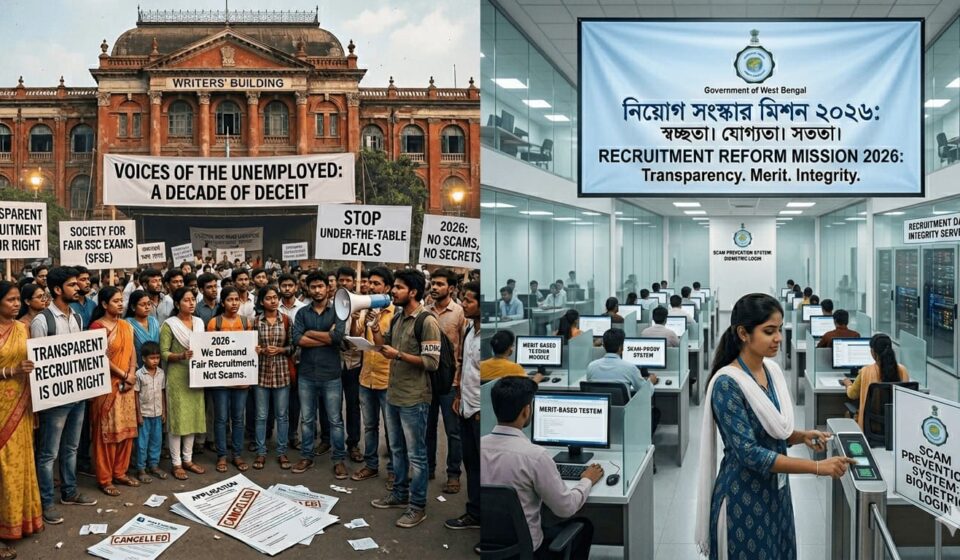

The shadow of corruption has long darkened the recruitment system in West Bengal. During the Trinamool era, the term most often echoed in courtrooms and political debates was “institutional corruption” — a phrase that captured the reality that malpractice was not limited to individuals or groups, but was backed by the very institutions meant to safeguard fairness.
Briefing on Recruitment Scams By Mamata Govt.
On Saturday, Chief Minister Suvendu Adhikari made it clear that his government’s foremost priority is to wipe away this stain. Speaking at a job fair in Sealdah, he acknowledged the damage caused by recruitment scandals: teacher appointments cancelled, municipal hiring tainted, and judicial interventions that shook public trust.
Suvendu Adhikari‘s Promised to stop Recruitment Scams in Future
He promised sweeping changes to the examination process, outlining reforms such as reducing the weight of oral interviews, emphasizing written tests and academic merit, and providing candidates with carbon copies of their OMR sheets to ensure transparency.
Victims of Corruption – Recruitment Scams
While these announcements have been welcomed across sections of society, many remain cautious. Victims of past corruption — qualified teachers who lost their jobs – argue that simply changing exam rules may not be enough. As one dismissed teacher, Chinmoy Mondal, pointed out: “Reducing marks in oral tests doesn’t automatically end favoritism.
Without strict administrative oversight and accountability, corruption can still seep into the system.” His words reflect the lingering mistrust among those who suffered under the previous regime.
Legal voices have also weighed in. Veteran lawyer and former CPM MP Bikash Bhattacharya, who fought relentlessly in the courts against recruitment scams, said:
“Our struggle was always for transparency. If the new government can truly deliver that, it deserves support. But promises must translate into action.”
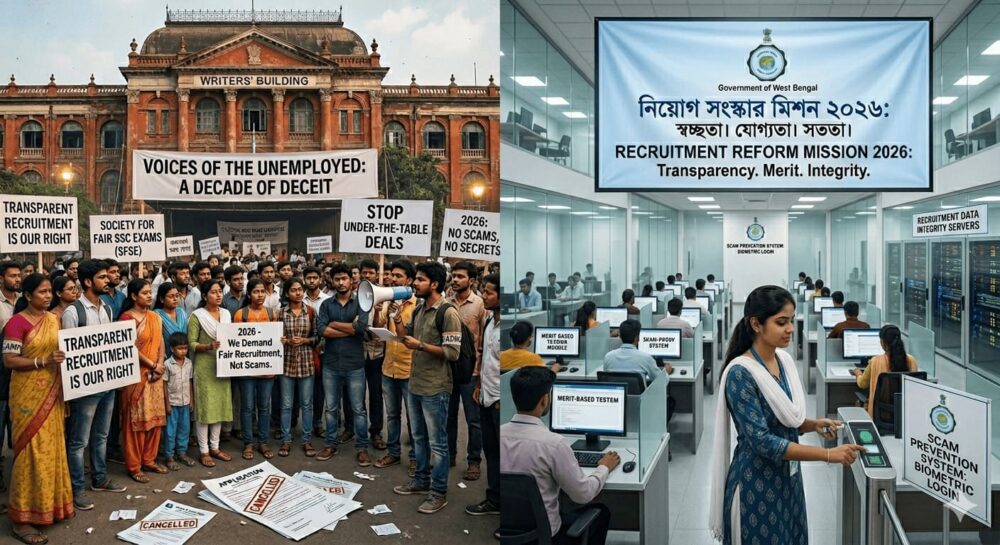
Academics, too, see the reforms as a step in the right direction. Political scientist Prashanta Roy noted that corruption in recruitment had become deeply entrenched, and rooting it out will be a long process. He emphasized that public anger against corruption was a decisive factor in the electoral shift, and now the government must prove it can honor that mandate.
Trinamool Congress’s Action on Recruitment Scams
The Trinamool Congress, however, has not missed the chance to strike back. Party spokesperson Arup Chakraborty welcomed Suvendu’s remarks but added a sharp jab: “Will he also point fingers at scams like NEET or the Vyapam scandal in Madhya Pradesh? If he is equally vocal against all forms of corruption, then his words will carry weight.”
Debate on Recruitment Scams
The debate, therefore, is not just about exam formats or recruitment laws. It is about rebuilding trust in institutions that were once seen as compromised. Suvendu Adhikari has chosen reform as his weapon against corruption. Whether these measures can truly restore integrity to West Bengal’s recruitment system remains to be seen — but for thousands of jobless, qualified candidates, the hope is that this time, promises will finally become reality.
Key Highlights of Suvendu Adhikari’s Announcement
- New Recruitment Policy Bill: To be tabled in the next Budget session of the West Bengal Assembly.
- Transparency Measures:
- OMR sheet carbon copies to be handed to candidates.
- Written exams and academic merit to carry more weight.
- Viva (oral interview) marks to be minimized.
- Reservation Framework: A 100‑point roster for OBC, SC/ST, and EWS categories is planned.
- Central Model Alignment: Recruitment will emulate practices of the Railway Recruitment Board and paramilitary forces.
Context: Why Reform Was Needed
- Past Scams: Recruitment scams under the Trinamool Congress led to widespread corruption in teacher appointments and municipal hiring.
- Judicial Intervention: Both the Calcutta High Court and Supreme Court intervened, resulting in the cancellation of 26,000 school jobs.
- Loss of Credibility: Even national institutions like Eastern Railway and South Eastern Railway avoided holding recruitment exams in West Bengal due to malpractice concern
Reactions
- Legal Experts: Lawyers like Bikash Bhattacharya welcomed the reforms but stressed that promises must be implemented in practice.
- Academics: Scholars such as Prashanta Roy noted corruption is deeply entrenched, and reforms must be backed by strict oversight.
- Opposition (TMC): While welcoming the intent, TMC leaders questioned whether Suvendu would also address national exam scandals like NEET or Vyapam.
Risks & Challenges
- Implementation Gap: Critics argue that exam reforms alone may not prevent corruption unless backed by strong administrative monitoring.
- Public Trust: Jobless qualified candidates remain skeptical, recalling past promises that failed to deliver.
- Political Pressure: The reforms will be closely scrutinized by opposition parties and civil society groups.
Why it is good for west bengal?
The recruitment reforms announced by Suvendu AdhikariThe recruitment reforms announced by Suvendu Adhikari can be very positive for West Bengal if implemented effectively, because they directly address the structural weaknesses that allowed corruption to flourish. Here’s how they could benefit the state:
Restoring Public Trust
- Past scams destroyed confidence in government hiring. Transparent measures like giving candidates carbon copies of OMR sheets and reducing oral interview marks can rebuild credibility.
- Citizens will begin to see recruitment as fair and merit‑based, which strengthens faith in institutions.
Creating Equal Opportunity
- Written exams and academic merit will carry more weight, reducing the influence of favoritism or nepotism.
- This levels the playing field for candidates from diverse backgrounds, ensuring that jobs go to the most qualified.
Reducing Institutional Corruption
- By minimizing discretionary elements (like high viva marks), the scope for manipulation shrinks.
- Aligning recruitment with central models (Railway Recruitment Board, paramilitary forces) introduces proven systems of accountability.
Supporting Education & Employment
- With 26,000 teaching jobs cancelled due to corruption, reforms can help restore stability in schools.
- A transparent system will encourage more young people to prepare for exams, knowing their effort will be rewarded fairly.
Strengthening Oversight
- Introducing laws in the Assembly creates a legal framework for recruitment, making malpractice easier to detect and punish.
- Administrative monitoring and stricter rules will help prevent future scams.
Long‑Term Impact
- Transparent recruitment boosts the quality of public servants, teachers, and municipal staff.
- Better governance and stronger institutions ultimately improve development outcomes for the state.
conclusion
The promise of reform in West Bengal’s recruitment system is more than a political statement. It is a test of governance, credibility, and the ability to heal a fractured public trust.
Years of institutional corruption under the previous regime left thousands of qualified candidates jobless, eroded confidence in examinations, and tarnished the state’s reputation nationally. By pledging to reduce the weight of oral interviews, emphasize written merit, and provide transparent mechanisms like OMR carbon copies, Chief Minister Suvendu Adhikari has set the stage for a new chapter.
Yet, the true measure of success will not lie in announcements but in execution: in whether oversight is strict, loopholes are closed, and accountability is enforced at every level of administration.
If these reforms are implemented with sincerity and vigilance, they can restore fairness, empower deserving candidates, and rebuild the integrity of institutions that were once compromised.
For West Bengal, this is not just about recruitment — it is about reclaiming dignity, ensuring equal opportunity, and proving that governance can rise above corruption to serve the people with honesty and justice.
See my knowledge building post also……………..>>>>