

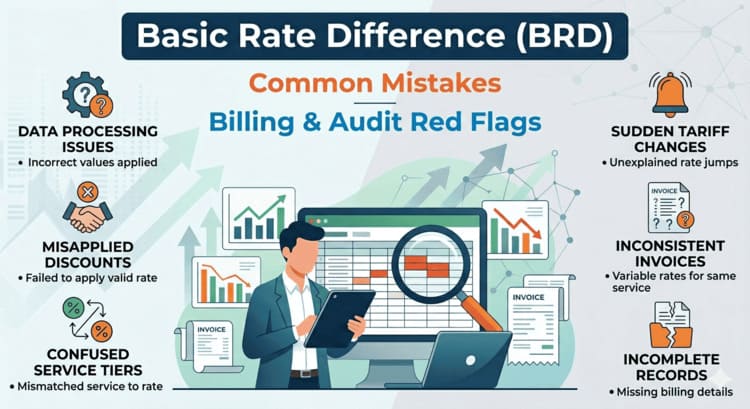

Basic Rate Difference (BRD) is a critical billing component in construction projects, used to compensate contractors for fluctuations in material prices. However, improper handling of Basic Rate Difference ( BRD ) often leads to overpayment, disputes, and financial leakage.
From a billing perspective, Basic Rate Difference ( BRD ) is one of the highest risk areas in vendor billing.
What are the common mistakes are happen during Basic Rate Difference i.e. BRD submission or certifications?
- Incorrect Base Rate Consideration
- Non-Approved Rate Reference
- Absence of Rate Approval before Execution
- Incorrect Quantity Consideration
- Ignoring Material Consumption Link
- Applying Basic Rate Difference ( BRD ) on Non-Eligible Items
- Incorrect Rate Validity Period
- Lack of Supporting Documents
- Duplicate Claim of Basic Rate Difference (BRD )
- No Reconciliation at Final Bill Stage
What will be Billing Checklist for Basic Rate Difference i.e. BRD Verification?
- Base rate as per contract verified
- Approved rate source used
- Prior approval available
- Quantity within permissible limits
- Linked with actual consumption
- Applicable items only
- Correct rate period considered
- Supporting documents attached
- No duplicate claims
- Final reconciliation done
Basic Rate Difference ( BRD ) is not just a rate adjustment, it is a controlled commercial mechanism. Weak control leads to silent cost leakage, which often goes unnoticed without strong billing systems.
Step-by-Step Basic Rate Difference i.e. BRD Calculation Process
Step 1: Identify Eligible Material
- Check BOQ / Contract / Work order / PO
- Confirm whether Basic Rate Difference ( BRD ) is applicable for:
- Steel ✅
- Cement ✅
- Bitumen ✅
- (Not applicable for labour items ❌)
- Output: Final list of Basic Rate Difference BRD -applicable materials
Step 2: Identify Base Rate (from BOQ / Tender)
Example:
Steel base rate in BOQ = ₹50,000 / MT
This becomes your first reference point
Step 3: Identify Actual Rate
Now check what source is allowed in contract to determine the actual rate:
Possible sources can be:
- Approved invoice
- Purchase invoice for client
- Government index (e.g., RBI/WPI/CPWD index)
- Client circular
Example:
- Steel actual rate (as per Purchase Invoice) = ₹56,000 / MT
- Output: Actual Rate = ₹56,000 / MT
Step 4: Identify Approved Rate for purchase.
Now check what source is allowed in contract to determine the actual rate:
Possible sources can be:
- Client email rate approval
- Certified Supplier from client
- Client circular
Example:
- Steel Approved purchase rate (as per client rate) = ₹53,000 / MT
- Output: Actual Rate = ₹53,000 / MT
Step 5: Check Rate Validity
Match:
- Client rate approval or certified supplier must contain rate validation period.
- Check with Material supply date with applicable rate period
Example:
- Steel delivered in April
- Client had approved the rates for April month only ✅
❌ Do not use May or March rate
Step 6: Calculate Basic Rate Difference (BRD)
Formula:
Rate Difference = Minimum of Purchase Rate & Approval rate – Base Rate
Example:
= Min(56,000,53,000) – 50,000
= ₹3,000 / MT
Output: Difference = ₹3,000 / MT
Step 7: Determine Payable Quantity
Select quantity based on:
- Theoretical quantity i.e. billed quantity only. (in Normal)
- Executed quantity (if executed less then billed)
- Within BOQ limit
- Deduct wastage (if clause applicable)
Example:
- Steel consumed = 10 MT
- Billed = 8 MT
- BOQ = 12 MT
- Wastage = 10 – 8 = 2 MT
Output: Quantity = 8 MT
Step 8: Apply Consumption Factor (if applicable)
Some contracts specify:
- Cement consumption per m³
- Steel consumption per tonnage
Example:
- RA bill includes 100 m³ concrete
- Steel consumption factor = 80 kg/m³
So:
Steel Qty = 80 × 0.1 = 8 MT
Use this instead of direct measured quantity
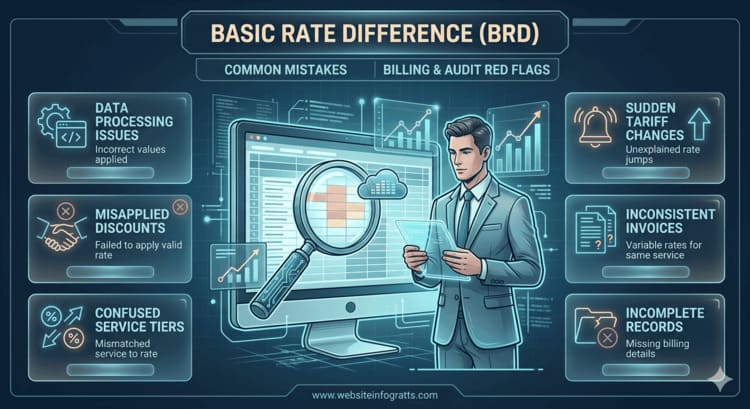
Step 9: Apply Basic Rate Difference (BRD) Formula
✅ Standard Formula:
Basic Rate Difference BRD Amount = Rate Difference × Quantity
Example:
= 3,000 × 8
= ₹24,000
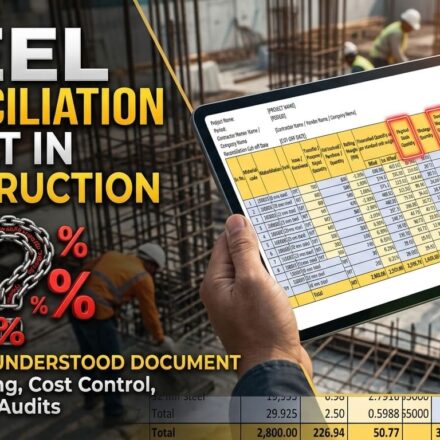
Step 10: Prepare Basic Rate Difference (BRD) Statement
What is inside this Basic Rate Difference (BRD) sheet as per billing practice?
Columns included:
- Material Name
- Description
- Challan date / delivery date
- Challan number
- Unit
- Quantity
- Delivered quantity
- Consumed quantity
- Theoretical quantity
- NOTE: minimum will be considered.
- Base Rate (₹)
- Actual Rate (₹) or Purchase Rate (₹)
- Approved rate (₹)
- Basic Rate Difference (BRD) (Auto-calculated)
- Basic Rate Difference (BRD) Amount (Auto-calculated)
Step 11: Attach Supporting Documents
Attach all required documents for validation:
- Rate approval copy
- Invoice and delivery challan
- Consumption calculation sheet
- BOQ reference
- Rate circular/index copy
This step ensures Billing acceptance and faster approval.
Step 12: Submit in RA Bill and Undergo Bill Verification
Finally:
- Include Basic Rate Difference (BRD) in RA bill
- Present all calculations and documents
During bill checking, verification is done for:
- Rate correctness
- Quantity accuracy
- Duplicate claim check
- Time period matching
After validation, Basic Rate Difference BRD is approved for payment.
Frequently Asked Questions (FAQs) on BRD (Basic Rate Difference)
1. What is Basic Rate Difference (BRD) in simple terms?
BRD is the difference between Purchase material rate / approved rate and base rate already included in BOQ.
2. What is the basic formula of Basic Rate Difference (BRD)?
Basic Rate Difference BRD = (Minimum of(Approved rate, Purchase Rate) – Base Rate) × Quantity
3. Which materials are generally eligible for Basic Rate Difference (BRD)?
Typically:
- Steel
- Cement
- Bitumen
Not applicable for:
- Labour items
- Fixed-rate BOQ items
- Lump sum items (unless specified)
4. How do I identify the base rate?
Base rate comes from:
- BOQ / Tender document
- Rate analysis (if provided)
- Contract clause
5. How do I determine the actual rate?
Actual rate must be taken from:
- Approved rate
- Approved index (WPI / CPWD / Client circular)
- Or approved invoices (if contract allows)
6. Which date should be considered for rate calculation – billing date or material date?
✅ Always use material supply/delivery date
❌ Not the RA bill submission date
7. What quantity should be used for Basic Rate Difference ( BRD ) calculation?
Use:
- Executed and certified quantity
- OR consumption-based quantity
Avoid:
- Ordered quantity
- Wastage (unless contract allows)
8. Can Basic Rate Difference ( BRD ) be claimed on excess quantity beyond BOQ?
✅ Only if:
- Deviation is approved by client
❌ Otherwise:
- Basic Rate Difference BRD may be restricted or rejected
9. Is rate approval mandatory before claiming Basic Rate Difference ( BRD )?
In most projects: YES
- Rate must be approved by:
- Client / Consultant / CR
❌ Without approval:
- Claim may be held or reduced
10. Can I claim Basic Rate Difference ( BRD ) every RA bill?
✅ Yes, if:
- Material consumed in that billing period
- Rate for that period is available
BRD is typically progressive (RA-wise)
11. Can negative Basic Rate Difference ( BRD ) happen? (Rate decrease case)
✅ Yes
If:
- Approved Rate or purchase rate < Base Rate
Then:
- Recovery (negative Basic Rate Difference BRD) is applied
12. Can Basic Rate Difference ( BRD ) be claimed without material consumption proof?
❌ No
13. What documents are required for Basic Rate Difference ( BRD ) claim?
Typically:
- Rate approval / index copy
- Invoices / delivery challans
- Quantity/consumption sheet
- BOQ reference
14. How should Basic Rate Difference ( BRD ) be presented in RA bill?
Best practice:
- Separate annexure or statement
- Clear calculation sheet
- Material-wise breakup
15. Can Basic Rate Difference ( BRD ) be claimed on stock material not yet used?
❌ No
BRD is linked to:
- Consumed / executed quantity only
16. What happens if wrong rate period is used?
Client may:
- Reduce claim
- Recalculate amount
- Delay certification
17. Is Basic Rate Difference ( BRD ) included in BOQ rates automatically?
Base rate is included
BRD is extra adjustment over BOQ
18. Can I revise Basic Rate Difference ( BRD ) in later RA bill?
✅ Yes, if:
- Earlier rate was provisional
- Final rate is approved later
19. What is the key to successful Basic Rate Difference ( BRD ) claim acceptance?
Not the formula — but:
- Correct base rate
- Approved actual rate
- Proper quantity linkage
- Clear documentation















[…] submitted to the client or PMC office and entered into the Bill Register / Bill Receipt Document (BRD). This is the official log of all bills submitted against the contract. Every entry gets a unique […]
[…] 27, 2026Read more: Basic Rate Difference ( BRD ) – Common Mistakes and Billing & Audit Red FlagsCivil […]
[…] can also read my article on the same topic for more […]