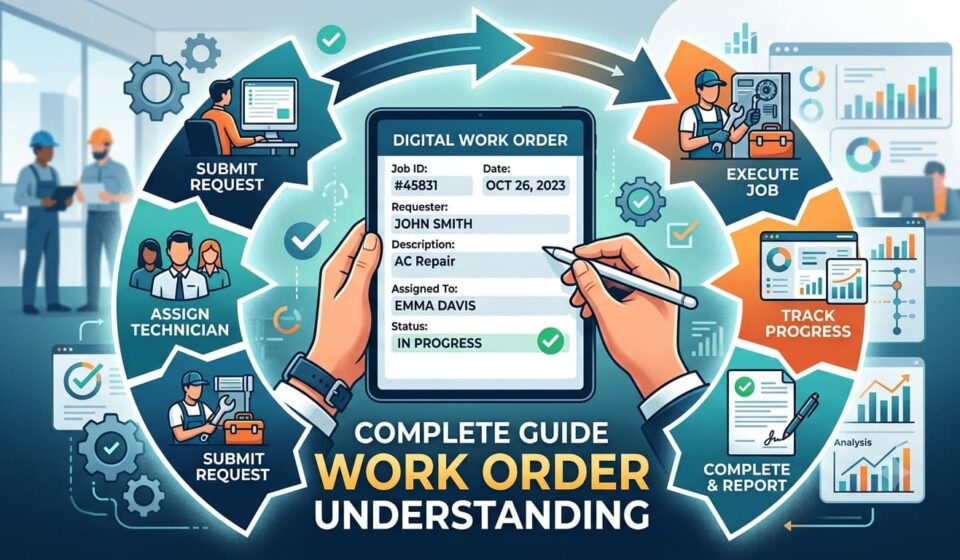
Complete Guide Work Order Understanding | Beyond the BOQ: How a Billing Engineer Holds the Every Lines of Work Order (Part 1)

In Running Account (RA) Bill & Final Bill preparation in construction projects/sites, work order understanding is the most important thing.
It directly impacts the payable value and brings many more risks to the project. So, if you are a billing engineer preparing an RA Bill or Final Bill, it becomes a very important checkpoint before final certification if you are a billing engineer from the client side, or before final submission if you are a contractor’s billing engineer.
When the first level of the billing process is cleared without proper review or checking, it is often found that the next levels are also cleared without noticing the errors or eliminating non-compliances. It mainly happens because of over-dependency on the lower level and forwarding/clearing bills blindly on the faith of the 1st level approver or reviewer.
In this blog, we will try to understand which are the most common mistakes or misunderstandings that happen due to negligence or overlooking their importance. As I have been working in this field, i.e., the civil construction industry, for over 18 years, studying, practicing, and monitoring teams actively involved in billing, cost control, and budgeting, and have gone through thousands of Work Orders, Service Orders & Purchase Orders while mitigating risks in multiple companies, I think I am able to explain what the control points should be and how you can approach them to minimize risks from your very first attempt after reading and understanding this blog.
Major Types of Construction Contracts
- Item Rate Contract (Unit Price / BOQ Contract)
- Lump Sum Contract (Fixed Price)
- Percentage Rate Contract
- Cost Plus Contract (Cost Reimbursable)
- EPC (Engineering, Procurement, Construction)
In this blog we will mostly discus item rate contract, however discussed point may apply to other type of contract also.

Contract Understanding – Scope Of Work
First thing is to understand the contract scope. For example, consider this contract scope details,
“Civil Works of Phase-1 comprising of Earthworks, RCC, Masonry, Plaster, Waterproofing, Gypsum & Allied Works of Building B, C, E & F (2 to 5 level basement/podium+ stilt +19 to 22 upper floor), Podium & Club House at (Project Location).”
When you reading this, what is your first thought?
This order given specifically for Phase I civil work. This means if vendor executes work in phase I, it must be billed under this specific Work Order (WO). However, if vendor executed any work outside phase I, vendor cannot bill under this work order.
Commonly it was found that vendor works across in multiple phases and WO was issued for those respective phases to vendor but they mises the whole concept of phases and billed phase I work under phase II Work Order and vice versa.
This type of mistake seems very small error in first glance repetitive mistakes will create major problem later. It compromises Phase wise budget control, execution monitoring & contractor bill cost tracking. Therefor we must understand the scope allocated for the contract to vendor. And strictly billed the executed work under the designated of the Work Order.
Here we excursive the scope of work order understanding from the short form of description which is given above. However, there will be a dedicated section in work order with full scope of work description which will be more detailed and specific.
Contract Understanding – CONTRACT SUM:
Next, we need to understand the contract sum. In this section, the cumulative contract value will be mentioned in both numbers and words.
It also clarifies that the mentioned contract sum or value is inclusive of taxes, duties, royalties, transportation, loading/unloading, shifting, and overhead profits. It also confirms that the contract sum includes all necessary expenses toward completing the work. If anything is to be paid extra such as labor cess, it will be mentioned clearly.

Contract Understanding – Mobilization Advance:
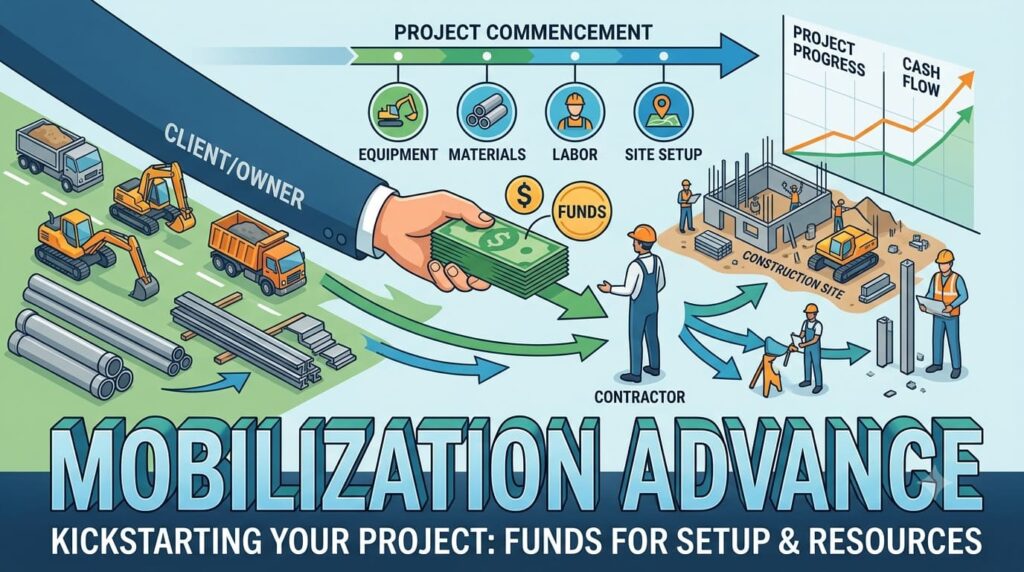
Initial cash flow is provided by the client to the contractor with very minimal conditions, such as the contractor mobilizing his manpower, machinery, and plant within the stipulated time period after the award of the Work Order. If the contractor fulfils those initial requirements from the client side, the said cash flow is released to the contractor.
Mobilization advance is often interest-free for a certain period.
As an example:
1st – 10% of the contract value (plus GST) will be paid on completion of temporary establishment and manpower mobilization as scheduled.
2nd – Rs. 1,00,00,000/- (Plus GST) towards procurement of an external tower crane. Payment to be done.
3rd – Rs. 50,00,000/- (Plus GST) towards procurement of a new concrete pump. Payment to be done.
Its recovery clause is also firmly mentioned in the Work Order.
Here is an example:
“The recovery of the mobilization advance shall start on a pro-rata basis from the 2nd RA bill onwards and will be fully recovered by 80% of the contract value execution and bill completion.”
This means recovery of the mobilization advance will start when the contractor submits the 2nd RA bill after execution of work, and the same will be followed on a pro-rata basis. The total advance amount needs to be recovered before completion of 80% of the contract value execution and billing.
Mobilization advance can be released in multiple phases, such as two, three, or more installments.
Contract Understanding – Performance Bond / Security:
When a new contract starts, the client almost always asks the contractor for a security deposit. Known as a Performance Security or Performance Bond, this money acts as insurance for the client. If the contractor fails to finish the project or does sub-standard work, the client can use this money to cover their financial losses or fix the bad work. Because there is real money on the line, this is easily one of the most crucial parts of any major contract.
This security can be collected in different ways depending on what the contract says.
Most of the time, the client asks for a Performance Bank Guarantee (PBG). A typical contract clause might say the contractor has to submit a bank guarantee from an approved bank worth 5% of the total contract value, valid for the contract period plus an extra three months. This has to be handed over right at the start during mobilization, before the client releases any funds. For example, on a ₹60 Crore project, a 5% PBG means the contractor has to put up a ₹3 Crore guarantee from a bank.
Other times, the client won’t ask for a bank document at all. Instead, they will keep cash back from the contractor’s early invoices. A clause might state that the client will retain 5% of the total contract price across the first three Running Account (RA) bills in equal parts. On that same ₹60 Crore project, instead of taking ₹3 Crore upfront, the client holds back ₹1 Crore from the first bill, ₹1 Crore from the second, and ₹1 Crore from the third. Here, actual cash is sitting in the client’s account rather than a guarantee from a bank.
So, when does the contractor actually get their money or bank guarantee returned?
The return policy is always spelled out in the work order. Usually, it says the guarantee or cash will be released once the project is finished and handed over, or after the Defect Liability Period (DLP) comes to an end. Once all the construction work is done, the final bill is settled, and the contractor hands over a No Claim Certificate, the client will release the performance security back to them.
Contract Understanding – Defects Liability Period:
What is the Defect Liability Period (DLP)?
The term Defect Liability Period is fairly self-explanatory. If any defects are discovered in the executed work within a specified timeframe, the contractor is legally obligated to rectify those defects entirely at their own cost and risk.
Under normal circumstances, the contractor must fix any defects arising before the end of the DLP whether caused by poor workmanship or sub-standard materials at their own expense. The client is required to notify the contractor in writing of any defects as they occur, or at least within 7 working days of discovering them.
Timelines for Remedial Action
Once notice is served, the process moves forward under the following rules:
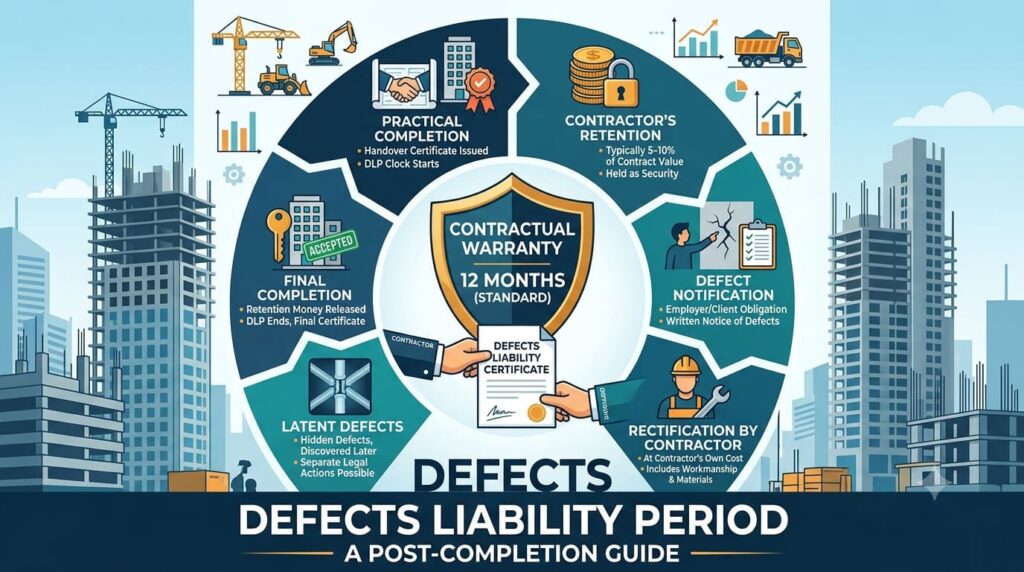
- The contractor must begin working on corrective measures within 7 days of receiving written notice from the client.
- The rectification work must be completed within a timeframe mutually agreed upon by both parties.
- If the contractor fails or neglects to fix a defect that arose during the DLP, their legal liability remains active until that specific defect is fully resolved.
What Happens if the Contractor Fails to Rectify Defects?
If the contractor fails to fix a defect to the client’s satisfaction or if the client determines that the contractor lacks the necessary technical expertise, or simply neglects the task, the client reserves the right to take direct action.
In such cases, the client can step in and hire a third-party agency to execute the corrective work at the contractor’s sole risk and cost. The expenses incurred will be recovered from the contractor based on:
- The direct expenses incurred to complete the work.
- An additional 10% charge levied by the client.
- Any additional oversight or supervision fees incurred by the client during the rectification process.
Standard Duration
The Defect Liability Period typically runs for either 12 months or 24 months, starting from the date of final project completion, as defined in the contract agreement.
Contract Understanding – Retention Money:
Retention money is an interest-free deposit held by a client from a contractor’s payments. Instead of paying the full amount of each running bill or final invoice, the client holds back a fixed percentage usually 2.5%, 3%, 5%, or 10%, depending on what was agreed in the contract.
This money is kept by the client throughout the project and through the Defects Liability Period (DLP) to ensure the contractor fixes any quality issues or defects that pop up after construction wraps up.
Can Retention Money Be Released Before the DLP Ends?
Yes, contractors can actually get their retention money released early instead of waiting around for the whole defect period to end.
To do this, the contractor can give the client a Bank Guarantee (BG) that covers the exact amount of money being held back. For the client to accept this swap, a couple of standard conditions usually apply:
First, the guarantee has to come from an approved bank or a nationalized one. Second, the BG needs to stay active until at least 30 days after the Defect Liability Period (DLP) finishes, plus any extra time if the project schedule gets extended. As soon as the client accepts the BG document, they hand over the retained cash.
That said, not every contract handles retention the exact same way:
Sometimes, the agreement says retention money is only held until the physical construction wraps up, rather than dragging all the way through the DLP. In those situations or whenever retention is handed back early the client will almost always ask for a Contract Performance Bank Guarantee (CPBG) to make sure they’re still protected against any future defect risks.
Contract Understanding – Goods and Service Tax (GST)
In this section, client ensure the all government taxes relates compliance which are mandatory to follow will be written down and take agreement from the contractor.
- Contractor should ensure every invoice includes all GST-mandated details (GSTIN of both parties, HSN/SAC codes, correct tax breakdown CGST / SGST or IGST, place of supply, invoice number / date).
- Contractor should upload your invoices into GSTR-1 promptly and accurately.
- if there are scope reductions, defects, discounts, or excess charges, contractor should issue credit notes immediately and ensure they reflect in your next month’s return.
- Contractor should pay your GST dues to the government within statutory deadlines.
- Contractor should maintain a clean record. Non-compliance or blacklisting will result in withheld payments and potential recovery of past GST paid to contractor.
- Contractor should keep their GST compliance rating high & client can issue a formal warning if your rating drops.
these are the main things a contractor should follow and normally drafted to a high value contract.
Contract Understanding – Project Timeline and Duration
in every contract a specific duration is mentioned in which contractor need to complete the whole work and handed over to the client for the total Every contract sets a clear deadline for the contractor to complete all the work and hand over the project to the client.

To manage this, the project gets planned using a master schedule, which is broken down into major phases called milestones.
It starts with a basic milestone layout, and then turns into a detailed execution schedule covering every single daily activity. Once both the client and the contractor review and agree on this schedule, both parties sign off on it. After that, the contractor is legally bound to meet those dates.
The schedule also accounts for a mobilization period right at the beginning in which contractor will mobilize their resources like manpower, machineries and plant
Contract Understanding – Free Issue Materials
In big construction contracts that cover both labor and materials, clients often choose to supply the expensive materials themselves.
Items like Ready Mix Concrete (RMC), Cement, Structural Steel, and Reinforcement Steel usually come directly from the client, while the contractor supplies the smaller materials and daily consumables.
Clients are also providing heavy items like aluminum or prefabricated formwork systems.
When the client hands over these “free-issue materials,” the contractor has to track every bit of it.
The contract makes it clear that the contractor must maintain a precise record of material consumption and submit a Materials Reconciliation Statement (MRS) with every bill, or whenever the client asks for one. The method used to reconcile these quantities must be reviewed and approved by the client’s team beforehand.
To keep a handle on material use, the client sets strict “permissible wastage” limits. The contractor has to stay within these allowances.
If the contractor goes over the limit and wastes too much material, heavy penalties kick in.
At a minimum, the client will charge the contractor for the excess material cost plus overheads. In many cases, contracts go further charging the actual material cost, an overhead fee, plus an extra 25% penalty. This steep financial hit is designed to keep contractors from being careless with client supplied stock.
Contract Understanding – Price validity Period
High-value contracts often include a Firm Fixed Price (No Escalation) clause with a pretty tough penalty twist.
It locks in the contractor’s quoted rates for the full contract period. Plus, if the project runs over schedule because of contractor delays, those same rates stay locked for the extra time. That means if diesel, labor, aggregate, or raw materials spike in price, the contractor can’t ask for a rate increase.
There are occasionally exceptions if the client permits price adjustments on major materials like cement and structural or reinforcement steel.
It’s also worth noting that if any basic-rate materials are tied to rate escalation, you have to subtract their cost from the total work done during that period before running the calculation. (Escalation math gets complicated, so we’ll break that down in a future post.)
Simple Example
If a 12 months project stretches to 18 months because the contractor fell behind: Even if market costs jump significantly after month 12, they won’t get any price escalation for that extra 6-month delay.
The contractor must finish the job at the original agreed prices.
Read more in Part – 2

No Inspection, No Measurement, No Payment: The Quality Papers Behind Every RA Bill in a Mumbai Project
A site engineer’s practical guide to the documents that make an RA bill stand up…

M30 on the Drawing, Honeycomb on the Column: What Really Decides Concrete Quality
A civil engineer’s practical guide to concrete, built around IS Code, can answer this simple…

Mastering Reinforcement Steel Reconciliation: A Technical Blueprint for Civil Engineers & Project Managers
1. Executive Summary & Introduction In structural concrete construction, reinforcement steel Reconciliation represents between 20%…
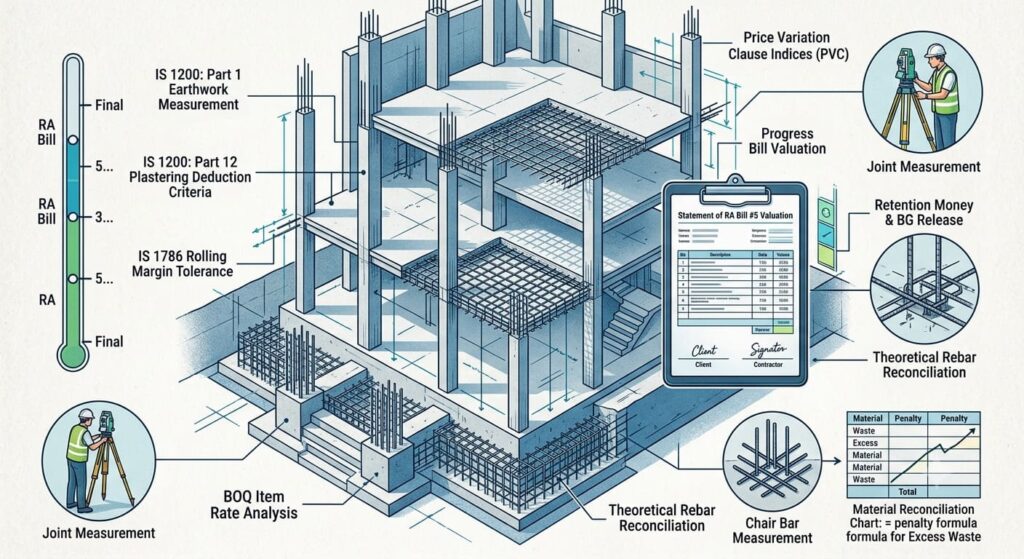
20 Essential Technical Interview Questions (Part – 3) | Master Class in Construction Project Billing & Quantity Surveying
I’ve sat on both sides of the table for these Technical interviews as the guy…
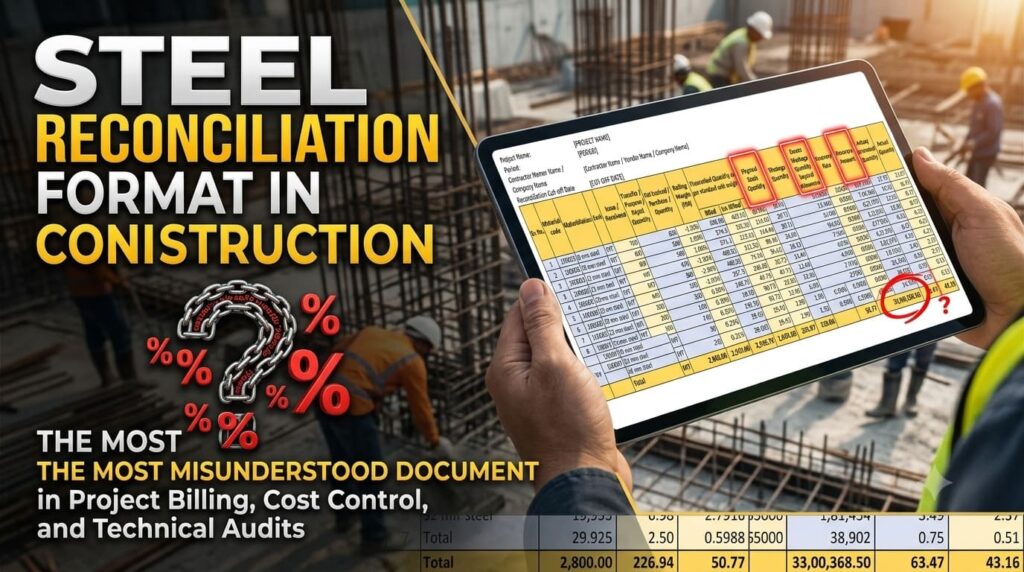
Steel Reconciliation Format in Construction | The Most Misunderstood Document in Project Billing, Cost Control and Technical Audits
Excel Reconciliation Format Download here There are a few documents like Steel Reconciliation Format in…

Complete Guide Work Order Understanding | Beyond The BOQ: How A Billing Engineer Must Read Every Line Of A Work Order (Part 2)
I still remember one particular bill audit many years ago. Work Order Understanding was the…