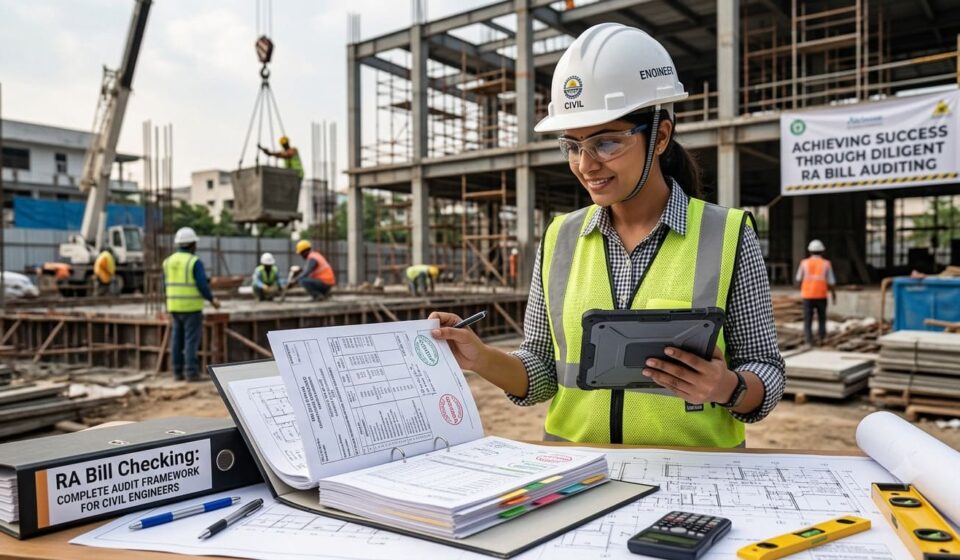

Introduction
In most construction projects, engineers believe that profit is controlled at site execution, through good planning, timely work, and efficient resource utilization. But in reality, profit is often lost at the billing table, not at the site.
From my experience in RA bill checking and civil billing audit, I have seen that projects rarely lose money due to execution issues. The real problem lies in weak construction bill verification systems, where small errors go unnoticed during monthly billing cycles.
Every month, RA bills are submitted, verified, and approved. Large values move quickly sometimes under pressure, and often with incomplete information. At that moment, everything appears normal. The quantities seem reasonable, the rates match the BOQ, and the documentation looks complete.
Yet, by the end of the project, a different picture emerges. Margins are reduced, costs exceed expectations, and recoveries remain pending.
Why does this happen?
Because RA bill checking is treated as a routine process, not as a structured RA bill audit framework.
In my professional journey in billing and audit, I have understood one thing very clearly:
Strong execution builds a project, but a strong billing control system protects its profitability.
This guide will help you understand the complete RA bill checking process, not as theory, but as a practical approach you can apply in real projects.
Understanding RA Bill vs Final Bill
When engineers begin their careers, they learn the difference between RA bill and final bill in theory. However, in real construction projects, this understanding needs to go deeper.

An RA bill is not just a running bill. It is a repeated financial checkpoint, where errors in quantity verification in construction or rate interpretation can accumulate over time.
Each month, quantities are measured, added, carried forward, and adjusted. Even small mistakes whether in measurement, rate application, or documentation gradually turn into significant financial impacts.
On the other hand, the final bill is often considered the stage where everything will be corrected. But in practice, that rarely happens.
By the time the final bill is prepared:
- Contractors strongly defend their billed quantities
- Documentation is already fixed
- Site conditions may no longer be verifiable
- Project teams may have changed
At that stage, corrections become disputes instead of adjustments.
That is why every experienced billing engineer follows a simple principle:
If the RA bill checking process is strong, the final bill becomes simple.
If not, the final bill becomes a major problem.
How RA Bill Checking Actually Happens on Site
Let us move away from theory and look at how construction billing verification actually happens.
A contractor submits the bill. The site engineer verifies the measurements. The billing engineer checks quantities and rates. The file moves for approval.
The process appears structured.

But if you observe closely, most engineers check bills in a very linear way:
- First quantity
- Then rate
- Then total
If nothing looks wrong, they proceed.
But the issue is not in what they check. The issue is in what they ignore.
A strong civil billing audit system is not about following steps it is about questioning assumptions at every stage of the RA bill checking process.
The First Layer: Documents – Where Errors Begin
Every RA bill is supported by documents work order, BOQ, drawings, previous bills, and measurement sheets.
Most engineers assume that if documents are attached, they are correct.
But in many cases, the problem starts here.
Sometimes, contractors use outdated BOQ revisions. Sometimes drawings are not the latest approved versions. Sometimes previous bill details are not properly considered.
These are not visible errors. But they directly affect the accuracy of construction bill verification.
An experienced billing engineer does not just ask, “Are documents available?”
He asks:
- Are these the correct versions of the BOQ and drawings?
- Are they aligned with each other?
- Have any revisions affected the billing engineer responsibilities at this stage?
Because even a small mismatch at the document level can distort the entire bill.
The Core of Billing: Quantity Verification
If there is one area where most billing mistakes in construction happen, it is quantity verification.
Most engineers depend heavily on measurement sheets. They check calculations and totals, assuming that the base measurements are correct.
But the real question is:
Where did the quantity come from?
A reliable quantity verification process in construction must connect three things:
- Drawing
- Actual site execution
- Measurement record
If even one of these is weak, the quantity becomes doubtful.
For example, in excavation work, if levels are not properly recorded, the quantity becomes an estimate. In structural work, ignoring deductions leads to inflated quantities. In finishing work, over-measurement across large areas creates significant cost impact.
This is why:
Quantity is not just a number, it is the foundation of RA bill audit accuracy.
Measurement Sheets: Clean Format, Hidden Risks
Measurement sheets often look structured and accurate. Many engineers feel confident once calculations match.
But this is where another common construction billing error occurs.
The calculations may be correct, but the base data may be wrong.
In many cases:

- Quantities are repeated across different RA bills
- Cumulative quantities are not tracked properly
- Previous deductions are missed
These mistakes are not visible unless you compare:
- Current bill vs previous bill
- Total quantity vs actual site progress
Experienced professionals always maintain their own tracking system. They do not rely only on contractor submissions.
Because in billing:
A clean-looking measurement sheet does not guarantee a correct RA bill checking result.
Rate Verification: Beyond Numbers
After quantity verification, the next step is rate verification.
Many engineers treat this as a simple comparison with BOQ. If the rate matches, it is accepted. If it is an extra item, they look at the approved rate.
But in reality, BOQ rate verification is far more complex.
Sometimes, item descriptions allow multiple interpretations. A small difference in wording can justify a higher rate. Sometimes, extra items are introduced without complete clarity. Sometimes, similar items carry different rates.
A proper rate analysis in construction billing requires understanding:
- What work was executed
- Under what conditions
- Whether the BOQ description correctly matches execution
Because:
Most rate analysis errors do not happen due to wrong numbers — they happen due to wrong interpretation.
Extra Items: The Highest Risk Area
Extra items are unavoidable in construction projects. Design changes, site conditions, and execution requirements make them necessary.
But they are also the highest risk area in construction bill verification.
Since extra items fall outside the original BOQ, they require:
- Technical approval
- Rate approval
- Proper documentation
If an extra item is executed without approval, the issue surfaces during billing.
At that stage, engineers are forced to decide whether to approve without documentation or reject and create disputes.
That is why a strong system ensures:
- Approval before execution
- Rate clarity before billing
Because:
Once work is executed without approval, RA bill audit becomes negotiation, not verification.
Editor’s Pick
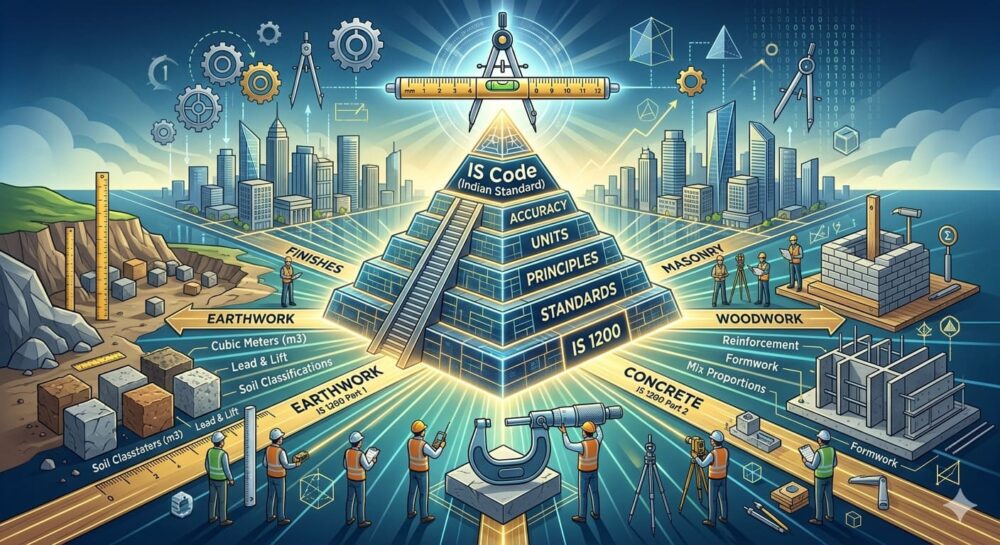
 Read more: Standardized Excavation Measurement Benchmark – IS Code Explained
Standardized Excavation Measurement Benchmark – IS Code Explained
on
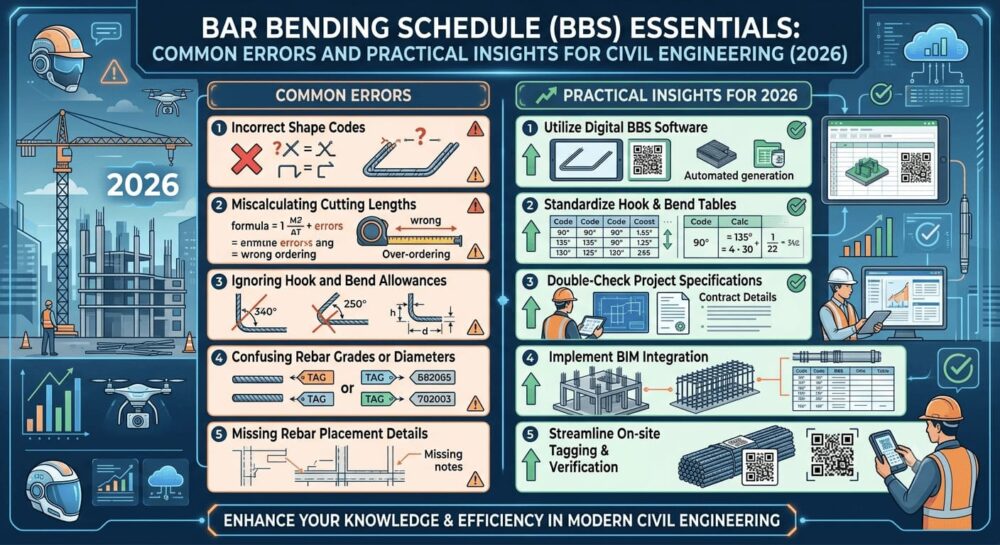
- Read more: Bar Bending Schedule Essentials: Common Errors and Practical Insights for Civil Engineering should help your Knowledge in 2026
Bar Bending Schedule Essentials: Common Errors and Practical Insights for Civil Engineering should help your Knowledge in 2026
on
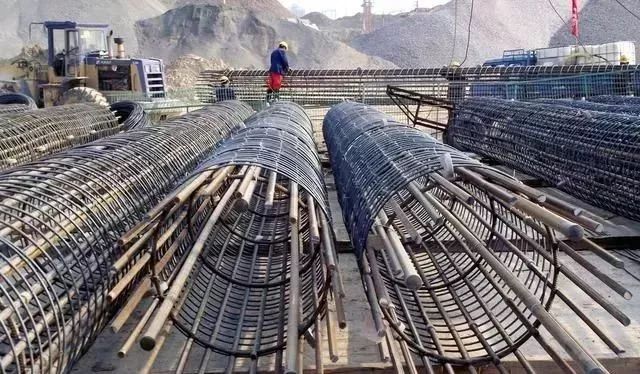
 Read more: Pile Foundation: The Hidden Strength Beneath Every Structure Now even in 2026
Pile Foundation: The Hidden Strength Beneath Every Structure Now even in 2026
on
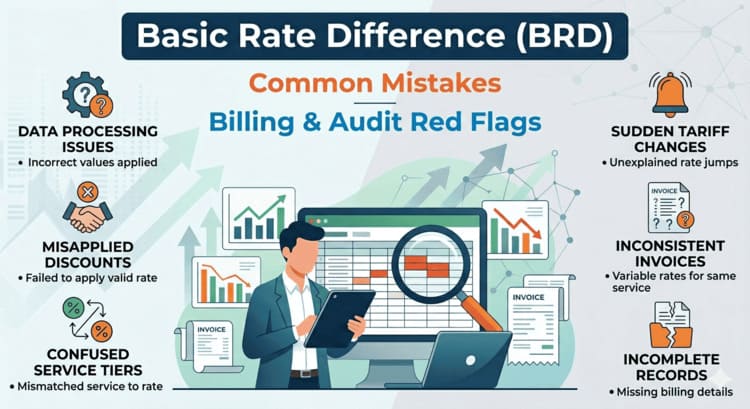
 Read more: Basic Rate Difference ( BRD ) – Common Mistakes and Billing & Audit Red Flags
Basic Rate Difference ( BRD ) – Common Mistakes and Billing & Audit Red Flags
on
Material Reconciliation
Material reconciliation is one of the most powerful but undervalued tools in civil billing audit.
Billing does not exist independently. It is directly linked to material consumption.
If materials like steel, cement, or blocks are not tracked properly, it becomes difficult to validate quantities.
Sometimes, quantities may appear correct. But material data tells a different story.
For example:
- Higher consumption may indicate over-measurement
- Lower wastage may indicate misreporting
- Mismatch between theoretical and actual quantities highlights control issues
This is why:
Material reconciliation in civil engineering often reveals what billing hides.
Debit Notes: The Most Ignored Control
In many projects, debit notes are prepared for:
- Rework
- Material wastage
- Delays
- Quality issues
But during RA bill checking, these are often ignored.
They remain as records, without affecting payments.
As a result, contractors receive full payment, while recoveries are delayed or lost.
The real issue is not identification — it is execution.
Unless debit notes are directly linked to the RA bill checking process, they have no financial impact.
Which leads to one simple truth:
A debit note without adjustment is not recovery, it is just documentation.
Billing and Finance
Many engineers believe that their responsibility ends after bill certification.
But in reality, construction billing audit directly impacts financial systems.
Billing connects with:
- SES (Service Entry Sheet)
- Provisioning
- Cash flow planning
If these are not aligned, it creates confusion at the management level.
A bill may be verified, but not released. A provision may be recorded but not matched with actual billing.
This is why:
Billing is not just an engineering activity it is a financial control system.
If you observe all these aspects carefully, one truth becomes clear.
Most billing mistakes in construction do not happen due to lack of knowledge.
They happen because:
- Assumptions are accepted
- Cross-checking is skipped
- Systems are not followed
Check → Confirm → Approve
But an audit-level approach is:
Question → Verify → Cross-check → Then approve
That shift defines a strong billing professional.

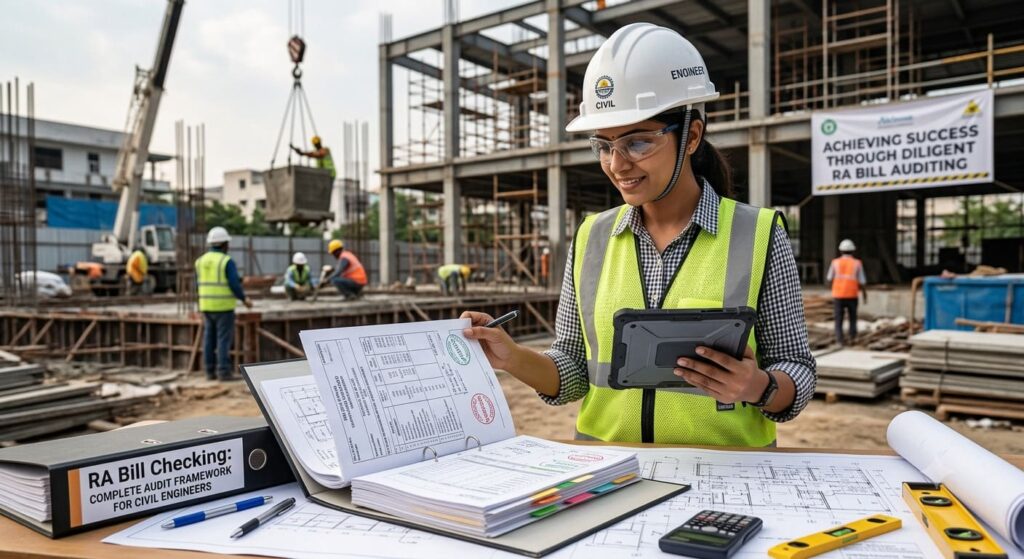
No Inspection, No Measurement, No Payment: The Quality Papers Behind Every RA Bill in a Mumbai Project
A site engineer’s practical guide to the documents that make an RA bill stand up…
M30 on the Drawing, Honeycomb on the Column: What Really Decides Concrete Quality
A civil engineer’s practical guide to concrete, built around IS Code, can answer this simple…
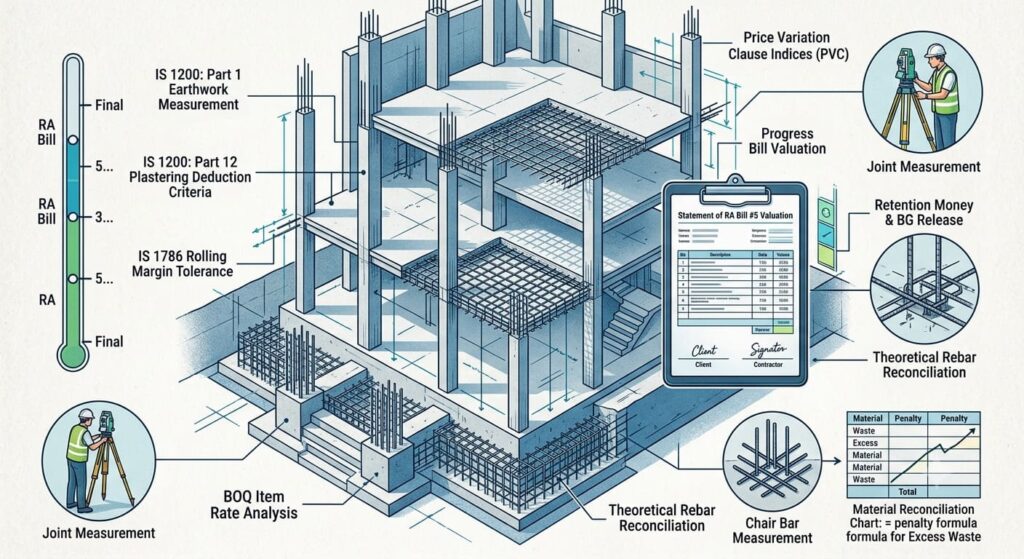
Mastering Reinforcement Steel Reconciliation: A Technical Blueprint for Civil Engineers & Project Managers
1. Executive Summary & Introduction In structural concrete construction, reinforcement steel Reconciliation represents between 20%…
20 Essential Technical Interview Questions (Part – 3) | Master Class in Construction Project Billing & Quantity Surveying
I’ve sat on both sides of the table for these Technical interviews as the guy…
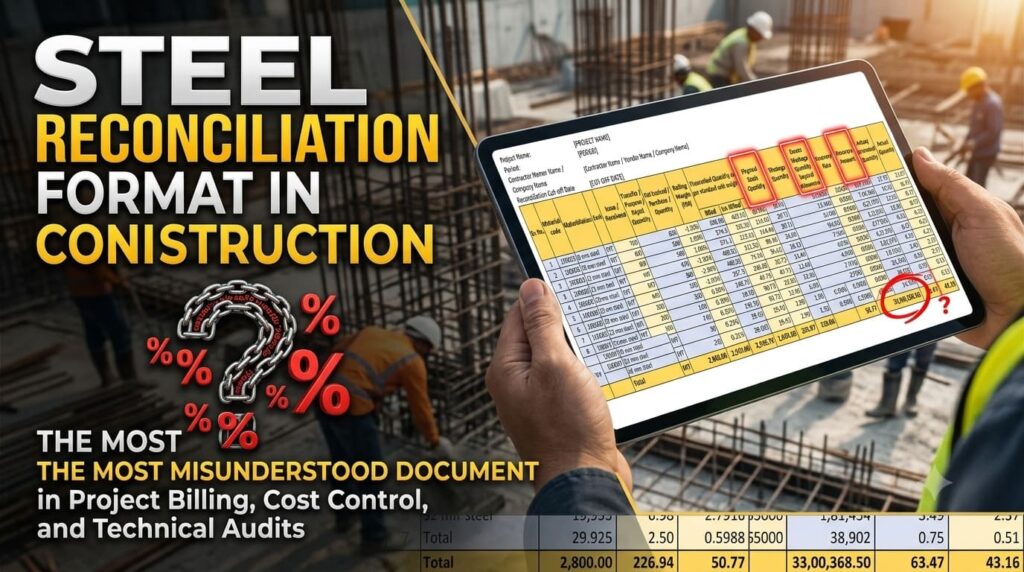
Steel Reconciliation Format in Construction | The Most Misunderstood Document in Project Billing, Cost Control and Technical Audits
Excel Reconciliation Format Download here There are a few documents like Steel Reconciliation Format in…

Complete Guide Work Order Understanding | Beyond The BOQ: How A Billing Engineer Must Read Every Line Of A Work Order (Part 2)
I still remember one particular bill audit many years ago. Work Order Understanding was the…