


CEMENT AND CONCRETE RECONCILIATION | The Complete Guide to Preparing a Contractor | Material Reconciliation Statement (MRS)

Introduction: What Is Cement and Concrete Reconciliation and Why It Matters
Cement and concrete reconciliation is the process of matching the quantity of cement (and, by extension, the concrete produced from it) received, issued, and consumed at a construction site against the quantity theoretically required as per the approved mix design and structural drawings. Alongside steel, it is one of the two materials that dominate every material reconciliation exercise on a construction project — and for good reason. Cement is priced per bag or per tonne, concrete volumes run into thousands of cubic meters on any sizeable project, and even a small percentage error in a cement and concrete reconciliation statement translates into a very large commercial number.
In my experience, cement reconciliation is treated far more casually than steel reconciliation on most sites — largely because there is no single dramatic document like a Bar Bending Schedule that everyone points to. But that is exactly what makes it dangerous: without a disciplined process, cement reconciliation quietly drifts into guesswork, and by the time the final bill is being negotiated, nobody can defend the numbers with confidence.
This guide builds a complete, defensible cement and concrete reconciliation process, stage by stage — from the delivery truck at the site gate to the final Material Reconciliation Statement (MRS) — with every formula that is actually used in practice.

Cement and Concrete Reconciliation Process Flow Chart
Before we walk through each stage, it helps to see the entire cement and concrete reconciliation process at a glance. The flow chart below maps every stage covered in this guide.
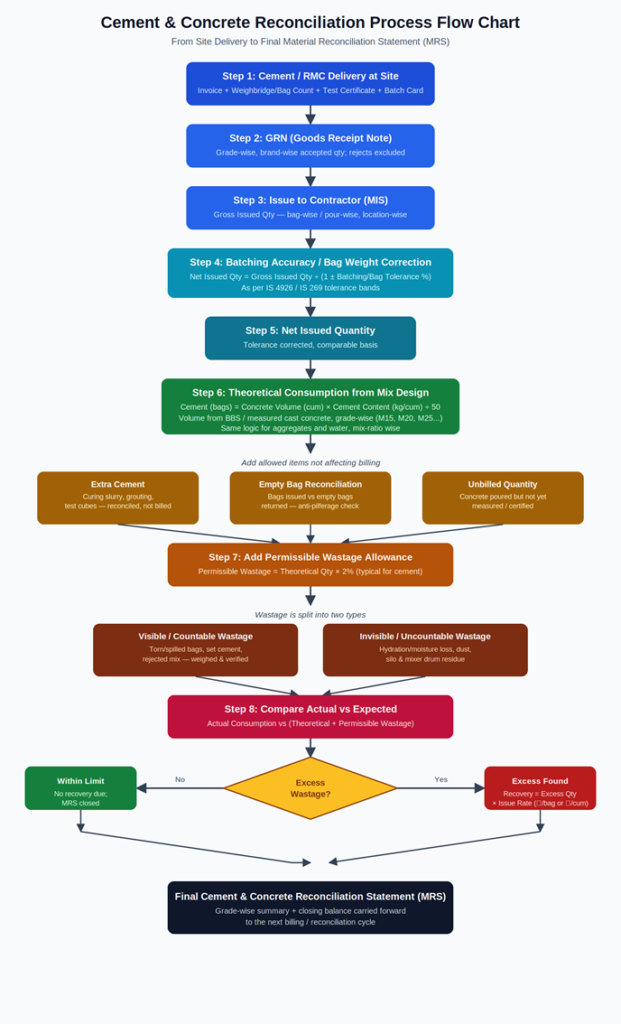
Flow chart: The complete cement and concrete reconciliation process, from delivery at site to the final Material Reconciliation Statement (MRS).
Keep this flow chart in mind as you read — each stage corresponds to a section below.
Delivery of Cement / Ready-Mix Concrete at Site
What Should Accompany Every Delivery
Every cement and concrete reconciliation exercise starts at the point of delivery, and delivery can take two very different forms on a modern project:
A. Bagged Cement (or bulk cement tankers), accompanied by:
- Tax Invoice — grade (OPC 43/OPC 53/PPC/PSC as per IS 269 / IS 1489 / IS 455), brand, quantity in bags or MT
- Weighbridge Slip (for bulk tankers) — gross, tare, and net weight
- Bag Count Verification (for bagged cement) — standard bag weight is 50 kg as per BIS
- Manufacturer’s Test Certificate — physical and chemical properties, batch/lot number, date of manufacture
- Delivery Challan — grade-wise, batch-wise breakup
B. Ready-Mix Concrete (RMC), accompanied by:
- Batching Plant Weigh-Batch Printout / Docket — actual weight of cement, aggregates, water, and admixture dosed per batch, along with grade and mix design reference
- Delivery Challan / Pour Card — volume of concrete (cum) supplied per transit mixer, time of batching, time of discharge
- Mix Design Report — approved design mix showing theoretical cement content (kg/cum), water-cement ratio, and aggregate proportions
The very first discipline of accurate cement and concrete reconciliation is this: never accept a “quantity delivered” figure without matching it to a specific grade, and without the batching printout in the case of RMC. If OPC and PPC bags get mixed in the same stack, or two different concrete grades get logged under one lump entry, grade-wise reconciliation becomes impossible later.
Physical Verification at Site
- Bag count and random weight check — a sample of bags from each lot should be weighed; BIS permits a small tolerance on the standard 50 kg bag weight (commonly accepted as approximately ±1%, i.e., roughly 49.5 kg to 50.5 kg per bag), and this must be checked periodically, not assumed.
- Date of manufacture / shelf life check — cement loses strength with age due to natural hydration from atmospheric moisture; cement older than about 90 days should trigger a fresh strength test before use, and this has a direct reconciliation implication (aged, rejected cement must be excluded from usable stock).
- RMC batch printout cross-check — for every transit mixer load, the batching printout (cement, aggregate, water, admixture actually dosed) should be checked against the approved mix design, and any batch outside the permitted tolerance band should be flagged before the concrete is poured.
- Sample testing — cube tests for compressive strength (7-day and 28-day), and periodic checks on fineness, setting time, and soundness for bagged cement as per IS 4031.
Just as with steel, almost every dispute I have seen in a final cement and concrete reconciliation statement traces back to this delivery stage — usually grade mixing, missing batching printouts for RMC, or “received quantity” being taken from the supplier invoice instead of actual bag count / weighbridge verification.

Goods Receipt Note (GRN) — The First Formal Record
What a GRN Represents
The GRN is the internal document confirming: “This much cement (or this much RMC) has been received, verified, and accepted into site stock/records.” It is the bridge between the supplier’s invoice or batching printout and the contractor’s issue register, and it is the foundation of the entire cement and concrete reconciliation process.
Contents of a Proper GRN
| Field | Why It Matters for Cement and Concrete Reconciliation |
| GRN Number & Date | Traceability |
| Grade & Brand (OPC 43/53, PPC, PSC) | Foundation for grade-wise reconciliation |
| Quantity (Bags / MT, or Cum for RMC) | Basic reconciliation unit |
| Batch/Lot Number or Batching Printout Ref | Traceability to test certificate / mix design |
| Accepted / Rejected Quantity | Only accepted qty enters stock or is counted as poured |
| Weighbridge/Bag Count Reference | Audit trail |
| Running Cumulative Receipt | Directly feeds the final MRS |
GRN Quantity vs Invoice/Batching Quantity

Always record GRN quantity as actual accepted quantity, not the invoiced or nominal batched figure. If a transit mixer’s docket claims 6.0 cum but site measurement (using a calibrated container, or cross-checked against the pour dimensions) indicates only 5.85 cum was actually discharged, the shortfall must be noted and only the verified quantity entered. This cumulative accepted figure across all GRNs/batching records becomes the single most important number in cement and concrete reconciliation — the Total Quantity Received at Site:
Total Received (GRN/Batching Cumulative) = Σ (Accepted Quantity per GRN or Pour Card)
Issue of Cement / Concrete to Contractor
The Material Issue Slip (MIS)
For bagged cement, once material is in store, it is issued to the contractor against a specific work front through a Material Issue Slip (MIS) recording date, grade, number of bags, location, and the contractor’s signed acknowledgment.
For RMC, the “issue” effectively happens the moment the transit mixer discharges concrete at the pour location — the Pour Card / Concrete Requisition Slip (raised by the contractor before casting, specifying grade, quantity requisitioned, and structural element) serves the same function as an MIS.
Gross Issued Quantity
Gross Issued Quantity (GIQ) = Σ (Quantity issued per MIS or Pour Card, grade-wise)
Exactly as with steel, Gross Issued Quantity in cement and concrete reconciliation is never directly compared against the theoretical requirement. It must first be corrected for batching and bag-weight tolerance — the cement/concrete equivalent of rolling margin.
Batching Accuracy and Bag-Weight Tolerance — The Cement Equivalent of Rolling Margin
Why a Tolerance Correction Is Needed Here Too
Just as TMT bars carry a manufacturing “rolling margin” between nominal and actual weight, cement and concrete carry their own equivalent tolerances that must be corrected for before comparing issued quantity to theoretical requirement:
- Bag Weight Tolerance — standard cement bags are nominally 50 kg, but actual filled weight varies within a small permitted band (commonly around ±1%, i.e., roughly 49.5–50.5 kg). Across thousands of bags on a large project, this adds up to a real, measurable difference between “nominal bag count × 50 kg” and “actual weight received.”
- Batching Plant Accuracy Tolerance — for RMC and site-batched concrete, IS 4926 (Code of Practice for Ready-Mixed Concrete) and IS 456 prescribe permissible batching accuracy: commonly ±2% for cement, ±3% for aggregates, and ±3% for water, by weight, per batch. This means a batching plant is allowed to dose slightly more or slightly less cement than the mix design calls for, and still be considered compliant.

How to Calculate the Tolerance-Corrected (Net Issued) Quantity
For Bagged Cement:
- Weigh a representative sample of bags from each lot.
- Calculate actual average bag weight.
Actual Average Bag Weight (kg) = Total Weight of Sample Bags (kg) ÷ Number of Bags in Sample
Compare against the nominal bag weight (50 kg):
Bag Weight Tolerance (%) = [(Actual Average Bag Weight − 50) ÷ 50] × 100
Correct the Gross Issued Quantity:
Net Issued Quantity = Gross Issued Quantity (nominal) ÷ (1 + Bag Weight Tolerance % / 100)
Worked Example:
Gross Issued Quantity = 2,000 bags × 50 kg (nominal) = 100.00 MT. Sample check shows actual average bag weight = 49.50 kg, i.e., Bag Weight Tolerance = -1%.
Net Issued Quantity = 100.00 ÷ 0.99 = 101.01 MT
Because bags were slightly underweight, the effective quantity actually needed to be issued (in nominal-bag terms) to deliver 100 MT of real cement is higher — this correction prevents the contractor being unfairly blamed for “wastage” that is actually a bag-filling shortfall by the supplier.
For RMC / Batched Concrete:
The same logic applies at the batching-plant level. If the batching printout shows cement dosed at, say, 2% above the mix design figure for a given pour (within the permissible IS 4926 tolerance), the effective cement content per cum actually supplied is higher than the nominal mix design figure, and this must be reflected when computing theoretical consumption, exactly as rolling margin is reflected for steel:
Effective Cement Content (kg/cum) = Design Cement Content (kg/cum) × (1 + Batching Tolerance % / 100)
Why This Correction Changes the Net Issued Quantity
This step matters for exactly the same reason it matters in steel reconciliation: cement is procured and issued by weight/bags, but the structure requires a certain volume of concrete built to a certain design strength, which depends on the actual cement content per cubic meter — not the nominal bag count. Skipping this correction and comparing raw bag counts directly against theoretical BBS-based volumes will always produce a distorted, and usually unfair, wastage figure.
Net Issued Quantity vs Theoretical Consumption — The Core Comparison
What Determines Theoretical Cement Consumption?
Theoretical cement consumption in cement and concrete reconciliation flows from two possible sources, depending on how the concrete is specified in the contract:
- Design Mix Concrete (most modern projects) — the theoretical cement content per cubic meter is taken directly from the approved Mix Design Report submitted by the contractor/RMC supplier and approved by the client’s quality team. This report specifies cement content (kg/cum), water-cement ratio, and aggregate proportions to achieve the target strength and workability.
- Nominal Mix Concrete (older contracts, minor/non-structural works) — where a fixed nominal mix ratio (e.g., 1:2:4, 1:1.5:3) is specified, theoretical cement consumption is taken from standard data books (such as CPWD/PWD Schedule of Rates analysis of rates, or IS 456 Table 9 guidance), which specify a standard number of cement bags per cubic meter for each nominal mix.
Commonly referenced indicative cement consumption figures (always verify against your project’s approved mix design or applicable SOR, since these vary with aggregate size, admixture use, and workability requirements):
| Concrete Grade / Mix | Typical Cement Content (kg/cum) | Approx. Bags/cum (50 kg bag) |
| M10 (1:3:6, nominal) | ~210–220 | ~4.2–4.4 |
| M15 (1:2:4, nominal) | ~250–260 | ~5.0–5.2 |
| M20 (1:1.5:3, nominal) | ~320–330 | ~6.4–6.6 |
| M25 (Design Mix) | ~330–360 | ~6.6–7.2 |
| M30 (Design Mix) | ~340–380 | ~6.8–7.6 |
The Theoretical Consumption Formula
Theoretical Cement (kg) = Volume of Concrete Poured (cum) × Cement Content per cum (kg/cum, as per approved mix design)
Theoretical Cement (Bags) = Theoretical Cement (kg) ÷ 50
The same logic extends to aggregates and water:
Theoretical Coarse/Fine Aggregate (cum or MT) = Volume of Concrete Poured × Aggregate Content per cum (as per mix design)
Where Does “Volume of Concrete Poured” Come From?
This is the cement-reconciliation equivalent of the BBS in steel reconciliation. The theoretical volume of concrete required is derived from:
Volume of Concrete (cum) = Σ (Length × Width × Depth/Thickness, as per structural drawing), summed across all elements
summed across every footing, column, beam, slab, and other cast-in-situ element, net of deductions for reinforcement volume (usually ignored as negligible) and any voids, block-outs, or openings shown on the drawing.
Grade-wise Reconciliation Is Non-Negotiable
Exactly as dia-wise reconciliation is mandatory for steel, grade-wise reconciliation is mandatory for cement and concrete. A contractor over-consuming cement on M25 elements while under-reporting M15 PCC volumes can create a misleadingly balanced total. Always reconcile grade by grade (M10, M15, M20, M25…), and only consolidate at the final summary stage.
Editor’s Pick
 Read more: Standardized Excavation Measurement Benchmark – IS Code Explained
Standardized Excavation Measurement Benchmark – IS Code Explained
on
- Read more: Bar Bending Schedule Essentials: Common Errors and Practical Insights for Civil Engineering should help your Knowledge in 2026
Bar Bending Schedule Essentials: Common Errors and Practical Insights for Civil Engineering should help your Knowledge in 2026
on
 Read more: Pile Foundation: The Hidden Strength Beneath Every Structure Now even in 2026
Pile Foundation: The Hidden Strength Beneath Every Structure Now even in 2026
on
 Read more: Basic Rate Difference ( BRD ) – Common Mistakes and Billing & Audit Red Flags
Basic Rate Difference ( BRD ) – Common Mistakes and Billing & Audit Red Flags
on




Extra Cement Considered in Reconciliation but NOT in Billing
Just as with steel, certain cement consumption is genuine, must be reconciled, but is not separately billed because it falls outside the measured/certified BOQ item:
- Curing — cement slurry or cement-based curing compounds used for curing exposed concrete surfaces; consumed on site and reconciled, but not billed as a separate item under most standard BOQ descriptions (curing is typically deemed included in the concrete rate).
- Grouting and Anchor Fixing — cement grout used for dowel bar fixing, machine foundation grouting, or non-shrink grout applications not separately measured.
- Test Cubes and Trial Mixes — cement consumed in casting compressive-strength test cubes and in trial mix batches during mix design approval; a genuine site consumption, but not part of billable concrete volume.
- Construction Joint Treatment — cement slurry applied at construction joints for bonding between old and new concrete pours.
- Temporary Works — cement used in temporary blockwork, plinth protection, or other non-permanent site requirements.
Principle (same as steel): Reconciliation is a physical/quantity exercise (where did the cement go?); billing is a commercial/contractual exercise (what can be claimed for payment?). The two must be kept conceptually separate.
Unbilled Quantity in Cement and Concrete Reconciliation
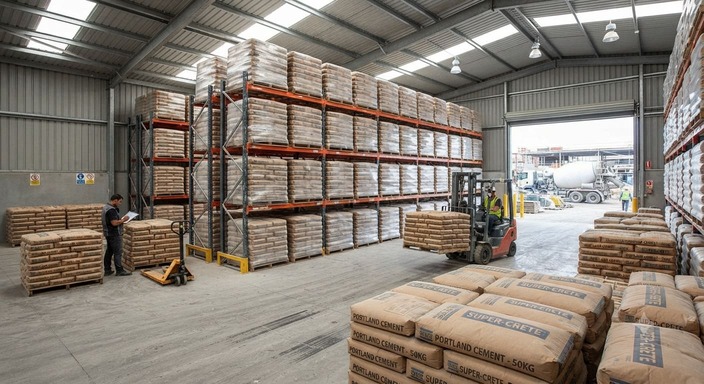
Unbilled Quantity here refers to concrete that has been poured and is physically in place, but has not yet been measured and certified for billing as of the reconciliation cut-off date — the same timing-mismatch concept as in steel reconciliation.
Quantity Reconciled = Billed Theoretical Quantity + Unbilled (Poured but not yet Measured) Quantity
A slab poured on the last day of the billing cycle, for instance, may only get measured and certified in the following month’s bill, after formwork is struck and the surface can be properly checked. Without accounting for this, a cement and concrete reconciliation statement will show a false gap that looks like excess consumption, when it is really just timing.
Empty Cement Bag Reconciliation — The Cement Equivalent of Cut Pieces
The Core Concept
In steel reconciliation, “cut pieces” are the concept that separates genuine reusable material from true scrap. In cement and concrete reconciliation, the equivalent control mechanism is Empty Bag Reconciliation — and it is, in my experience, one of the most under-utilized but most powerful checks available to a site engineer.
Every bag of cement issued to the contractor should, after use, leave behind an empty bag. On a disciplined site, empty bags are collected, counted, and tallied against the number of bags issued. If 2,000 bags were issued for a particular period and only 1,850 empty bags are returned/accounted for, that 150-bag gap is a serious red flag — it may indicate diversion of cement to unauthorized use, theft, or simply undocumented consumption elsewhere on site.
Empty Bag Reconciliation Check = Number of Bags Issued − Number of Empty Bags Returned/Counted
A well-run site keeps an Empty Bag Register, and any shortfall beyond a small allowance for genuinely torn/destroyed bags (usually a very small percentage) must be investigated and explained before the reconciliation is closed.
Why This Distinction Matters
This is not a “wastage” item in the same sense as scrap steel — an empty bag itself is valueless — but the discipline of counting empty bags is a control mechanism, not an accounting entry. It is the single most direct, physical evidence that a bag of cement was actually consumed at the site and not diverted elsewhere. Any cement and concrete reconciliation process that skips this check is missing one of its most important safeguards, particularly on projects where the contractor also has cement requirements at other, non-client sites.
Note on RMC: Empty bag reconciliation does not apply where cement is used at a batching plant in bulk (silo-fed) form; there, the equivalent control is a cement silo stock register, cross-checked against batching printouts, cement received into the silo, and periodic physical/ultrasonic level checks of the silo.
Wastage in Cement and Concrete Reconciliation — Visible and Invisible
Visible (Countable) Wastage
Physically observable and, where possible, weighable:
- Torn or burst bags during handling and stacking — spilled cement that cannot be recovered
- Set/hardened cement due to moisture ingress in storage (monsoon exposure, ground contact without proper dunnage/waterproof stacking) — must be discarded
- Rejected concrete batches — batches failing slump test or found non-compliant at the point of pour, rejected and wasted
- Cube test failures requiring rework — if a structural element fails to achieve target strength and has to be demolished and recast, the cement in the failed pour is a real, countable loss
- Spillage during transit mixer discharge or pumping — visible loss during placement operations
Visible Wastage (MT or Bags) = Quantity of collected/identified spilled, set, or rejected material
Invisible (Uncountable) Wastage
Real but not physically collectible:
- Hydration/moisture absorption loss — cement naturally absorbs atmospheric moisture during storage and handling, a small but real and unrecoverable loss even under good storage conditions
- Dust loss during bag opening and tipping into the mixer — a fine cement dust cloud escapes during every bag-opening operation; individually negligible, but real across thousands of bags
- Silo aeration and pneumatic transfer losses — small quantities of cement are lost as dust during pneumatic conveying into and within silos at batching plants
- Mixer drum residue — a thin coating of cement paste that remains adhered to the inside of a transit mixer drum or site mixer after each batch, never fully discharged
- Wind loss during pouring — particularly relevant for dry-mix or shotcrete-type applications, less so for standard wet-mix concrete, but still a recognized loss category
Exactly as with steel, none of this invisible wastage can be demonstrated with a weighbridge slip, so the industry allows a standard permissible wastage percentage to cover it, rather than demanding physical proof.
Standard Permissible Wastage in Cement and Concrete Reconciliation
Most Indian contract specifications and standard schedules (CPWD/PWD-type specifications) allow a total permissible wastage of around 2% on theoretical cement consumption (always confirm the exact figure against your specific contract — some contracts differentiate slightly between bagged cement wastage and bulk/RMC wastage, given the very different handling profile of each). As with steel, this percentage covers both unrecoverable visible loss and the entire invisible wastage category combined.
Excess Wastage Calculation — The Final Commercial Step
The Master Cement and Concrete Reconciliation Equation
Net Issued Qty = Theoretical Qty + Permissible Wastage + Excess Wastage − Empty Bag Shortfall (if investigated) + Unbilled/Balance in Hand
Rearranged to isolate excess wastage:
Excess Wastage = Net Issued Qty − Theoretical Qty − Permissible Wastage Allowance − Balance Stock in Hand
Permissible Wastage Allowance = Theoretical Quantity × Permissible Wastage % ÷ 100

Worked Example — Complete Cement Reconciliation Calculation
Given (M20 Grade Concrete, over a reconciliation period):
- Gross Issued Quantity (cement) = 2,060 bags (nominal, 50 kg each) = 103.00 MT
- Bag Weight Tolerance (tested) = -1% (bags slightly underweight)
- Theoretical Cement Consumption (from mix design, based on measured concrete poured) = 96.00 MT
- Permissible Wastage (contract) = 2%
- Balance stock in hand (verified, unused bags) = 1.20 MT
Step 1 — Net Issued Quantity:
Net Issued Quantity = 103.00 ÷ 0.99 = 104.04 MT
Step 2 — Permissible Wastage Allowance:
96.00 × 2 ÷ 100 = 1.92 MT
Step 3 — Expected Total Consumption:
96.00 + 1.92 = 97.92 MT
Step 4 — Actual Quantity Consumed:
104.04 − 1.20 = 102.84 MT
Step 5 — Excess Wastage:
102.84 − 97.92 = 4.92 MT
Recovery Amount = Excess Wastage (MT) × Issue Rate of Cement (₹/MT or ₹/Bag)
In this example, unlike the earlier steel example, there is a genuine excess — and before recovery is pursued, the engineer must go back and check: was the empty bag count consistent with 2,060 bags? Was there an unbilled pour that hasn’t yet been added to the theoretical quantity? Was any concrete rejected and recast (visible wastage that should be separately identified rather than clubbed into “excess”)? Only once these are ruled out does the 4.92 MT become a genuine, defensible recovery figure.
A Note on Fairness
Just as with steel, excess wastage in cement and concrete reconciliation should never be calculated in isolation. Always cross-check batching/bag-weight tolerance direction, empty bag reconciliation, visible wastage already identified and set aside, and unbilled/balance stock, before arriving at a final excess figure. Skipping any of these steps consistently produces an inflated, unfair figure against the contractor — and that is exactly what fuels prolonged commercial disputes at project closure.
Cement and Concrete Reconciliation Statement Format
Below is the complete, grade-wise cement and concrete reconciliation format used to consolidate everything covered in this guide into one auditable statement:
| Sr. | Particulars | Formula / Basis | Unit | Value (M20 eg.) |
| 1 | Opening Balance (Stock brought forward) | Carried from previous period | MT | 0.00 |
| 2 | Add: Total Received at Site (GRN Cumulative) | Σ Accepted Quantity per GRN | MT | 103.00 |
| 3 | Total Available Quantity | (1) + (2) | MT | 103.00 |
| 4 | Gross Issued Quantity to Contractor | Σ Quantity per MIS/Pour Card | MT | 103.00 |
| 5 | Bag Weight / Batching Tolerance (tested) | (Actual − Nominal) ÷ Nominal × 100 | % | −1.00 |
| 6 | Net Issued Quantity (Tolerance Corrected) | (4) ÷ (1 + Tolerance%) | MT | 104.04 |
| 7 | Less: Balance Stock Lying Unused (verified) | Physical bag count verification | MT | 1.20 |
| 8 | Actual Quantity Consumed | (6) − (7) | MT | 102.84 |
| 9 | Theoretical Cement Consumption (Mix Design × Volume) | Volume (cum) × Cement Content ÷ 1000 | MT | 96.00 |
| 10 | Add: Extra Cement (Curing/Grouting/Test Cubes) | Reconciled, not billed | MT | Site-specific |
| 11 | Permissible Wastage Allowance | (9) × Permissible Wastage % | MT | 1.92 |
| 12 | Total Expected Consumption | (9) + (10) + (11) | MT | 97.92 |
| 13 | Excess / (Saving) Wastage | (8) − (12) | MT | 4.92 |
| 14 | Recovery Amount (if Item 13 is positive) | (13) × Issue Rate (₹/MT) | ₹ | As applicable |
| 15 | Unbilled Quantity (Poured, not yet certified) | Physical + measurement cut-off | MT | Site-specific |
| 16 | Empty Bag Reconciliation Check | Bags Issued − Empty Bags Returned | Bags | To be verified |
| 17 | Closing Balance (Carried Forward) | Balance stock not yet consumed | MT | 1.20 |
Prepare this table grade-wise for every concrete grade used on the project (M10, M15, M20, M25, etc.), then consolidate into a summary sheet for the final cement and concrete reconciliation statement.
Closing Thoughts on Cement and Concrete Reconciliation
Cement and concrete reconciliation deserves the same discipline that steel reconciliation gets, but rarely receives it in practice — largely because there is no single dramatic document, like a BBS, that forces the issue. Yet every stage matters just as much: delivery verification with grade-wise segregation, GRN discipline, batching/bag-weight tolerance correction, mix-design-based theoretical consumption, a clear separation of extra (unbilled) cement from billable concrete, unbilled quantity tracking, empty bag reconciliation as an anti-pilferage control, and an honest split between visible and invisible wastage.
In my experience, the projects where cement and concrete reconciliation holds up at final settlement are the ones where empty bag registers were maintained from day one, batching printouts were checked pour by pour, and grade-wise records were never allowed to blur into a single lump total. I hope this guide gives you that same structured foundation for cement and concrete, exactly as the companion guide did for steel.
Follow the below links for more blogs………………
RA Bill Checking: Complete Audit accomplished Framework for Civil Engineers
Why Site Skills in Civil Engineering Trump Textbook Knowledge – Every Single Time




















[…] CEMENT AND CONCRETE RECONCILIATION | The Complete Guide to Preparing a Contractor | Material Reconci… […]