


RMC – Ready Mix Concrete Reconciliation : A Complete IS-Code Based Guide for Billing Engineers and Materials Management Officers

When a client or PMC decides to directly supply Ready Mix Concrete (RMC) to a contractor instead of letting the contractor procure it independently, RMC – Ready Mix Concrete Reconciliation is required & the entire commercial equation of the project changes. The client is no longer paying for concrete “as billed” the client is paying for concrete “as consumed,” and the gap between the two is where profit, loss, disputes, and audit objections are born.
Over the years of executing high-budget projects, plants, high-rises, metro depots, industrial sheds, and infrastructure packages I have found that most disputes on free-issue RMC do not arise because contractors are dishonest or clients are unreasonable. They arise because nobody agreed, in writing, on a reconciliation format before the first truck of concrete rolled onto site. By the time the project is 60% complete, everyone is arguing about wastage percentages that should have been fixed at the contract stage.
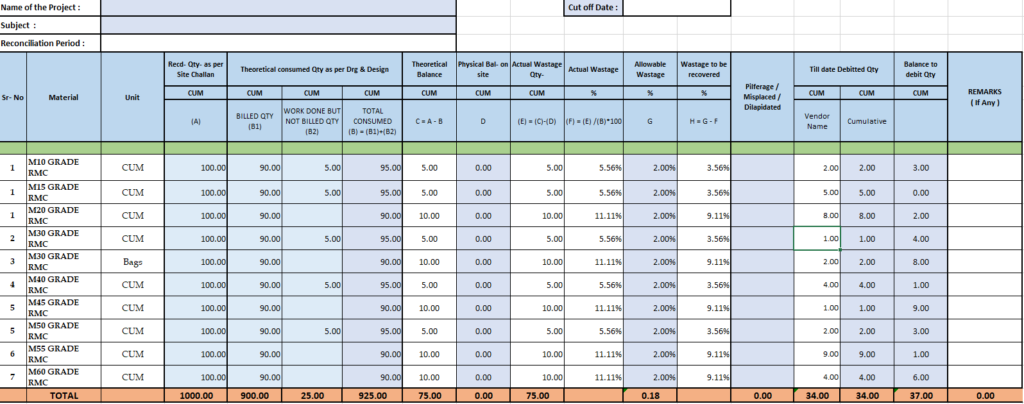
This article lays out, in complete technical and commercial depth, the exact Concrete reconciliation format I use on my projects (a version of which is shown at the top of this article as a working table), the IS code and CPWD basis for every column and every wastage percentage in it, and a full worked example so that any billing engineer, quantity surveyor, or materials management officer can replicate it on their own project quarterly, monthly, or bill-to-bill.
Why Client-Supplied RMC Needs a Different Concrete Reconciliation Approach
In a normal item-rate or lump-sum contract, the contractor procures concrete (whether site-mixed or RMC) at his own cost, and the client pays for the quantity of work executed, measured as per the drawing and Bill of Quantities (BOQ). The contractor’s profit or loss on material efficiency is his own business if he wastes concrete, he absorbs the cost; if he is efficient, he keeps the saving.
The moment the client or the client’s PMC starts supplying RMC directly — a very common arrangement on high-value industrial, metro, power, and government projects where the client wants direct control over concrete quality, source, and cost this equation inverts. Now:
- The client bears the direct cost of every cubic metre of concrete supplied.
- The contractor is only paid for labour, placement, finishing, curing and other allied activities (the “conversion cost”), because the material itself is a “free issue material” (FIM), also called “client-supplied material” or “free-issue item.”
- Any concrete consumed beyond the theoretical requirement of the drawing is, in effect, a direct loss to the client unless it is recovered from the contractor’s bills.
This is precisely why a dedicated RMC Concrete Reconciliation Statement becomes essential, and why it must be prepared and signed jointly by the contractor and the client/PMC representative quarterly at minimum, and ideally along with every Running Account (RA) bill, as recommended under the CPWD Works Manual’s Standard Operating Procedure for material reconciliation with running bills.

Without this discipline, two failure modes are almost guaranteed on any project running longer than six months:
- Silent over-consumption the contractor draws more RMC than the drawing requires (due to poor formwork, over-excavation, over-break in foundations, or simple carelessness) and nobody notices until the final bill, by which time recovery becomes a legal dispute rather than a routine deduction.
- Untraceable wastage spillage, drum residue, rejected loads, and slump-failure rejections at site are never separately recorded, so when the Concrete reconciliation is finally done, the contractor cannot explain the gap and the client cannot prove intent leading to arbitration.
A well-designed Concrete reconciliation format, applied every quarter, prevents both.
The Contractual and Legal Basis for Concrete Reconciliation
Before we get into the format itself, it is important to understand why this exercise is not just good practice but a contractual obligation on most high-value projects.
2.1 General Conditions of Concrete Contract (GCC) clauses
Almost every standard form of contract used in India for free-issue materials CPWD General Conditions of Contract, MES conditions, State PWD conditions, and most private EPC contract templates carries a clause that requires:
- A theoretical consumption statement to be prepared and countersigned by the contractor with every RA bill.
- Permissible variation between theoretical and actual consumption to be defined (commonly expressed as an allowable wastage percentage).
- Recovery at issue rate (or a penal rate) for any consumption in excess of theoretical requirement plus allowable wastage.
The CPWD Works Manual is explicit on this for materials like cement, bitumen, and steel under Clause 42, which prescribes variation limits such as ±2% to ±3% for cement (depending on contract value) and ±2% for reinforcement and structural steel, with nil variation for “all other materials” unless specifically negotiated. Because RMC is a comparatively newer free-issue item (site-mixed concrete was the historical default when these clauses were drafted), most contracts today explicitly insert a bespoke wastage clause for RMC typically in the 2% range rather than relying on the “nil” default, since some wastage in batching, transit, pumping, and placement of a ready, time-sensitive material is physically unavoidable.
This is exactly why the Concrete reconciliation format shown in this article carries a fixed “Allowable Wastage %” column of 2.00% across grades this is a negotiated, contract-specific figure, not a number invented arbitrarily; it should always be traced back to the Special Conditions of Contract (SCC) signed for that specific project, and cross-checked against the benchmarks discussed in Section 6.
2.2 Why quarterly reconciliation, specifically
While ad-hoc/monthly Concrete reconciliation is good practice, quarterly Concrete reconciliation has become the informal industry standard on large projects for three practical reasons:
- It aligns with the quarterly internal/statutory audit cycle most large contractors and PSU clients follow.
- It gives enough volume of concrete poured (typically several hundred to a few thousand cubic metres on an active high-rise or industrial project) for wastage percentages to stabilize statistically monthly figures on a low-pour month can look alarming even when nothing is actually wrong.
- It matches the natural rhythm of RA bill certification cycles, since most contracts require RA bills at least once every one to three months.
I recommend doing a lightweight bill-to-bill tracking sheet (running total, updated every RA bill) feeding into a formal, signed quarterly Concrete reconciliation statement this gives you both early warning and a clean audit trail.
Governing IS Codes and Reference Documents Concrete Reconciliation
Indian Standards do not, by themselves, prescribe a fixed “wastage percentage” for RMC this is a common misconception. What the IS codes do provide is the technical and measurement basis on which theoretical consumption, mix proportions, and site tolerances are calculated, which is what makes a defensible wastage percentage possible in the first place. The relevant codes are:
| IS Code | Title | Relevance to Concrete Reconciliation |
|---|---|---|
| IS 4926:2003 | Code of Practice — Ready-Mixed Concrete (Second Revision) | The primary code governing RMC production, batching tolerance, transit time (2 hours from loading, extendable with admixtures per Clause 8), slump tolerance (±25 mm or ±1/3 of specified value, whichever is less), and sampling of concrete from the transit mixer at site. This defines what constitutes a compliant, acceptable load — and therefore what counts as a legitimate site rejection versus a contractor-caused loss. |
| IS 456:2000 | Plain and Reinforced Concrete — Code of Practice | Defines concrete grade designations (M10 to M60 and beyond), mix design requirements, durability requirements, minimum cement content, and tolerances on dimensions of cast members — the dimensional tolerance clause is what feeds directly into the “Theoretical Consumed Qty as per Drg & Design” column of the Concrete reconciliation format. |
| IS 10262:2019 | Concrete Mix Proportioning — Guidelines | Governs mix design procedure for each grade; the approved mix design/design mix report is the primary reference that ties a client-approved concrete grade to a specific batching recipe, which in turn underpins the billed quantity certification. |
| IS 1199 (Part 1 to 3):2018 | Fresh Concrete — Methods of Sampling, Testing and Analysis | Governs sampling of fresh concrete at the point of discharge — directly relevant when a load is rejected on slump or workability grounds, since rejected/returned loads must be recorded separately in Concrete reconciliation (see Section 9). |
| IS 383:2016 | Coarse and Fine Aggregate for Concrete — Specification | Relevant where theoretical yield calculations are cross-checked against aggregate specific gravity and grading, particularly on projects where the client also supplies aggregate for site batching alongside RMC (mixed supply arrangements). |
| IS 1200 (Part 2) | Method of Measurement of Building and Civil Engineering Works — Concrete Work | Governs how executed concrete quantity is measured (net or gross, deductions for openings, etc.) for billing — this is the basis of the “Theoretical Consumed Qty — Billed” figure (Column B1 of the format). |
| IS 516:2021 | Hardened Concrete — Methods of Test for Strength | Relevant to disputes where rejected/failed cubes lead to a member being recast, which affects theoretical vs actual consumed quantities. |
| CPWD Works Manual, Clause 42 | Standard schedule/statement for theoretical quantity, and permissible variation | Basis of the contractual variation percentage mechanism applied to free-issue materials; the RMC wastage clause in most modern contracts is modelled directly on this clause, extended to RMC by contract-specific SCC provisions. |
| Delhi Schedule of Rates (DSR) / State PWD SOR & CPWD Analysis of Rates | Rate analysis with embedded consumption coefficients | Where the contract is item-rate and materials are not free-issued, DSR/SOR consumption coefficients are the fallback theoretical benchmark; even in free-issue contracts, these coefficients are frequently used as a sanity check against the drawing-based theoretical quantity. |
Practical note for billing engineers: always attach copies of the specific IS code clauses being relied upon (transit time, slump tolerance, sampling procedure) to your quarterly Concrete reconciliation statement as an annexure. This converts your Concrete reconciliation from an internal spreadsheet into a defensible technical document that will hold up in an audit, a vigilance inquiry, or arbitration.
Latest Articles

Standardized Excavation Measurement Benchmark – IS Code Explained
In civil engineering, precision in measurement is essential for accurate billing, auditing, and project control. The IS 1200 (Part 1) 1992 standard defines how earthwork should be measured, ensuring uniformity and reliability across all…

By
📆
Bar Bending Schedule Essentials: Common Errors and Practical Insights for Civil Engineering should help your Knowledge in 2026
Understanding Unit Weight Error of Reinforcement Steel in Civil Engineering In civil engineering, precision in calculation is vital for accurate estimation and billing. One common area where minor discrepancies occur…
By
📆

Pile Foundation: The Hidden Strength Beneath Every Structure Now even in 2026
When I think about construction, one truth always stands out: no building, bridge, or tower can rise with confidence unless its foundation is strong. And in modern civil engineering, that…
By
📆


Understanding “Theoretical Consumption” vs “Actual Consumption” in Concrete Reconciliation
This is the conceptual heart of the entire exercise, and the format is built entirely around this comparison.
4.1 Theoretical Consumption
Theoretical consumption is what the drawing and design say should have been used for the work actually executed not what was ordered, not what was delivered, but what the geometry of the cast member demands, computed net of standard deductions as per IS 1200.
In the Concrete reconciliation format, this has two sub-components:
- Billed Quantity (B1): The RMC quantity corresponding to work that has been measured and billed in the RA bill i.e., work for which a Measurement Book (MB) entry exists and payment has been certified.
- Work Done But Not Billed (B2): RMC quantity corresponding to work that is physically complete/poured on site but has not yet been measured or billed very common at the cut-off date of a quarterly Concrete reconciliation, since concrete work often runs a few days to a few weeks ahead of the billing/measurement cycle. This must be estimated from drawing quantities of the poured members, verified by a joint physical inspection, not guessed.
Adding these two gives the Total Theoretical Consumed Quantity (B = B1 + B2) this is the true “should-have-used” figure as of the cut-off date, and it is more accurate than relying on billed quantity alone, which almost always lags actual site progress.
4.2 Theoretical Balance
Theoretical Balance (C = A − B) is the quantity of RMC that, in a perfect world with zero wastage, should still be lying at site unused, either as leftover in a transit mixer awaiting the next pour, or logically “available” against material received but not yet consumed in permanent work.
4.3 Actual Consumption and Actual Wastage
Since RMC (unlike cement or steel) largely cannot be physically stored it must be placed within the IS 4926 transit window the “Physical Balance on Site” is, in almost all normal cases, zero or near-zero at any cut-off date. This is one of the most misunderstood aspects of RMC Concrete reconciliation compared to cement/steel reconciliation: there is no meaningful stockpile to physically count, because RMC is a perishable, time-bound material.
This is why the format is structured so that:
- Physical Balance on Site (D) is recorded (usually 0.00 for RMC, since concrete cannot be stockpiled this field exists mainly to catch genuine leftover-in-drum situations recorded at the exact cut-off time, or partial loads held back for the next shift under IS 4926’s extended transit provisions).
- Actual Wastage Quantity, E = (C) − (D) since the physical balance is the residual after actual field consumption, this arithmetic yields the quantity that has effectively “disappeared” beyond the theoretical requirement.
- Actual Wastage % (F) = (E)/(B) × 100 expressed against the theoretical consumed quantity (the base most auditors expect), not against the received quantity, because wastage should be judged relative to what work actually demanded, not relative to how much material happened to be ordered.

The Complete Concrete Reconciliation Format Column by Column
Below is the exact structure of the format I use (the same structure shown in the table at the top of this article), explained column by column so any reader can rebuild it in Excel or ERP.
Header block:
- Name of the Project
- Subject (e.g., “Quarterly Concrete Reconciliation Statement RMC (Client Supplied)”)
- Reconciliation Period (e.g., Q2 FY 2026–27)
- Cut-off Date
Body columns, grade-wise (one row per concrete grade, e.g., M10, M15, M20 … M60):
| Column | Formula / Basis | Purpose |
|---|---|---|
| Sr. No. | — | Serial identifier |
| Material | Grade designation (e.g., M20 Grade RMC) as per IS 456 | Identifies each concrete grade separately — never reconcile all grades together, since wastage behaviour, pump-ability, and rejection rates vary sharply by grade and by unit of supply (CUM vs Bags — note Bags applies to dry-mix/pre-bagged concrete variants, not standard transit-mixer RMC) |
| Unit | CUM (cubic metre) generally; Bags where applicable | Basis of measurement per IS 1200 |
| Recd. Qty as per Site Challan (A) | Sum of quantities on the RMC supplier’s delivery challans/tax invoices, cumulative | This is the client’s “supply record” — must be cross-verified against the batching plant’s computerized batch report, not just the driver’s handwritten challan |
| Theoretical Consumed Qty — Billed (B1) | From approved RA bill measurements, as per drawing & IS 1200 deductions | What has been formally certified as executed |
| Theoretical Consumed Qty — Work Done But Not Billed (B2) | From joint physical measurement of poured-but-unbilled members | Captures the billing lag |
| Total Consumed (B = B1+B2) | Sum | True theoretical requirement to date |
| Theoretical Balance (C = A − B) | Arithmetic | What should remain if there were zero wastage |
| Physical Balance on Site (D) | Physical stock verification | Genuine leftover concrete (rare, near-zero for RMC) |
| Actual Wastage Qty (E = C − D) | Arithmetic | The quantity unaccounted for by work executed or physical stock |
| Actual Wastage % (F = E/B × 100) | Arithmetic | Wastage expressed against theoretical requirement |
| Allowable Wastage % (G) | Per SCC/contract, benchmarked in Section 6 | The contractually agreed tolerance |
| Wastage to be Recovered (H = G − F) | Arithmetic — note the sign convention | Where actual wastage exceeds allowable wastage, this becomes negative, indicating an amount recoverable from the contractor; where actual wastage is within allowable limits, it remains positive/zero, indicating no recovery due |
| Pilferage/Misplaced/Dilapidated | Separately investigated and recorded, not merged into wastage % | Distinguishes genuine technical wastage from theft, damage, or diversion — see Section 11 |
| Till Date Debited Qty — Vendor Name, Cumulative | Running record of quantity already recovered/debited to specific sub-contractors/vendors responsible for that pour | Tracks recovery already actioned |
| Balance to Debit Qty | Arithmetic — total recoverable minus already-debited | What remains to be recovered in the current or next RA bill |
| Remarks | Free text | Justifications, exceptional approvals, cube test failures, weather delays, etc. |
A grand TOTAL row at the bottom aggregates every column across all grades, which becomes the single figure quoted in the covering Concrete reconciliation letter to the client/PMC.
5.1 Reading the sign convention correctly (a frequent source of confusion)
The single most common error I have seen junior billing engineers make is misreading Column H (Wastage to be Recovered). The formula is H = G − F (Allowable % minus Actual %):
- If Actual Wastage % (F) is higher than Allowable % (G), then H becomes negative this is the amount that must be recovered from the contractor, since he has consumed more than the tolerance permits.
- If Actual Wastage % (F) is lower than or equal to Allowable % (G), H remains positive or zero no recovery is due, and in fact the contractor has performed better than the contractual benchmark.
Always state this sign convention explicitly as a footnote in your Concrete reconciliation statement I have seen recovery notices sent to the wrong party purely because this was misread by someone reviewing the sheet later without context.
Grade-Wise Wastage Benchmarks (M10 to M60) with Code Basis for Concrete Reconciliation
Because IS codes do not prescribe a universal RMC wastage percentage, the industry benchmark that has developed and which I recommend as the starting negotiating position for any new SCC draws from three sources: (a) CPWD’s variation-permissible logic under Clause 42 (2–3% band for other free-issue materials), (b) documented DSR/SOR wastage allowances for concrete generally quoted in the 1–3% range for machine-batched, well-supervised work, and (c) actual field experience of transit-mixer drum residue, line-priming loss in pumped concrete, and rejection due to slump/temperature non-compliance under IS 4926.
| Grade | Typical Application | Recommended Allowable Wastage Band | Notes |
|---|---|---|---|
| M10 | PCC, blinding, levelling course | 2.0% – 3.0% | Higher tolerance often justified — thin sections, more edge spillage relative to volume |
| M15 | PCC, non-structural fill | 2.0% – 3.0% | Similar reasoning to M10 |
| M20 | RCC — slabs, minor structural elements | 2.0% | Standard structural grade; well-documented pumping efficiency data available |
| M25 | RCC — beams, columns, slabs (general structural) | 2.0% | Most common structural grade on mid-rise buildings |
| M30 | RCC — columns, shear walls, higher-load members | 2.0% – 2.5% | Slightly higher tolerance where pump line priming losses are proportionally larger on smaller, more congested pours |
| M35 – M40 | High-rise columns, transfer structures, raft foundations | 2.0% – 2.5% | Larger continuous pours (e.g., raft foundations) can reduce percentage wastage due to economy of scale, even though absolute wasted volume rises |
| M45 – M50 | High-strength structural elements, industrial floors | 2.0% – 2.5% | Frequently pumped over longer distances; higher rejection risk on slump/temperature grounds in hot weather, per IS 4926 transit-time provisions |
| M55 – M60 | Specialized/high-performance concrete (bridges, special structures) | 2.5% – 3.0% | Higher wastage tolerance often justified due to tighter quality rejection criteria and lower tolerance for any deviation, meaning more loads legitimately rejected at site |
Important caveat: these are industry practice ranges, not IS-code-mandated figures. On your project, the number that legally governs recovery is whatever is written in your Special Conditions of Contract. If your SCC is silent on RMC wastage specifically, escalate this immediately do not let a Concrete reconciliation exercise be the first time this number gets decided, because retroactively negotiating a wastage percentage after wastage has already occurred is a weak commercial position for either party.
The Concrete reconciliation table shown at the start of this article uses a flat 2.00% allowable wastage across all grades this is a common simplification adopted on many contracts for administrative ease, and it is a defensible position provided it is documented in the SCC. Where a project has a genuine mix of thin PCC works and high-grade pumped structural concrete, I recommend negotiating grade-band-specific percentages as shown in the table above, rather than a flat rate, since flat rates tend to under-compensate contractors on thin sections and over-compensate them on large, efficient structural pours.
Step-by-Step Quarterly Concrete Reconciliation Process
Here is the exact sequence I follow, and recommend, for a defensible quarterly RMC Concrete reconciliation:
Step 1 — Freeze the cut-off date. Choose a date (e.g., last day of the quarter) and communicate it to the site team, the RMC vendor/plant, and the contractor’s billing team at least a week in advance. All challans, MB entries, and site records must be frozen as of this date no backdated entries permitted after freeze.
Step 2 — Reconcile received quantity (Column A). Collect every site challan/tax invoice for the period, tally against the RMC plant’s computerized dispatch register (most organized RMC plants under IS 4926 maintain digital batching records), and reconcile any discrepancy between challan quantity and plant batch record before proceeding this is your foundation figure, and errors here propagate through every subsequent column.
Step 3 — Freeze billed quantity (Column B1). Extract quantities from all RA bills certified up to the cut-off date, grade-wise, from the Measurement Book.
Step 4 — Conduct a joint physical walk for unbilled work (Column B2). This is the step most frequently skipped, and its absence is the single biggest cause of Concrete reconciliation disputes. Walk the site with the contractor’s engineer, physically identify every poured-but-unmeasured member, estimate its theoretical concrete requirement from drawings, and get it jointly signed on a simple annexure before including it in B2.
Step 5 — Verify physical balance on site (Column D). For RMC this will almost always be zero or a small figure representing genuine leftover in a drum at the exact cut-off moment do not let this become a “plug figure” used to balance the sheet; it must be physically verified.
Step 6 — Compute the arithmetic (Columns C, E, F, H) exactly as per the formulas in Section 5.
Step 7 — Compare against the allowable wastage (Column G) as fixed in the SCC (or the benchmark table in Section 6, if not yet contractually fixed but flag this clearly as provisional).
Step 8 — Investigate any pilferage/misplacement/dilapidation separately (see Section 11) before finalizing the wastage percentage — do not let genuine theft or damage inflate the “wastage” narrative, since these are governed by different contractual/insurance clauses than technical wastage.
Step 9 — Prepare the recovery statement for the “Balance to Debit Qty” column, cross-check against amounts already debited in prior RA bills (“Till Date Debited Qty”), and raise the recovery in the next RA bill.
Step 10 — Joint sign-off. The Concrete reconciliation statement must be signed by the contractor’s authorized representative, the client/PMC’s billing engineer, and (on larger projects) countersigned by the Project Manager — an unsigned Concrete reconciliation sheet has very limited value in any future dispute.
Step 11 — File and trend. Maintain a cumulative register across quarters so that wastage trends (rising, falling, or grade-specific spikes) are visible over the life of the project a single quarter’s number in isolation tells you far less than a trend line.
Worked Numerical Example for Concrete Reconciliation
Let us walk through the M20 Grade RMC line from the format at the top of this article, since M20 is the most universally used structural grade and the arithmetic generalizes directly to every other grade.
Given data (all figures in CUM, cumulative to date):
- Received Qty as per Site Challan (A) = 100.00
- Theoretical Consumed — Billed Qty (B1) = 90.00
- Theoretical Consumed — Work Done But Not Billed (B2) = 0.00 (in this particular row, unlike most others which show 5.00 — meaning all poured work in this grade has already been billed as of the cut-off date)
- Total Consumed (B = B1 + B2) = 90.00
- Theoretical Balance (C = A − B) = 100.00 − 90.00 = 10.00
- Physical Balance on Site (D) = 0.00
- Actual Wastage Qty (E = C − D) = 10.00 − 0.00 = 10.00
- Actual Wastage % (F = E/B × 100) = (10.00/90.00) × 100 = 11.11%
- Allowable Wastage % (G) = 2.00%
- Wastage to be Recovered (H = G − F) = 2.00% − 11.11% = −9.11%, i.e., 9.11% is recoverable
Converting the recoverable percentage back into quantity and value:
Recoverable Quantity = 9.11% × 90.00 CUM (theoretical consumed base) ≈ 8.20 CUM
If the client’s issue rate for M20 RMC is, say, ₹6,500 per CUM (illustrative figure only — always use your actual project rate), the recoverable value works out to approximately:
8.20 CUM × ₹6,500 = ≈ ₹53,300, recoverable from the contractor’s next RA bill for this grade, for this quarter alone.
Cross-check with the debit tracking columns: Suppose ₹8,000 (1.00 CUM equivalent, cumulative) has already been debited to the contractor against a specific vendor/pour identified earlier in the quarter (as shown in the “Till Date Debited Qty Cumulative” column of the master format). The Balance to Debit Qty for this line would then be approximately 4.00 CUM (matching the “Balance to debit Qty” figure shown against M20 in the master table), i.e., the recovery already actioned is netted off against the total recoverable amount before raising the fresh debit note.
Why this matters: an 11.11% actual wastage against a 2% allowance is a serious red flag nearly 5.5 times the tolerance. On a real project, this single line item would trigger an immediate root-cause investigation (see Section 9) rather than a routine recovery entry, because a wastage rate this high on a standard structural grade almost always indicates either a measurement error in B1/B2, a formwork/over-break problem, or unrecorded rejected loads not “ordinary” spillage.
Latest Articles
Standardized Excavation Measurement Benchmark – IS Code Explained
In civil engineering, precision in measurement is essential for accurate billing, auditing, and project control. The IS 1200 (Part 1) 1992 standard defines how earthwork should be measured, ensuring uniformity and reliability across all…
By
📆
Bar Bending Schedule Essentials: Common Errors and Practical Insights for Civil Engineering should help your Knowledge in 2026
Understanding Unit Weight Error of Reinforcement Steel in Civil Engineering In civil engineering, precision in calculation is vital for accurate estimation and billing. One common area where minor discrepancies occur…
By
📆
Pile Foundation: The Hidden Strength Beneath Every Structure Now even in 2026
When I think about construction, one truth always stands out: no building, bridge, or tower can rise with confidence unless its foundation is strong. And in modern civil engineering, that…
By
📆
Root Causes of RMC Wastage on Site for Concrete Reconciliation
A high actual-wastage percentage is a symptom, not a diagnosis. In my experience, the causes cluster into five categories:
9.1 Formwork and excavation over-break
The single largest controllable cause. Poorly braced shuttering that bulges under concrete pressure, or foundation excavations dug wider/deeper than the drawing (common in hard/soft soil transitions, or where the excavating contractor works ahead of the RCC drawing issue), directly increases the actual volume poured against the same theoretical (drawing-based) quantity. This is not “wastage” of material quality it is a quantity overrun, and it should be investigated as a formwork/excavation quality issue, with corrective action (shuttering audits, camber checks) rather than treated purely as a billing recovery matter.
9.2 Transit and pump-line losses
Per IS 4926, concrete must be discharged within a defined transit window, and pumped concrete requires line priming (a small quantity of mortar/grout pumped first to lubricate the pipeline) which is technically a legitimate, unavoidable loss, not contractor negligence. Concrete Reconciliation formats should ideally have a remarks-column entry distinguishing “line priming loss” from other wastage, since this is one of the few genuinely irrecoverable technical losses.
9.3 Rejected loads (slump, temperature, or time non-compliance)
Under IS 4926 and IS 1199 sampling procedures, a load can be legitimately rejected at site for slump outside tolerance, elapsed time beyond the permissible transit window, or temperature non-compliance in hot weather. A rejected load that is sent back to the plant and not placed in permanent work must not appear in Column A (Received Qty) at all if the plant issues a credit note; if it has already been counted as “received,” it must be separately tracked and excluded from the wastage-percentage calculation, since this is a supply-side/quality issue, not a site consumption inefficiency.
Your Attractive Heading
9.4 Spillage and drum residue
A small, genuine, and universally accepted category concrete adhering to the transit mixer drum, chute spillage during discharge, and minor over-pour at construction joints. This is the category the 2% (or grade-specific) allowable wastage percentage is primarily designed to absorb.
9.5 Recasting due to quality failure
Where a cast member fails cube testing under IS 516 and must be demolished and recast, the theoretical quantity for that member effectively doubles (original pour + recast), while only one member’s worth of “work done” can ultimately be billed. This must be flagged and treated as a distinct root cause not lumped into ordinary wastage because the commercial responsibility (contractor’s workmanship failure vs client-supplied material quality failure) needs separate determination.
9.6 Seasonal and weather-related losses
Hot-weather concreting and monsoon-season pours behave very differently, and a good Concrete reconciliation process should note the season against each quarter’s figures rather than comparing them blindly.
- Hot weather (site temperatures generally above ~35°C): IS 4926 and IS 456 both flag that high ambient temperature accelerates slump loss in transit, increasing the proportion of loads that arrive outside the tolerance band and are legitimately rejected at the point of discharge. Retarding admixtures, ice/chilled water batching, and shorter permissible transit distances are common mitigations but even with these, hot-weather quarters should be expected to show a somewhat higher rejection-driven wastage than cooler months, and this should be flagged in the remarks column rather than treated as an unexplained anomaly.
- Monsoon/heavy rain: unprotected excavations collapsing or filling with water before a scheduled pour, and last-minute pour cancellations after a truck has already left the plant, are recurring monsoon-season causes of “received but not consumed in the same window” quantities. Where a load genuinely cannot be placed and is diverted to another authorized pour location on the same site (not wasted, merely redirected), this must be tracked by challan cross-reference so it is not mistakenly counted twice or shown as a loss.
- Night pours and large continuous pours (e.g., raft foundations): these typically show lower percentage wastage due to economies of scale and continuous, uninterrupted batching-to-placement flow, reinforcing the point made in Section 6 that trend comparison must always account for the mix of pour types within a quarter, not just the headline percentage.
9.7 Measurement and drawing-revision errors
A quieter but very real cause: where structural drawings are revised mid-project (a common occurrence on fast-track projects where design and construction run in parallel) and the billing team continues to compute theoretical quantity against a superseded drawing revision, an artificial “wastage” appears that has nothing to do with site performance at all. Before accepting a high wastage percentage at face value, always confirm that the theoretical quantity in Column B was computed against the latest approved-for-construction (AFC) drawing revision, cross-checked against the site’s drawing register.
Wastage Recovery The Commercial and Contractual Mechanism for Concrete Reconciliation
Once “Balance to Debit Qty” is established, recovery is normally actioned through one of these routes, depending on what the contract specifies:
- Direct debit in the next RA bill, at the client’s RMC issue rate (the rate at which the client accounts for the cost of the RMC supplied) this is the most common and administratively simplest route.
- Debit at a penal rate higher than the issue rate, where the SCC specifically provides for a penalty (not merely a cost pass-through) for wastage beyond the allowable limit this is more common on projects where wastage has been a recurring issue and the client wants a stronger deterrent.
- Adjustment against retention/security deposit, typically used near project closeout when there are no further RA bills against which to debit.
- Vendor/sub-contractor-specific recovery, where the main contractor has, in turn, supplied the RMC to a nominated sub-contractor or specialist agency (e.g., a specialized foundation or piling sub-contractor) in this case the “Till Date Debited Qty Vendor Name” column becomes critical, since recovery must ultimately reach the party actually responsible for the pour, not just sit against the main contractor’s account in aggregate.
A well-run Concrete reconciliation always closes the loop between the technical finding (Column H, recoverable wastage) and the commercial action (an actual debit note number, RA bill reference, and amount) a reconciliation statement that identifies recoverable wastage but is never followed through to an actual financial recovery is, commercially, worthless.
Pilferage, Misplacement, and Dilapidation Treating Them Separately from Wastage Concrete Reconciliation
The format deliberately carries a separate column for “Pilferage/Misplaced/Dilapidated,” distinct from the technical wastage percentage calculation, and this separation is important for three reasons:
- Different burden of proof. Technical wastage is a statistical/engineering conclusion from the numbers; pilferage or diversion is an allegation of misconduct that requires investigation, evidence (e.g., mismatched challan destinations, unauthorized discharge locations), and often a separate disciplinary or even police process it should never be silently absorbed into a wastage percentage.
- Different contractual remedy. Wastage beyond tolerance is typically a straightforward cost recovery; pilferage may trigger contractual termination clauses, blacklisting provisions, or criminal proceedings, which are far more serious than a billing adjustment.
- Different insurance treatment. Genuine material loss due to accident (e.g., a transit mixer overturning en route, discharge into an uncontrolled excavation collapse) may be covered under the project’s Contractor’s All Risk (CAR) policy, whereas ordinary technical wastage is never an insurable event.
For RMC specifically, given its perishable nature, true “pilferage” (diversion of the material itself for use elsewhere) is rarer than for cement or steel but misplacement (concrete discharged into the wrong member, or discharged and subsequently demolished due to a marking/setting-out error) does occur and should always be recorded in this column with a clear remark, never silently folded into the general wastage percentage.
Role and Responsibilities of the Billing Engineer / Materials Management Officer
Based on the process above, here is a consolidated responsibility checklist:
- Maintain a live, bill-to-bill tracking sheet (not just a quarterly one) so that wastage trends are visible early, not discovered as a shock at quarter-end.
- Cross-verify every RMC challan against the plant’s computerized batch report, not just the site copy site copies are more prone to manual error or, in rare cases, manipulation.
- Conduct the joint physical walk for unbilled work (Step 4, Section 7) diligently this single step prevents the majority of Concrete reconciliation disputes.
- Keep rejected-load records (slump/temperature/time non-compliance) separately, supported by the site engineer’s rejection memo and, where possible, the plant’s corresponding credit note.
- Ensure grade-wise segregation is never compromised never reconcile “total concrete” as a single blended figure, since wastage behaviour genuinely differs by grade (Section 6) and blended figures hide grade-specific problems.
- Escalate immediately if the SCC does not clearly specify an allowable wastage percentage for RMC do not let this ambiguity persist into a live dispute.
- Ensure every quarterly Concrete reconciliation is jointly signed, dated, and filed as a controlled document, cross-referenced to the RA bill in which any recovery was actually actioned.
- Periodically (at least annually, or at major milestones) review whether the negotiated allowable wastage percentage still reflects actual site conditions and communicate data-backed proposals for revision to the Project Manager/Client if a structural change (e.g., a change in RMC plant, a shift to a more complex geometry phase of work) justifies it.
Common Mistakes That Derail Concrete Reconciliation
- Treating “Received Qty” as gospel without verifying against the plant’s batch report. Challans can be manually altered or misread; batch reports (digital, time-stamped) are the stronger primary evidence.
- Ignoring “Work Done But Not Billed.” Comparing received quantity only against billed quantity (ignoring B2 entirely) systematically overstates wastage, since a meaningful volume of legitimately-used concrete simply hasn’t reached the billing stage yet.
- Blending all grades into one number. This hides the fact that, for example, M10 PCC wastage might be well within tolerance while M40 structural pours are significantly over a blended average would mask the real problem area.
- Using “wastage” as a catch-all for pilferage and quality-rejection losses. As discussed in Sections 9 and 11, these need separate treatment.
- No joint physical walk before finalizing the statement. A Concrete reconciliation prepared unilaterally by either party, without a joint site walk, invites immediate rejection or dispute by the other party.
- No agreed allowable wastage percentage in the SCC. Doing the arithmetic is meaningless if there is no contractually accepted benchmark to compare against this must be fixed before, not after, wastage occurs.
- Recovery identified but never actually debited. A technically perfect Concrete reconciliation statement that never converts into an actual RA bill deduction achieves nothing commercially.
- No trend tracking across quarters. A single quarter’s number, viewed in isolation, can be misleading (e.g., a quarter with unusually high raft foundation pours will show artificially better percentage wastage due to economy of scale) trend analysis across the project life gives a far more reliable picture.
Digitalizing the Concrete Reconciliation Process
On any project handling more than a handful of grades or a high pour volume, I strongly recommend moving this format from a manual spreadsheet into either:
- A structured Excel workbook with formula-locked columns (never allow the wastage % or recovery columns to be manually overtyped this is the single biggest integrity risk in a manual sheet), with a separate tab per grade and a consolidated summary tab.
- A construction ERP module (many mid-to-large contractors now use dedicated material Concrete reconciliation modules) that automatically pulls received quantity from digital plant integration, billed quantity from the RA bill module, and computes the wastage percentage without manual intervention this removes both honest transcription errors and the possibility of deliberate manipulation.
Whichever route you choose, the underlying logic and column structure described in Section 5 remains identical digitalization only reduces the manual error rate, it does not change the governing formulas or the contractual basis.
Documentation and Audit-Trail Checklist (Annexures)
A quarterly RMC Concrete reconciliation statement should never be submitted as a standalone sheet. On every project I have worked on, the statement is accompanied by the following annexures, each individually referenced by annexure number in the covering letter to the client/PMC:
- Annexure A — Site Challan Register: chronological list of every RMC delivery challan for the period, cross-tied to invoice numbers.
- Annexure B — RMC Plant Batch Report: the plant’s own computerized dispatch/batch record for the same period, used to cross-verify Annexure A.
- Annexure C — RA Bill Extract: grade-wise billed quantities extracted from the Measurement Book, tied to the specific RA bill number and date of certification.
- Annexure D — Joint Physical Walk Report: signed record of the “work done but not billed” walk (Section 7, Step 4), with photographs and drawing references for each identified member.
- Annexure E — Rejected/Returned Load Register: date, challan number, reason for rejection (slump/temperature/time, referenced against the specific IS 4926/IS 1199 clause invoked), and corresponding plant credit note, if any.
- Annexure F — Cube Test Failure and Recasting Register: any member recast during the period due to IS 516 cube test failure, with theoretical quantity impact noted separately from ordinary wastage.
- Annexure G — Pilferage/Misplacement Investigation Notes: where applicable, a short factual note (not a conclusion of guilt) on any quantity routed to the separate “Pilferage/Misplaced/Dilapidated” column.
- Annexure H — Prior-Quarter Trend Summary: a simple table/chart showing wastage percentage by grade across all quarters to date, so the current quarter’s figure is read in context rather than in isolation.
- Annexure I — Debit Note Copies: copies of any debit notes already raised against the contractor in the current or prior quarters, tied to the “Till Date Debited Qty” column.
Filing these annexures consistently, quarter after quarter, is what converts a Concrete reconciliation exercise from a defensible internal record into genuine audit-proof documentation, this is exactly the kind of paper trail that a statutory auditor, a vigilance inquiry, or an arbitrator will ask for first, and its absence (far more than any single wastage number) is what typically turns a routine reconciliation into a prolonged dispute.
Quick-Reference Glossary about Concrete Reconciliation
- Free Issue Material (FIM): material supplied by the client/employer directly to the contractor, with its cost excluded from the contractor’s rate, as distinct from contractor-procured material.
- Theoretical Consumption: the quantity of material that ought to have been used for the work executed, computed from drawings and measurement rules (IS 1200), independent of what was actually issued or received.
- Actual Consumption: the quantity of material physically used at site, derived here as Theoretical Balance minus Physical Balance.
- Allowable Wastage: the contractually agreed tolerance band within which a variance between theoretical and actual consumption is accepted without financial recovery.
- Recoverable Wastage: the portion of actual wastage that exceeds the allowable wastage band, expressed as both a percentage and a converted quantity/value for billing recovery.
- Cut-off Date: the date as of which all records (challans, MB entries, site walks) are frozen for a given Concrete reconciliation period.
- Debit Note: the formal commercial instrument by which a recoverable amount is deducted from a contractor’s RA bill or security deposit.
Frequently Asked Questions
Q1. Is there a fixed IS-code-mandated wastage percentage for RMC? No. IS 4926, IS 456, and related codes govern production, batching, sampling, and measurement they do not prescribe a universal wastage percentage. The allowable wastage percentage is a contractually negotiated figure (commonly in the 2%–3% range, drawing on the logic of CPWD Clause 42 applied to other free-issue materials), which must be explicitly stated in the Special Conditions of Contract for each project.
Q2. What is the difference between “theoretical consumption” and “billed quantity”? Billed quantity is only the portion of theoretical consumption that has been formally measured and certified in an RA bill to date. Theoretical consumption (used correctly in Concrete reconciliation) also includes concrete that is physically poured but not yet measured/billed omitting this systematically overstates apparent wastage.
Q3. Why is “Physical Balance on Site” usually zero for RMC? Because RMC is a perishable, time-bound material under IS 4926’s transit-time provisions it cannot be stockpiled the way cement or steel can. Any figure other than a small, genuinely verified drum-residue quantity should be treated with suspicion in a Concrete reconciliation sheet.
Q4. How should rejected/returned RMC loads be treated? A load rejected on slump, temperature, or transit-time grounds under IS 4926/IS 1199 and returned to the plant (with a corresponding plant credit note) should not be counted in “Received Quantity” at all. If it has already been recorded as received, it must be tracked and excluded separately, since this is a supply-quality issue, not a site consumption inefficiency.
Q5. Should pilferage be included in the wastage percentage? No. Pilferage, misplacement, and dilapidation should always be recorded in a separate column and investigated through a different process (often disciplinary or insurance-related), never blended into the technical wastage percentage.
Q6. How often should Concrete reconciliation be done monthly or quarterly? Quarterly formal, signed reconciliation is the recommended minimum for high-value projects, aligned with RA bill and audit cycles but a running, informal tracking sheet should be maintained bill-to-bill so that problems surface early rather than as a quarter-end shock.
Q7. What happens if the actual wastage is significantly higher than allowable, as in the worked example (11.11% vs 2%)? This should trigger an immediate root-cause investigation (formwork/over-break, transit/pump losses, unrecorded rejections, or recasting due to quality failure) before the recovery is simply debited a very high number is often a symptom of a measurement or process problem, not just “wastage” in the ordinary sense.
Q8. Can the allowable wastage percentage be revised mid-project? Yes, but only through a formal contract amendment/SCC revision, ideally supported by data showing that site conditions (e.g., pour geometry, pumping distance, plant location) have materially changed since the original percentage was negotiated it should never be revised unilaterally by either party during a live Concrete reconciliation dispute.
Q9. Should the Concrete reconciliation be done grade-wise or as one combined figure for all RMC? Always grade-wise. A combined figure across M10 to M60 masks exactly where the problem lies well-controlled M20 pour can offset a genuinely problematic M40 pour in a blended average, delaying corrective action on the grade that actually needs it.
Q10. Who should sign the quarterly Concrete reconciliation statement? At minimum, the contractor’s authorized site representative and the client’s/PMC’s billing engineer. On high-value projects, I recommend the Project Manager also countersigns the summary page, since this is the level at which recovery decisions and any escalation to arbitration are typically made.
Q11. What if the contractor disputes the “Work Done But Not Billed” quantity used in Column B2? This is precisely why the joint physical walk (Section 7, Step 4) must be conducted and signed before the Concrete reconciliation statement is finalized a B2 figure arrived at unilaterally by either party, without a joint walk, has weak standing if challenged later, whereas a jointly signed walk report is very difficult to dispute after the fact.
Q12. Does a high wastage percentage automatically mean the contractor is at fault? No. As Section 9 sets out, high wastage can stem from formwork/excavation over-break (often a shared or client-side design/soil-condition issue), legitimate transit/pump-line losses, weather-driven rejections, or even a drawing-revision mismatch in the theoretical quantity calculation a high number should always trigger investigation before it triggers blame.
Conclusion
Reconciling client-supplied RMC is not a bookkeeping formality it is one of the most direct levers of cost control on any high-budget project where the client has chosen to bear material risk directly. Done well, on a disciplined quarterly cycle, with a clear grade-wise format, a contractually fixed allowable wastage percentage rooted in IS 4926, IS 456, and CPWD-derived logic, and a joint physical verification process, it protects both the client’s cost exposure and the contractor’s commercial fairness. Done poorly as a once-a-year afterthought with blended figures and no agreed benchmark it becomes a source of avoidable, expensive, and often bitter dispute at the worst possible time: project closeout, when leverage on both sides is at its weakest and goodwill is already thin.
The format described in this article has served me well across several high-value projects precisely because every column traces back to a specific, defensible basis drawing, an IS code clause, a signed site measurement, or a contractually fixed percentage rather than to assumption or convenience. I would encourage every billing engineer and materials management officer reading this to adopt the same discipline: fix the format and the allowable percentage before the first truck arrives, not after the dispute begins.
References and Further Reading
- You can read my other blog on this topic “Cement and Concrete Reconciliation Statement
- Bureau of Indian Standards, IS 4926:2003 — Ready-Mixed Concrete: Code of Practice (Second Revision). Available at: https://law.resource.org/pub/in/bis/S03/is.4926.2003.pdf
- Bureau of Indian Standards, IS 456:2000 — Plain and Reinforced Concrete: Code of Practice.
- Bureau of Indian Standards, IS 10262:2019 — Concrete Mix Proportioning: Guidelines.
- Bureau of Indian Standards, IS 1199 (Parts 1–3):2018 — Fresh Concrete: Methods of Sampling, Testing and Analysis.
- Bureau of Indian Standards, IS 383:2016 — Coarse and Fine Aggregate for Concrete: Specification.
- Bureau of Indian Standards, IS 1200 (Part 2) — Method of Measurement of Building and Civil Engineering Works: Concrete Work.
- Bureau of Indian Standards, IS 516:2021 — Hardened Concrete: Methods of Test for Strength.
- Central Public Works Department, CPWD Works Manual — Clause 42: Theoretical Consumption Statement and Permissible Variation on Materials.
- Central Public Works Department, Delhi Schedule of Rates (DSR) 2023 and Delhi Analysis of Rates (DAR) 2023.
- Constro Facilitator, “Ready Mixed Concrete – Code of Practice” — practitioner FAQ on IS 4926 transit time and slump tolerance provisions. Available at: https://constrofacilitator.com/ready-mixed-concrete-code-of-practice/
- Civilnotess, “Ready Mix Concrete (RMC): Types, IS 4926 Requirements, Process & Quality Control.” Available at: https://civilnotess.com/ready-mix-concrete-rmc/
- Civil4M Forum, “Reconciliation Statement of Cement and Cement Coefficient Derivation as per DSR” — discussion of CPWD Clause 42 variation percentages applied to free-issue materials. Available at: https://civil4m.com/threads/reconciliation-statement-of-cement-and-cement-coefficient-derivation-as-per-dsr.9042/
- Site Setu, “Material Reconciliation Statement Format — Construction India.” Available at: https://sitesetu.app/blog/material-reconciliation-statement-construction-india
- TryBuildCalc, “Construction Material Wastage Factors: Complete Guide.” Available at: https://trybuildcalc.com/knowledge/material/construction-material-wastage-guide
- RICS, Commercial Management of Construction — referenced for Cost Value Reconciliation (CVR) principles adapted to material-level reconciliation in this article.
Disclaimer: The wastage percentages and benchmarks discussed in this article represent industry practice and the author’s field experience; they are not, and should not be represented as, mandatory limits prescribed by any IS code. Always rely on the Special Conditions of Contract governing your specific project as the binding document for allowable wastage percentages and recovery mechanisms.

No Inspection, No Measurement, No Payment: The Quality Papers Behind Every RA Bill in a Mumbai Project
A site engineer’s practical guide to the documents that make an RA bill stand up…

M30 on the Drawing, Honeycomb on the Column: What Really Decides Concrete Quality
A civil engineer’s practical guide to concrete, built around IS Code, can answer this simple…

Mastering Reinforcement Steel Reconciliation: A Technical Blueprint for Civil Engineers & Project Managers
1. Executive Summary & Introduction In structural concrete construction, reinforcement steel Reconciliation represents between 20%…
20 Essential Technical Interview Questions (Part – 3) | Master Class in Construction Project Billing & Quantity Surveying
I’ve sat on both sides of the table for these Technical interviews as the guy…
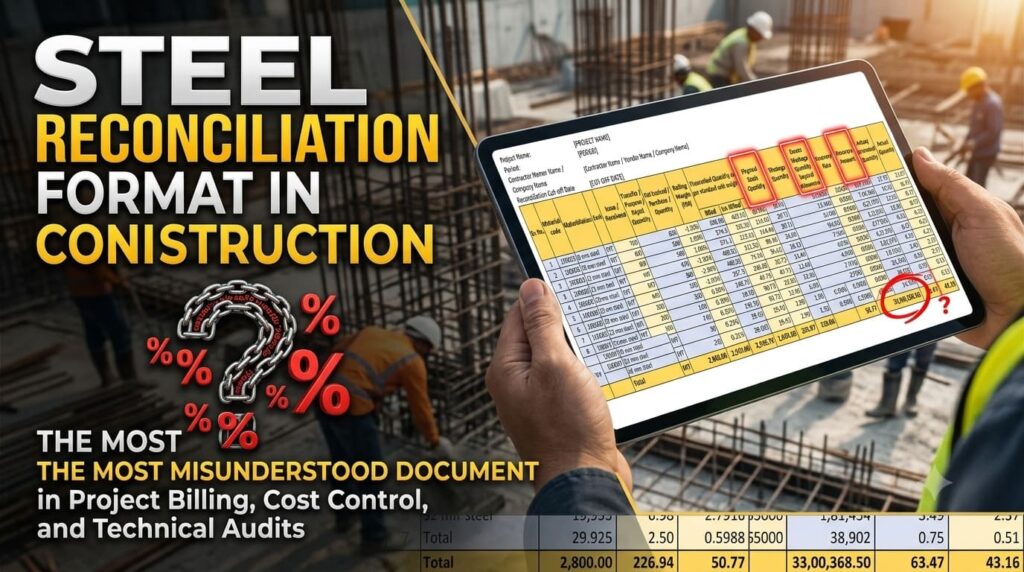
Steel Reconciliation Format in Construction | The Most Misunderstood Document in Project Billing, Cost Control and Technical Audits
Excel Reconciliation Format Download here There are a few documents like Steel Reconciliation Format in…

Complete Guide Work Order Understanding | Beyond The BOQ: How A Billing Engineer Must Read Every Line Of A Work Order (Part 2)
I still remember one particular bill audit many years ago. Work Order Understanding was the…



















[…] like Ready Mix Concrete (RMC), Cement, Structural Steel, and Reinforcement Steel usually come directly from the client, while the […]