


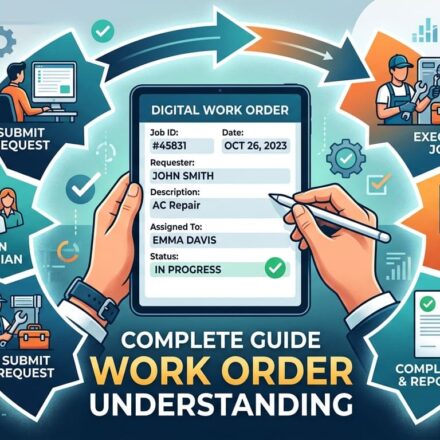
Complete Guide Work Order Understanding | Beyond The BOQ: How A Billing Engineer Must Read Every Line Of A Work Order (Part 2)

I still remember one particular bill audit many years ago. Work Order Understanding was the most critical part of it.
The contractor had already received payment of several crores across multiple RA Bills. Site engineers had verified it. Project managers had signed it. Planning team had no objections. Accounts team released payment. Everything looked perfect.
Then during an audit review, one simple question was raised. “Under which work order is this quantity actually payable?” The room became silent.
Everyone knew the quantity existed on site. Everyone knew the work was executed. Everyone knew measurements were available. But nobody had checked whether the quantity was payable under that specific contractual provision. That single observation resulted in a recovery running into lakhs.
Unfortunately this is not an isolated incident.
During my career in billing, contract management, technical audit, cost control and commercial review, I have repeatedly noticed that most billing professionals spend enormous amounts of time measuring quantities but comparatively little time understanding the document that governs payment.
That document is the Work Order.

Many engineers see a Work Order only as a reference number. Others look only at contract value. Some only open the BOQ pages. Very few read the entire document. And that is where the actual risk begins. Because in civil construction, payment is rarely decided by quantity alone. Payment is decided by conditions. The BOQ tells us what is measured. The Work Order tells us what is payable. These two are not always the same thing.
As project sizes increase, contract conditions become more complex. A small residential project may survive poor contract understanding. A ₹500 Crore township project may not.
A single overlooked clause can affect:
- Bill certification
- Budget monitoring
- Cost control
- Cash flow
- Contractor profitability
- Client recoveries
- Final claim settlements
In this article I will discuss what I believe is the most neglected area of construction billing. How to read and understand every line of a Work Order beyond the BOQ. The Biggest Mistake Most Billing Engineers Make
Let me ask a simple question. A contractor receives a Work Order consisting of: 150 BOQ Items, 80 Pages of Conditions, and 25 Pages of Technical Specifications, 15 Pages of Annexures.
- Which page do most engineers open first? – The BOQ.
- Which page do they continue referring to throughout the project? – The BOQ.
- Which pages do they almost never review again? – Everything else.
This habit creates enormous risk. Because many engineers subconsciously assume payment is controlled by the BOQ. But in reality payment is controlled by the Work Order. The BOQ is only one section of the Work Order.

Yet many billing disputes arise because engineers treat the BOQ as the entire contract. I have personally seen situations where:
- Quantity was correct but payment was rejected.
- Rate was correct but payment was rejected.
- Measurement was correct but payment was rejected.
Question is why? – Because a condition somewhere else in the Work Order overruled the BOQ assumption. This is why professional bill certification starts with contract interpretation.
- Not quantity take-off.
- Not abstracting.
- Not Excel working.
- Not RA bill formats.
- Contract interpretation.
Work Order Understanding – Why Every Word in a Work Order Has Financial Value?
Young engineers often think, “It is just legal language.” No.
Every sentence inside a Work Order carries financial value. Sometimes a single word can create a difference of lakhs.
Consider these examples.
Example 1
“Rate includes transportation.” – Simple statement.
Now contractor claims:
- Internal shifting
- Double handling
- Material transfer
Can he claim separately? Maybe not. One sentence already closed the door.
Example 2
“Rate includes all leads and lifts.”
Suddenly, Horizontal transportation, Vertical transportation, Multi-floor shifting may no longer become extra payable items.
Example 3
“No compensation shall be payable on account of site constraints.” Now site becomes congested. Execution becomes difficult. Contractor demands extra payment. & Client rejects.
Now question is why? – Because the clause already anticipated the situation that sentence may represent several lakhs of financial exposure.
Over 12 years of reviewing contracts, I have learned something important. Lawyers read contracts looking for legal protection. Project managers read contracts looking for execution obligations.
& billing engineers must read contracts looking for payment triggers and payment blockers. That mind-set changes everything.
Work Order Understanding – Reading a Work Order like An Auditor
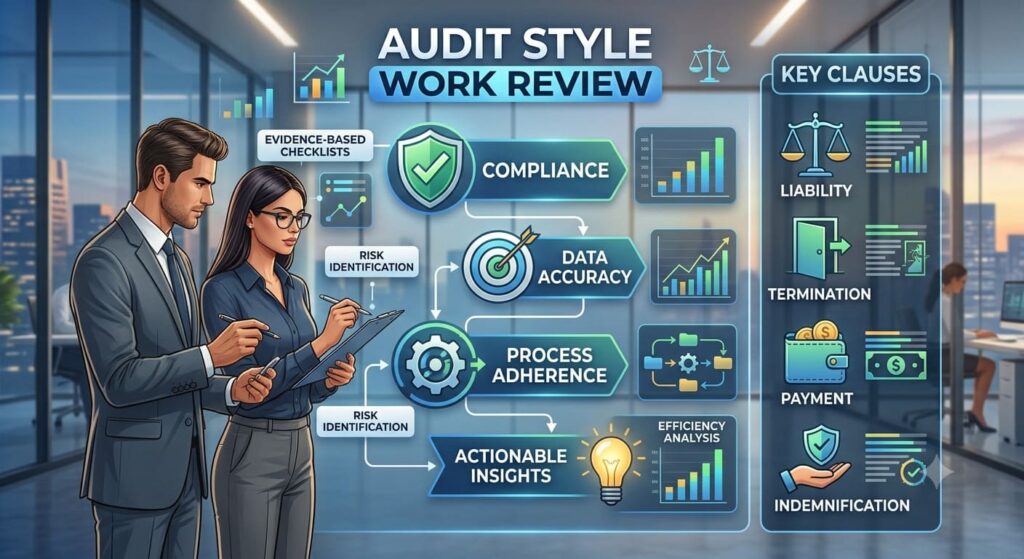
Whenever I receive a new Work Order, I do not start with rates. I start with questions. I literally ask myself:
- What can become payable?
- What cannot become payable?
- What can be recovered?
- What can become disputed?
- What requires approval?
- What can reduce contractor entitlement?
- Which conditions depend on documentation?
- Which conditions depend on time?
- Which conditions depend on quality?
Only after identifying these answers do I begin detailed bill reviews. This habit has saved multiple projects from costly mistakes. Because the purpose of reviewing a Work Order is not understanding today’s bill. It is understanding future risks before they occur.
Understanding the Difference between Executed Work and Payable Work
This is perhaps the most important lesson any billing engineer can learn.
Many engineers believe that Work Done = Payment Due.

Unfortunately contracts do not work that way. In construction, there are usually three stages.
- Work Executed.
- Work Verified.
- Work Becomes Contractually Payable.
These are three different milestones.
I have seen contractors execute substantial quantities and still not become eligible for payment because of below listed reason.
- Shop drawings not approved.
- Material reconciliation pending.
- Test reports pending.
- Consultant approval pending.
- Quality observations open.
- Method statement not approved.
The work physically has performed by contractor but it not eligible for contractually payable.
Work Order Understanding – Reading What Is Written, Understanding What Is Not
One lesson I learned very early in my career was that reading a contract and understanding a contract are two completely different things. Most engineers can read a Work Order. Very few can interpret it. And the difference between the two can be worth several lakhs or even crores over the life of a project.
When a new Work Order arrives, everyone is usually interested in the contract value, rate comparison, payment terms, and execution schedule. Hardly anybody is excited about spending hours reading pages of clauses, conditions, notes, exclusions, annexures, and technical specifications.
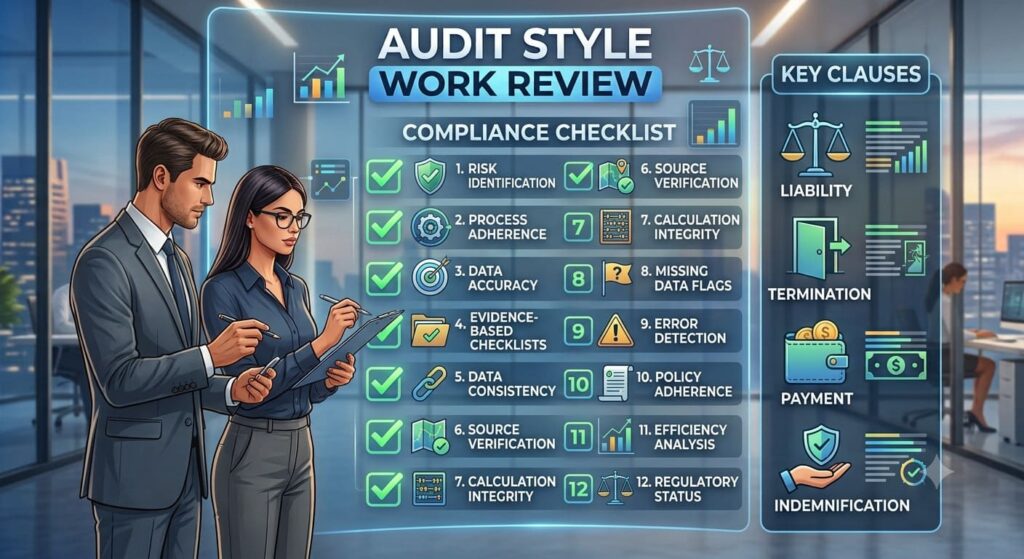
To many people these pages look like boring legal language. But to me, these pages are where the actual money is hidden. Over the years, I have noticed that almost every major billing dispute originates from one common problem.
Two people read the same sentence & both understand it differently. Both believe they are correct and both can produce logic to support their interpretation that is where contract interpretation begins.
The objective is not merely to read the words. The objective is to understand the commercial intention behind those words.
A Work Order should never be read like a storybook. It should be investigated like an auditor examines evidence. In every sentence should trigger questions.
- What does this clause allow?
- What does it restrict?
- What risk does it transfer?
- Who bears the cost?
- Under what conditions does payment become due?
- What happens if those conditions are not fulfilled?
These questions transform contract reading into contract interpretation and this is where most billing engineers create value.
Work Order Understanding – The Most Dangerous Assumption in Construction Billing
Perhaps the biggest mistake I see repeatedly is this, “If the work is executed, payment should be made.” This sounds logical but contracts are not governed by logic alone.
They are governed by agreed conditions. I have seen contractors execute work worth lakhs and still struggle to receive payment not because the quantity was wrong, not because the rate was disputed, not because the work was rejected.
The payment got stuck because a clause somewhere in the contract created a condition that had not been satisfied. To a young engineer this often feels unfair, the contractor has completed the work. Why should payment be withheld?
The answer is simple – Because execution alone was never the contractual requirement. The contract demanded additional compliance. The contractor agreed to those terms while accepting the Work Order.
Therefore, a billing engineer must train his mind to stop looking at physical work only. Instead, he should always ask:
“Has the contractor fulfilled every contractual requirement attached to this payment?” That single question changes the entire approach to bill certification.
Understanding the Hierarchy of Documents
One of the most overlooked areas of contract interpretation is document hierarchy. A contract is rarely a single document. A typical construction contract may contain:
- Letter of Intent
- Work Order
- BOQ
- Special Conditions
- General Conditions
- Technical Specifications
- Approved Drawings
- Tender Clarifications
- Subsequent Amendments
- Change Orders
Now imagine a situation. The BOQ says one thing. The specification says something else. The drawing indicates a third requirement.
Which document should be followed?
Many billing engineers immediately choose the document that favours their billing position. Unfortunately, contracts do not work this way. Most Work Orders define an order of precedence.
This establishes which document will override another in case of conflict. I remember a project where the contractor was claiming additional payment based on a BOQ description. But when we examined the technical specifications, the activity was already included within the item scope.
The contractor’s argument was based on a single BOQ line. The audit observation was based on the hierarchy of contract documents & the claim was ultimately rejected.
The quantity had no issue. But the interpretation did. This experience taught me something important. Whenever two contract documents appear contradictory, never assume. Find the hierarchy clause. The answer is often already written there.
Work Order Understanding – Reading between the Lines
Contract interpretation is not only about what is written. It is equally about what is implied.
For example, consider the following statement, ‘the contractor shall make all necessary arrangements required for execution of the work.” At first glance it appears harmless. Many engineers simply move to the next page but what is hidden inside this sentence?
Potentially:
- Temporary storage
- Water arrangements
- Safety barricading
- Labour accommodation
- Site lighting
- Internal transportation
- Material handling
None of these may be explicitly listed. Yet they may become the contractor’s responsibility. This is why professional contract review requires reading beyond the literal words. Every sentence should be challenged if this clause is enforced tomorrow, what costs will arise? Who will bear them? Can they be claimed separately? Or have they already been included within contract rates?
This thought process prevents future disputes.
Work Order Understanding – Why Auditors Read Contracts Differently
One interesting observation from my career is that auditors read contracts differently from project teams. The site team usually looks for execution. The planning team focuses on timelines. Procurement focuses on sourcing. Accounts focus on documentation. Auditors focus on exposure.

Whenever I review a Work Order, I immediately search for three things:
- Payment Triggers
- Conditions that make payment possible.
- Payment Blockers
- Conditions that can stop payment.
- Recovery Rights
- Conditions that allow money to be deducted later.
Everything else becomes secondary. This approach has repeatedly helped identify risks that were invisible during routine reviews.
A clause that appears insignificant today can become a major recovery observation after three years. By then it is usually too late.
Therefore contract interpretation should always be performed before the first RA Bill is certified, not after the dispute begins.
Work Order Understanding – The Cost of One Wrong Interpretation
Many people underestimate the impact of a small misunderstanding. Let me share a common example.
Contract clause, “Rates are inclusive of all leads, lifts and handling charges.”
The contractor later raises claims for:
- Multiple shifting.
- Tower crane handling
- Internal transportation
- Vertical movement
The claim value grows month after month. Eventually it reaches several lakhs. The dispute escalates & meetings are arranged.
Management gets involved, Emails multiply, and everyone starts debating. Yet the answer was available from the day the contract was issued.
The interpretation was wrong. This happens more often than most people realize. A mistaken interpretation in Month 1 becomes a commercial dispute in Month 18 & that is why experienced billing engineers invest significant time understanding a contract before the work begins.
Work Order Understanding – Why Experience Changes the Way You Read Contracts
When I was younger, I used to read Work Orders from beginning to end. Today, I still read them from beginning to end. The difference is that now I know where the dangers are usually hidden.
I automatically look for –
- Scope exclusions
- Recovery clauses
- Included activities
- Measurement conditions
- Approval requirements
- Documentation dependencies
- Time-linked conditions
- Liability clauses
- Material reconciliation obligations
- Variation approval processes
Years of audits teach you that these clauses generate most disputes. The wording may change from company to company. The risks remain remarkably similar. This is why contract interpretation is not a legal skill alone.
- It is a commercial skill.
- It is a billing skill.
- It is a risk management skill.
- And for large projects, it becomes a survival skill.
My Personal Approach before Certifying Any New Work Order
Before I allow a new Work Order to enter the billing cycle, I mentally ask myself a few questions.
If I cannot answer them clearly, I continue reviewing.
- What exactly is payable?
- What is specifically not payable?
- What documentation is mandatory?
- What recoveries can be imposed?
In this way I approach the billing process or bill reviewing process.
Read more in Part 3

No Inspection, No Measurement, No Payment: The Quality Papers Behind Every RA Bill in a Mumbai Project
A site engineer’s practical guide to the documents that make an RA bill stand up…

M30 on the Drawing, Honeycomb on the Column: What Really Decides Concrete Quality
A civil engineer’s practical guide to concrete, built around IS Code, can answer this simple…

Mastering Reinforcement Steel Reconciliation: A Technical Blueprint for Civil Engineers & Project Managers
1. Executive Summary & Introduction In structural concrete construction, reinforcement steel Reconciliation represents between 20%…
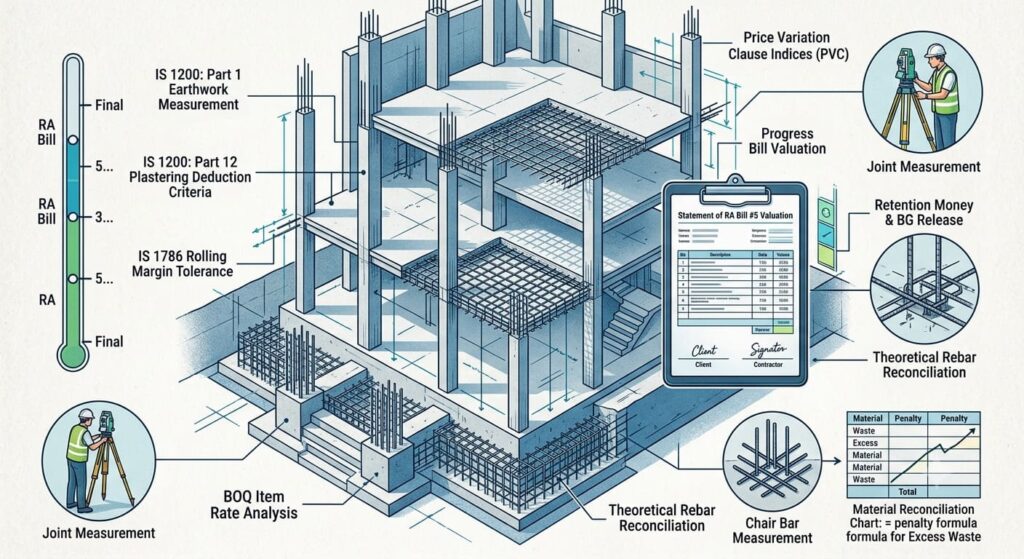
20 Essential Technical Interview Questions (Part – 3) | Master Class in Construction Project Billing & Quantity Surveying
I’ve sat on both sides of the table for these Technical interviews as the guy…
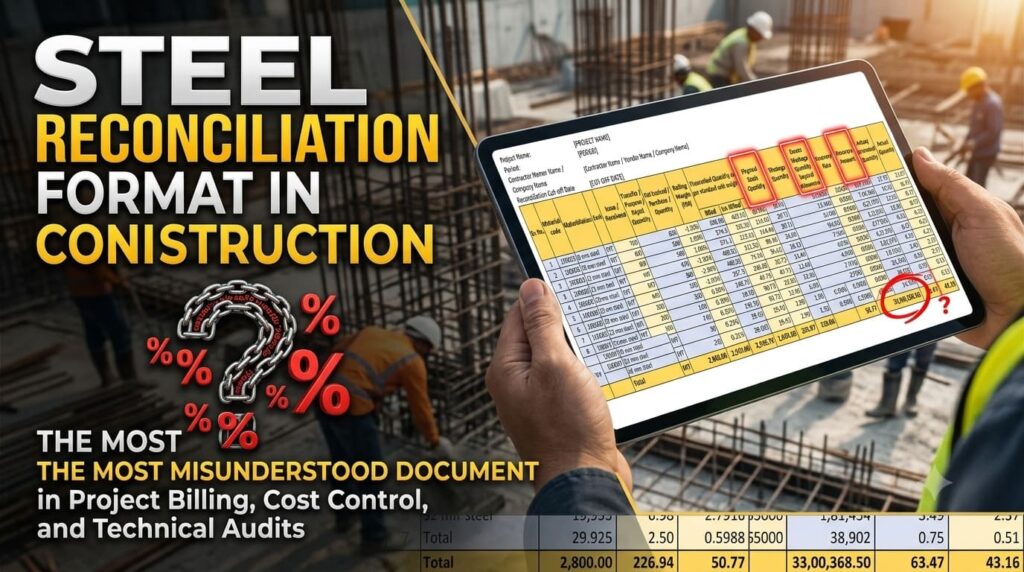
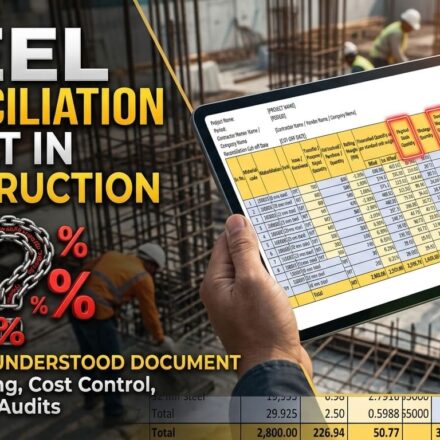
Steel Reconciliation Format in Construction | The Most Misunderstood Document in Project Billing, Cost Control and Technical Audits
Excel Reconciliation Format Download here There are a few documents like Steel Reconciliation Format in…

Complete Guide Work Order Understanding | Beyond The BOQ: How A Billing Engineer Must Read Every Line Of A Work Order (Part 2)
I still remember one particular bill audit many years ago. Work Order Understanding was the…

















[…] Read more in Part – 2 […]