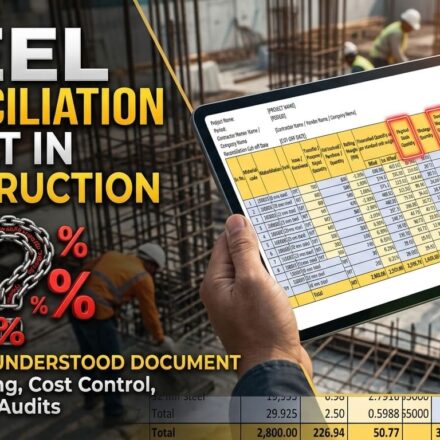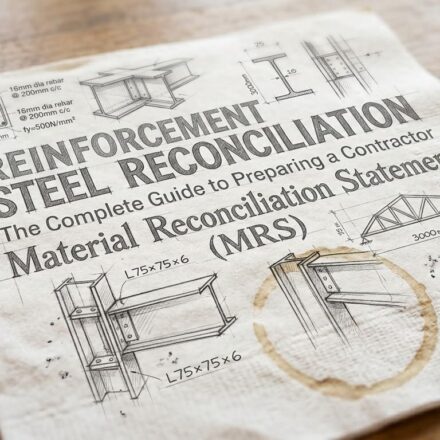
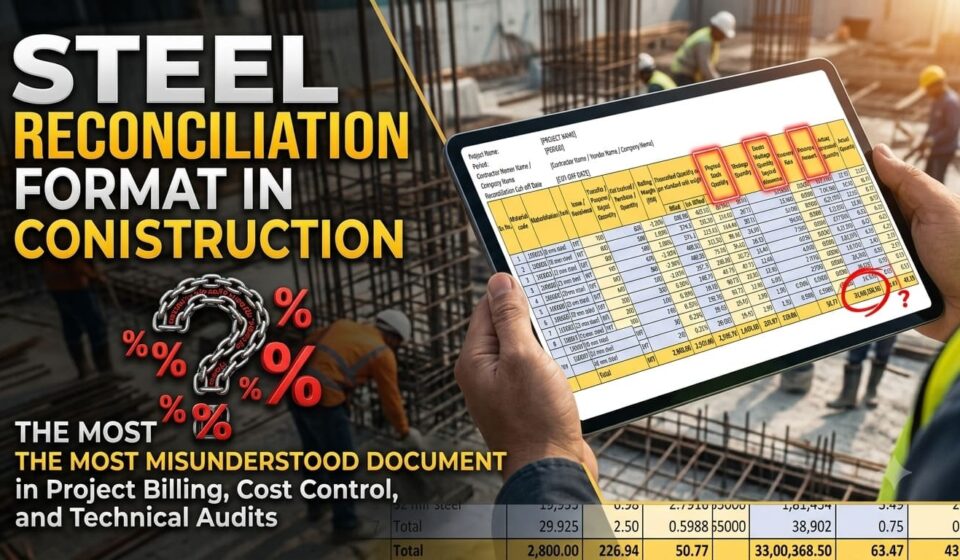
Steel Reconciliation Format in Construction | The Most Misunderstood Document in Project Billing, Cost Control and Technical Audits

There are a few documents like Steel Reconciliation Format in construction that people fear not because they are complicated. Not because they are difficult to prepare but because they expose the truth.
A Steel Reconciliation Statement is one of them. I have attended countless billing meetings where contractors confidently submitted Running Account Bills worth crores, the quantities were certified, and measurements were available, abstract sheets were ready, Consumption statements looked acceptable, everyone in the meeting was relaxed, then someone asked a simple question.
“Can we see the steel reconciliation up to this bill period?”
The atmosphere immediately changed, Phones started ringing, and Store teams were called, Site engineers opened old registers, Billing engineers searched previous RA Bills, and suddenly a document that nobody had considered important became the center of the discussion.
Over my years in construction billing, cost control, contract management, technical audits and commercial reviews, I have repeatedly noticed a strange pattern. Most engineers spend enormous time measuring concrete, checking shuttering, certifying quantities, but very few invest the same effort in understanding steel reconciliation.
Ironically, steel is often one of the most valuable materials in the project and whenever there is a cost overrun, inventory mismatch, commercial dispute, audit observation, contractor recovery, stock shortage or unexplained financial loss, steel reconciliation usually appears somewhere in the story.
This article is not simply about preparing a reconciliation statement. Hundreds of websites can teach that but this article is about understanding why steel reconciliation exists in the first place because once you understand the reason behind reconciliation, preparing the format becomes easy.

The Day I Understood Why Reconciliation Is More Important Than Measurement
Early in my career, I used to believe measurements were everything. If the measurements were correct, the bill should be correct & it seemed logical. After all, construction billing is based on measurement, then one audit changed my understanding completely. A large contractor had executed structural works, Measurements matched drawings, bar bending schedules were available, and Bills were certified & Payments were released. Everything looked perfect.
Yet the audit team identified substantial excess steel consumption. At first nobody believed it. Everyone questioned
“How could steel be excess when quantities were measured correctly?”
The answer became clear after a detailed investigation. The measurements were correct, billing was correct, but the material control was not and that distinction changed the way I looked at construction projects forever. From that day, I stopped looking at steel merely as reinforcement. I started looking at steel as money because every kilogram of steel purchased becomes a financial liability until somebody proves where it has gone & that proof is called steel reconciliation.
Why Steel Is Different From Every Other Material?
A question I often ask young engineers is this. Imagine a project consumes:
- Cement worth ₹3 Crore
- Concrete worth ₹10 Crore
- Steel worth ₹15 Crore
Which material will create the highest commercial risk? Most people immediately answer steel and they are correct.
The reason is simple, steel remains visible, measurable, and recoverable. If concrete is poured yesterday, its individual ingredients become difficult to verify later but steel leaves traces everywhere.
- In stock yards.
- In cutting yards.
- In fabrication areas.
- In scrap yards.
- In Bar Bending Schedules.
- In reconciliation statements.
- In contractor recoveries.
Because of this traceability, steel has always attracted special attention from clients, auditors and commercial teams.
The larger the project becomes, the greater this attention becomes, a small residential building may tolerate weak material controls. A township project consuming several thousand metric tonnes cannot, without reconciliation, nobody can confidently answer a simple question.
“Where exactly did the steel go?”
What Is Steel Reconciliation Actually Trying To Prove?
This may sound surprising. Steel reconciliation is not trying to prove consumption. Steel reconciliation is trying to prove accountability. There is a huge difference.
Consumption merely tells us that steel has been used, accountability tells us that every kilogram received has been explained & that explanation usually falls into a few categories.
The steel was:
- Consumed in permanent works
- Available as physical stock
- Transferred elsewhere
- Returned
- Disposed
- Converted into scrap
- Lost within allowable wastage
If the entire quantity can be logically distributed into these buckets, reconciliation becomes successful. If it cannot, somebody needs to answer questions and those questions eventually become commercial liabilities.
Why Most Steel Reconciliation Statements Fail During Audits?
One mistake I repeatedly encounter is that engineers prepare reconciliation only because someone asked for it. The project reaches billing stage, management requests reconciliation, Audit requests reconciliation, Client requests reconciliation, then engineers scramble to compile data.
That is where problems begin.

A reconciliation prepared at the end of the process is merely a reporting document, a reconciliation maintained throughout the project becomes a control document.
There is a difference, one reports mistakes, the other prevents them.
The strongest reconciliation systems are built from the first steel receipt itself, every inward quantity, every transfer, every return, and every scrap generation, every theoretical consumption, every stock verification. Everything gets recorded from the beginning & by the time the final bill arrives, the reconciliation already tells the story.
No surprises remain.
The Biggest Lie in Construction Material Control
Over the years I have heard one statement hundreds of times.
“Sir, stock will be adjusted in the next reconciliation.”
Whenever I hear this statement, alarms immediately start ringing in my mind because stock does not adjust itself, numbers do not correct themselves, and material does not disappear without reason. A mismatch is usually telling us something.
- Perhaps the BBS is incorrect.
- Perhaps material receipts were missed.
- Perhaps theoretical consumption is wrong.
- Perhaps scrap records are incomplete.
- Perhaps physical stock verification is inaccurate.
- Or perhaps material losses are occurring.
Reconciliation is not a mathematical exercise, it is an investigation, whenever numbers refuse to balance, the objective should not be forcing them to balance. The objective should be understanding why they do not balance.
Understanding the Real Strength of Diameter-Wise Reconciliation
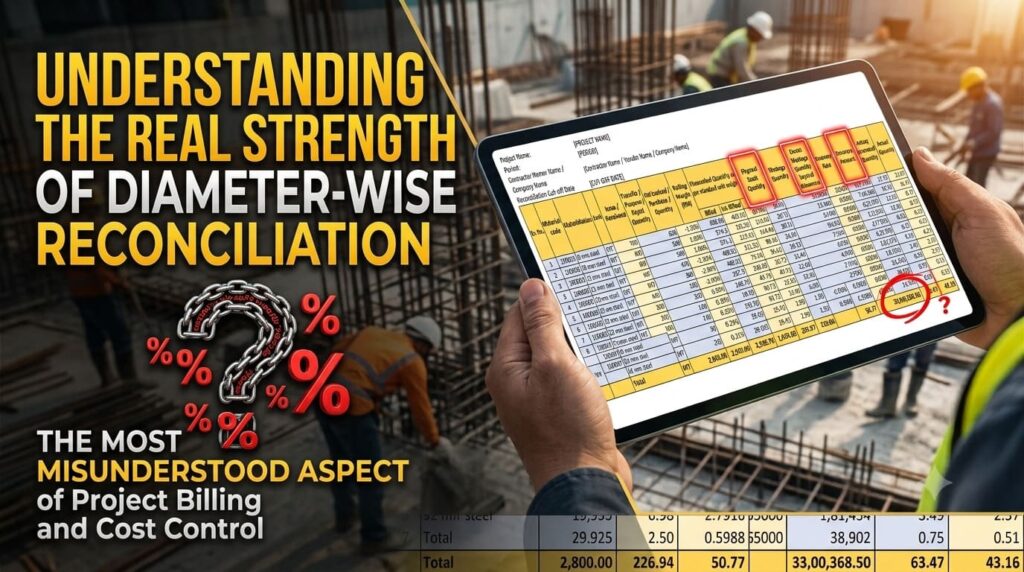
One of the reasons I designed reconciliation reviews around diameter-wise analysis is because cumulative figures can hide serious issues.
Let’s imagine:
- Total Steel Received = 2,500 MT
- Total Steel Consumed = 2,450 MT
- Balance = 50 MT
At first glance everything appears normal.
Now separate the data:
- 8 mm = Excess Consumption
- 10 mm = Shortage
- 16 mm = Surplus
- 20 mm = Stock Difference
- 25 mm = Wrong Issue Entry
Suddenly the picture changes.
The overall total still balances, but individual diameters reveal multiple problems. In my experience, audits rarely fail because of total quantities. They fail because hidden discrepancies remain buried inside totals that is why diameter-wise reconciliation is not optional.
It is essential.
Your template follows this philosophy by monitoring each steel size separately rather than tracking only cumulative steel quantities.
The Relationship between Theory and Reality
One of the most fascinating aspects of steel reconciliation is the battle between theoretical consumption and actual consumption.
Theoretical consumption lives in drawings & actual consumption lives on site. And these two worlds rarely match perfectly.
- Drawings assume ideal conditions & projects do not.
- Drawings assume perfect cutting & projects do not.
- Drawings assume optimization & projects do not.
- Drawings assume zero mistakes & projects certainly do not.
This is why reconciliation becomes important because without reconciliation, organizations have no mechanism to compare theory against reality. The moment theoretical and actual values begin diverging significantly, management receives an early warning signal & that warning often prevents much bigger losses later.
Why Wastage Should Never Be Viewed As a Bad Word
Young engineers sometimes become nervous whenever wastage appears in reconciliation. They immediately assume something is wrong but experienced engineers know differently.
A project with zero steel wastage usually indicates one of two things.
- Either the reconciliation is wrong.
- Or the reporting is incomplete.
Steel fabrication naturally generates losses, Cut pieces, Short lengths, End cuts, Hook adjustments, Crank formations, Starter bars & Fabrication corrections, All of these generate wastage. Therefore the question should never be:
“Why is there wastage?” The correct question is: “Why is wastage exceeding allowable limits?”

Those are two very different conversations where Most Contractors Lose Money. One lesson I have repeatedly observed is that contractors often focus on project execution while neglecting material efficiency.
Initially it appears harmless, a few kilograms extra here, a few kilograms extra there, Minor cutting losses, Additional laps, Small fabrication mistakes. Everything seems insignificant individually but construction projects are not governed by individual numbers.
They are governed by cumulative numbers. Hundreds of small losses eventually become tonnes and tonnes eventually become lakhs. By the time management notices the issue, recovery discussions have already begun that is why strong reconciliation systems should not be treated only as client requirements.
They should be treated as business survival tools.
Why Auditors Love Steel Reconciliation?
Whenever I conduct an audit, reconciliation often becomes one of the first documents I request.
The reason is simple, steel reconciliation connects multiple departments into a single story.
- Store records.
- Purchase records.
- BBS records.
- Billing records.
- Stock registers.
- Scrap records.
- Recovery calculations.
- Physical verification sheets.
Everything eventually meets inside one statement that makes reconciliation extremely powerful.
In many cases, I have identified problems not because the stock percentage looked abnormal, but because different records were telling different versions of the same story.
A properly maintained reconciliation eliminates these contradictions.
The Philosophy behind My Reconciliation Format?
After reviewing numerous project formats over the years, I created that most reconciliation sheets focus only on basic stock calculations that approach is not enough.
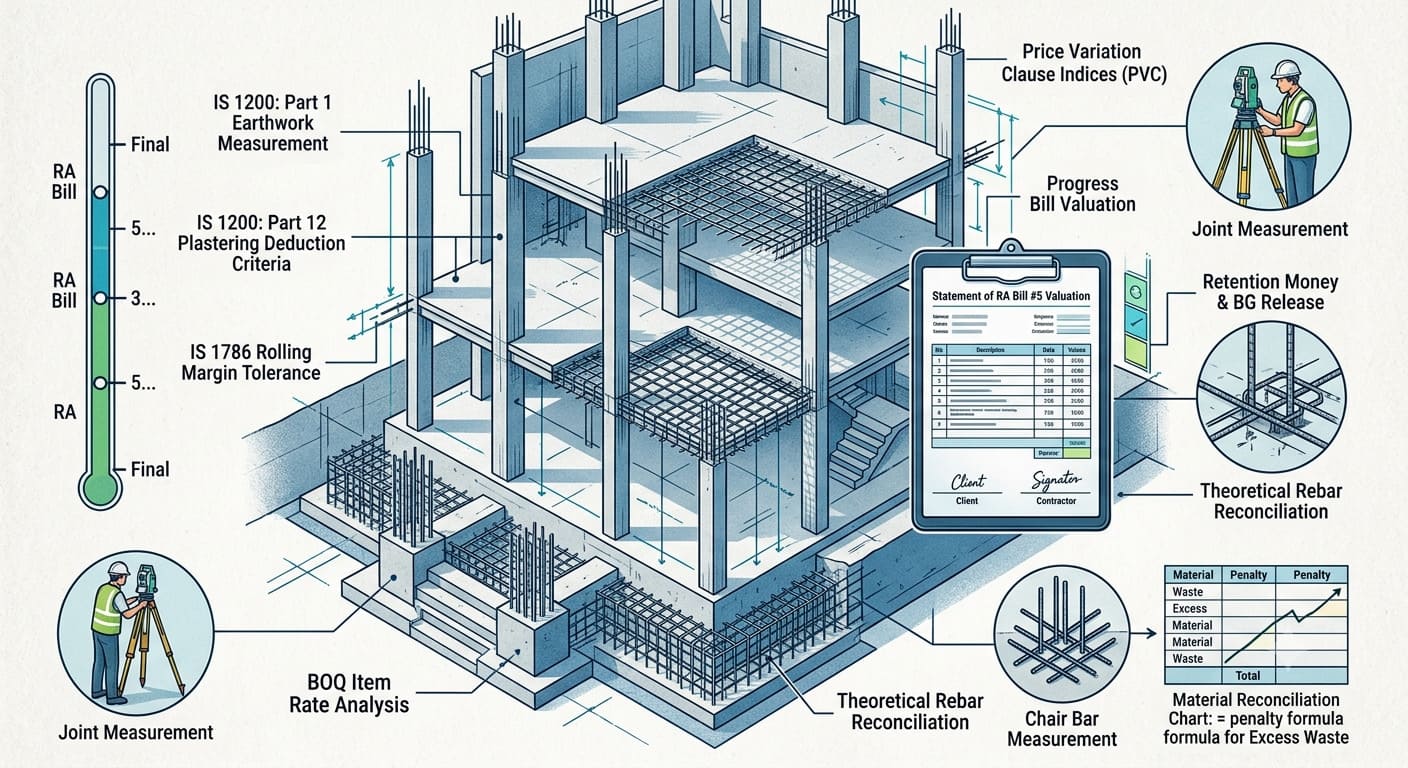
The objective should be risk control & that is why the template includes control points such as:
- Material Code.
- Receipt Quantities
- Transfer Quantities
- Rolling Margin
- Net Available Quantity
- Theoretical Consumption
- Physical Stock
- Allowable Wastage
- Excess Consumption
- Recovery Rate
- Recovery Amount
- Maximum Scrap Generation
- Actual Scrap Quantity
- Billed Quantity
- Unbilled Quantity
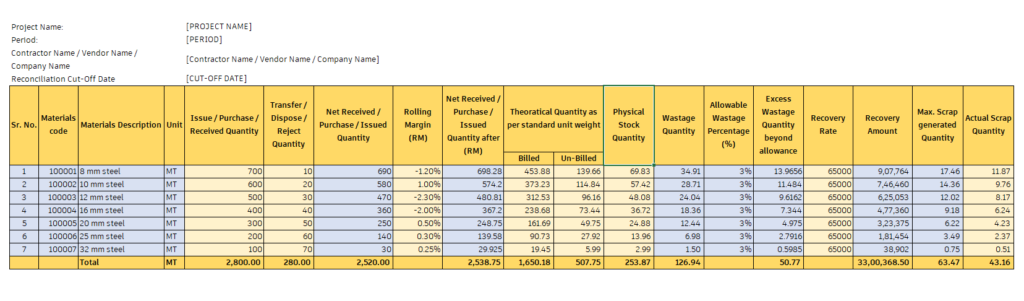
These controls transform reconciliation from a reporting sheet into a commercial control tool.
Final Thoughts
After spending years in billing, audits, contract administration and project commercial management, I have come to a simple conclusion.
“Most project teams believe steel reconciliation is prepared for auditors.”

No Inspection, No Measurement, No Payment: The Quality Papers Behind Every RA Bill in a Mumbai Project

M30 on the Drawing, Honeycomb on the Column: What Really Decides Concrete Quality



Mastering Reinforcement Steel Reconciliation: A Technical Blueprint for Civil Engineers & Project Managers
20 Essential Technical Interview Questions (Part – 3) | Master Class in Construction Project Billing & Quantity Surveying