
Why this topic matters in real projects?
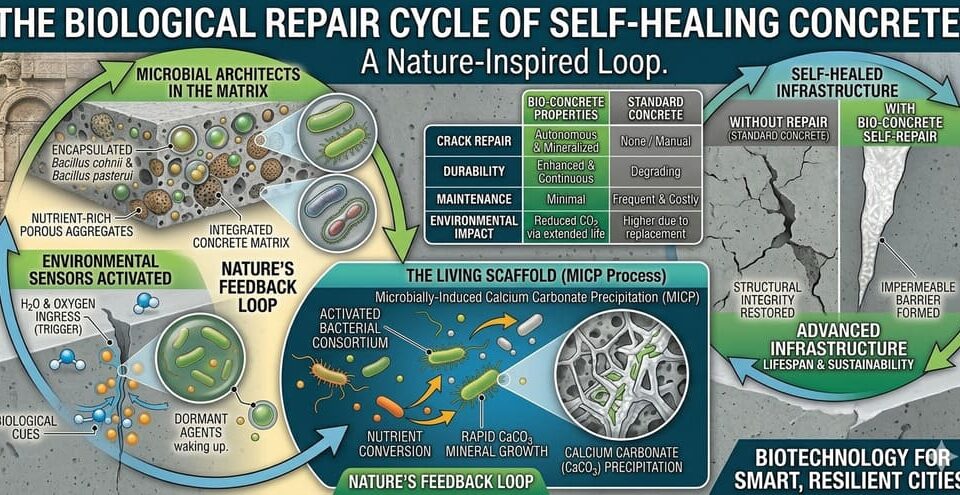
In most civil projects, concrete doesn’t fail suddenly—it fails slowly. The slow failure starts with something that looks small: a crack. A crack can stay cosmetic, or it can become a connected route for water, chlorides, sulfates, and acids. Once that route exists, durability problems accelerate: seepage complaints, corrosion initiation, spalling risk, repeated repairs, and finally long, expensive disputes that hit schedules and bills.
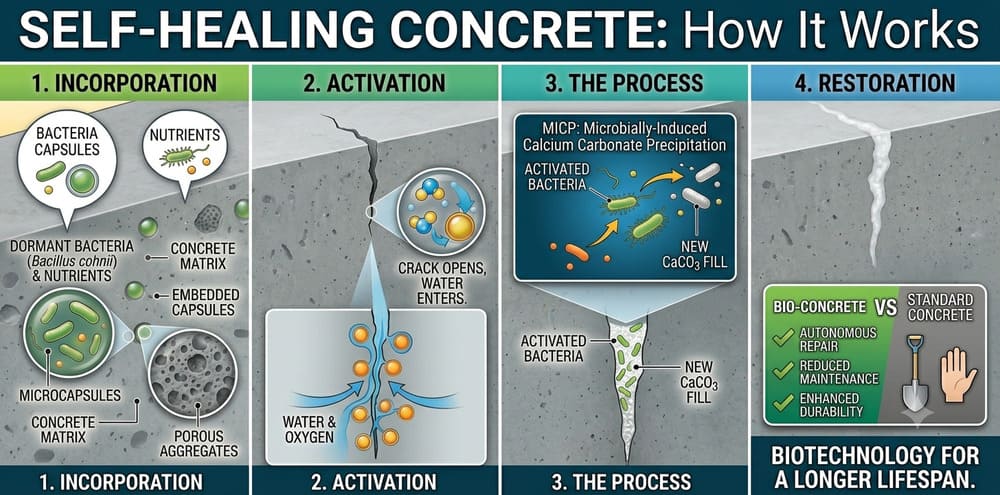
Self‑healing concrete tries to change that story. Instead of treating cracks only after they appear, it tries to seal microcracks automatically so that cracks don’t evolve into long‑term permeability pathways. In the bacterial approach (bio‑concrete), the sealing happens through bacteria‑driven precipitation of calcium carbonate inside cracks. That idea has moved from laboratory proof to broader research, and even to trial narratives for infrastructure. [slideshare.net], [slideshare.net], [greentree.global]
1) Concept, Source, and History
1.1 The concept
Concrete is strong in compression and weak in tension. When temperature changes, shrinkage, restraint, or service loads create tensile stress, concrete cracks. We can manage crack width and distribution, but we can’t realistically guarantee “zero cracking” on most projects.
Self‑healing concrete accepts this reality and introduces a second line of defense: when cracks occur, the material itself contributes to sealing. The goal is not only “crack looks closed,” but “crack no longer behaves like an open pipe for water and ions.” That shift toward performance restoration is highlighted in global self‑healing frameworks. [https://in…s/original], [mdpi.com]
A simple way to understand it is:
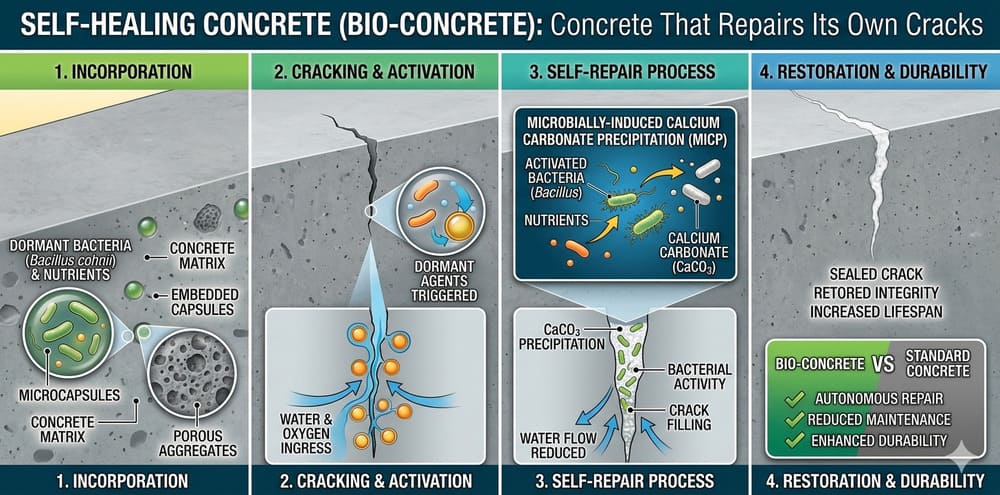
- Normal concrete: crack forms → water enters → corrosion/leakage risk rises → repair required
- Self‑healing concrete: crack forms → internal healing response begins → permeability drops → durability improves → less repair demand
1.2 Where “bio‑concrete” became a defined approach?
Self‑healing concrete exists as a broad idea, but “bio‑concrete” became widely recognized through bacterial self‑healing research linked to TU Delft and Hendrik (Henk) Jonkers. In the documented TU Delft work, a key practical detail is protecting bacteria and nutrients in porous expanded clay particles, so they survive mixing and stay dormant until cracks allow water ingress. [slideshare.net], [slideshare.net]
This is important: the success of bio‑concrete is not just “put bacteria in concrete.” It is “put bacteria in concrete in a way they can survive alkalinity, mixing energy, and long dormancy.”
1.3 How the idea matured into a serious engineering topic?
When I read across technical summaries and publications, the development of self‑healing concrete becomes clearer:
- Self‑healing became a formal cementitious materials research area with international technical groups focusing on definitions and mechanisms. [civilenggs…ogspot.com], [https://in…s/original]
- Biological self‑healing became a structured direction, including early technical writing on the biological approach. [fermiunive…ogspot.com]
- 2010–2011 period includes well‑cited work documenting bacterial crack sealing and permeability improvements using protected carriers. [slideshare.net], [slideshare.net]
- The field expanded into deeper microbiological pathways and performance evaluation, acknowledging that different metabolic routes can drive mineral formation. [devalt.org], [constructioncost.co]
- Recent research includes modelling and data‑driven approaches to predict healing efficiency and optimize parameters, showing the topic is still evolving. [slideshare.net]
2) Why it is attractive, and why it may be the future
2.1 Why it is attractive to engineers
Civil engineers don’t love “fancy materials.” We love materials that reduce risk and reduce rework. Bio‑concrete is attractive because it targets one of the most stubborn long‑term problems: microcracks turning into durability pathways.
The TU Delft bacterial concrete work clearly frames the durability motivation: small cracks can increase permeability, and ingress can cause corrosion and degradation; repairs can be costly or difficult—therefore autonomous healing would be beneficial. [slideshare.net], [slideshare.net]
To put it in simple project language:
- If your basement leaks after monsoon, it becomes a never-ending cycle of injections, patching, and dispute letters.
- If your water tank has microcracks, “liquid tightness” becomes a functional failure, not an aesthetic issue.
- If you’re coastal, cracks become entry points for chlorides and corrosion accelerates.
Bio‑concrete tries to reduce these outcomes by sealing micro‑pathways early.
2.2 Why it is attractive to owners and clients?
Owners care about:
- repeated maintenance and shutdowns
- cost of rectification
- warranty disputes
- long-term service life
Self‑healing aligns with “less repair, longer life.” That is exactly why innovation profiles talk about infrastructure maintenance burden and why durability-focused frameworks highlight service life as the real target. [slideshare.net], [https://in…s/original]
2.3 Why it may be the future?
I do not see bacterial self‑healing concrete replacing all conventional concrete. The future is likely selective adoption where lifecycle benefits justify premium cost:
- underground structures
- water retaining structures
- marine/coastal works
- critical infrastructure where closure costs are huge
Self‑healing frameworks also treat autogenic and autonomic approaches as complementary rather than universal replacements, which supports the idea of selective adoption. [https://in…s/original], [mdpi.com]
3) The core scientific idea (MICP) in practical terms
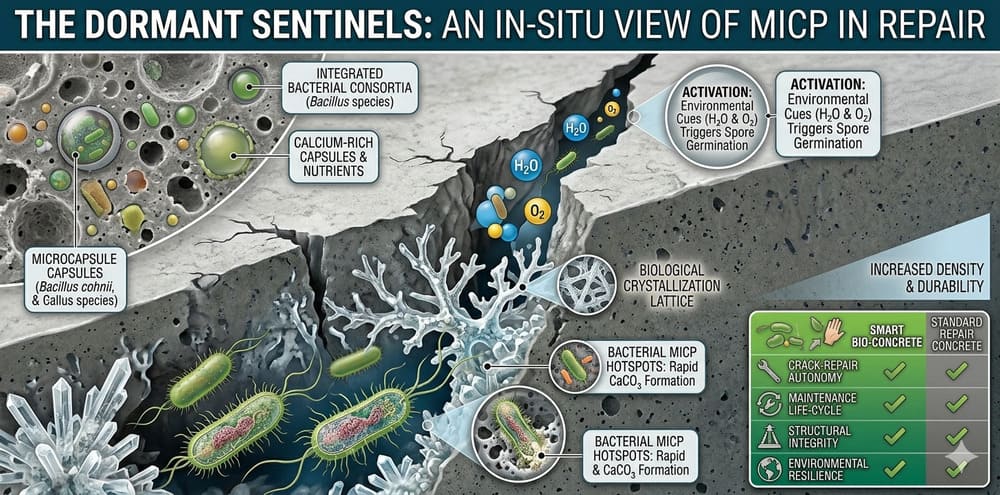
Bacterial self‑healing is often described through Microbially Induced Calcium Carbonate Precipitation (MICP). Reviews explain that microbes can drive calcite formation through different metabolic pathways; the engineering outcome is mineral deposition that blocks pores and cracks. [devalt.org], [constructioncost.co]
The final mineral precipitation step that matters for crack sealing is:
Ca2++CO32−→CaCO3↓
That CaCO₃ is limestone/calcite. When it forms inside a crack, it acts like a natural filler.
In the TU Delft approach, the healing agent is not just “bacteria in water.” It is bacteria plus organic compounds (nutrient sources) packaged in protective carriers, enabling crack sealing and improved permeability behavior. [slideshare.net], [slideshare.net]
4) The execution process (how it is actually done in real construction)
This section is written like a method statement discussion, because execution is where new technologies fail.
Step 1 – Define what “success” means
Before ordering any system, define:
- What crack width range do we want to seal (hairline / microcracks)?
- What performance target matters most: watertightness, permeability reduction, durability index?
- What exposure condition will the structure face?
Without this, billing and acceptance will become disputes later.
Step 2 – Decide the delivery/protection method
Bacteria must survive:
- high pH environment
- mixing energy
- long dormancy
The TU Delft documented method uses porous expanded clay particles as carriers for bacteria and nutrients. This is a proven concept for survivability and controlled activation when water enters. [slideshare.net], [slideshare.net]
Other research also explores encapsulation methods; the general theme is always protection + controlled release/activation. [engisphere.com], [devalt.org]
Step 3 – Mix design integration (don’t treat it as “one more admixture”)
Even if you add a healing system, the base concrete must meet grade and durability:
- choose w/c ratio to meet durability exposure
- ensure workability for placing and compaction
- maintain strength requirements
In India, this naturally anchors to IS 456 and IS 10262 for concrete quality and proportioning, and IS 9103 if the product is treated as an admixture-type system requiring comparative performance evaluation. [mdpi.com], [tudelft.nl], [youtube.com]
Step 4 – Mandatory trials (non-negotiable)
Trial mixes should confirm:
- slump/workability for your placing method (pump/tremie/manual)
- segregation resistance (especially if carriers behave like lightweight particles)
- early strength and 28-day strength
- any changes in setting time
Step 5 – Placement and curing discipline (bio‑concrete is not a cure for poor concrete)
A hard truth: self‑healing won’t fix honeycombing, cold joints, or poor compaction. Those defects are larger than typical healing capacity. Curing remains essential because curing reduces early-age cracking and improves matrix density.
Step 6 – Verification plan
Because healing evaluation is not universal, define:
- which tests prove performance
- when to test
- acceptance thresholds
Technical groups emphasize the importance of performance-based evaluation and the gap in universal methods across systems. If you don’t define this, even a good system can end in disputes. [https://in…s/original], [mdpi.com]
5) Mathematical representations
(A) Concrete mix design target mean strength (India practice)
Any concrete—bio‑concrete included—must meet grade acceptance. Mix design typically targets mean strength:
ftarget=fck+1.65×S
IS 10262 is the core Indian guideline for mix proportioning and references IS 456 requirements as applicable. [tudelft.nl], [biorender.com], [mdpi.com]
(B) Healing efficiency as a measurable KPI
Research commonly expresses healing efficiency using permeability or absorption reduction. A generic form:
ηh=PcrackedPcracked−Phealed×100%
This kind of measurable KPI is important in contracts because it helps define acceptance beyond visual inspection. Some recent reviews and studies present healing efficiency and testing approaches across methods. [engisphere.com], [youtube.com]
6) Research papers and references I would rely on
If I were writing a technical note or client justification, these would be strong references:
- TU Delft / Heron / repository record describing bacteria-based self‑healing concrete with carriers and permeability observations. [slideshare.net], [slideshare.net]
- A microbiology-focused review explaining MICP processes and how they apply to bioconcrete. [devalt.org]
- Experimental work showing durability/strength trends in bacterial mortar/concrete systems. [constructioncost.co]
- Recent modelling/ML approach to bacterial self‑healing performance, showing ongoing research maturity. [slideshare.net]
- RILEM summary clarifying autogenic vs autonomic healing and performance recovery focus. [https://in…s/original], [civilenggs…ogspot.com]
7) IS standards: is there any IS code specifically for bio‑concrete?
In mainstream Indian practice, there is no widely used BIS standard titled specifically “bacterial self‑healing concrete.” So we use:
- IS 456:2000 for durability and concrete practice baseline [mdpi.com]
- IS 10262:2019 for mix proportioning guidelines [biorender.com], [tudelft.nl]
- IS 9103:1999 for admixture specification/evaluation philosophy when the healing system behaves like an admixture package [youtube.com], [mdpi.com]
Because a dedicated IS doesn’t exist for bio‑concrete performance, project specifications must define healing performance and test protocols.
8) Use, benefits, project‑based explanation, limitations & negative impacts
8.1 Where bio‑concrete is most useful?
Bio‑concrete makes the most sense where:
- cracks are likely
- water exposure is constant or periodic
- repairs are expensive/difficult
- watertightness is functional
Examples:
- basements and underground retaining walls
- water tanks, sumps, STP basins
- coastal structures
- tunnels and critical infrastructure
TU Delft also expects suitability in wet environments where reinforcement corrosion tends to threaten durability. [slideshare.net], [slideshare.net]
8.2 Benefits
Benefit 1 — Reduced permeability pathways
The core benefit is crack sealing and permeability reduction. TU Delft’s work directly connects crack healing to improved sealing compared to control concrete. [slideshare.net], [slideshare.net]
Benefit 2 — Durability improvement chain
When cracks seal, ingress reduces. Lower ingress means lower corrosion initiation risk and better durability. This logic aligns with MICP/bioconcrete discussions in reviews. [devalt.org], [https://in…s/original]
Benefit 3 — Reduced repair cycles and lower lifecycle cost
The major value proposition is fewer repair interventions. This is emphasized in both durability frameworks and innovation narratives about infrastructure maintenance burden. [https://in…s/original], [slideshare.net]
Benefit 4 — Sustainability (indirect but real)
Fewer repairs and longer life reduce repeated material use and repair-related emissions over the lifecycle. [https://in…s/original], [slideshare.net]
8.3 Project‑based explanation
Scenario: Underground basement in a high water-table city.
Typical chain in conventional construction:
- hairline cracks appear (shrinkage/restraint)
- seepage marks appear after monsoon
- waterproofing blames civil; civil blames waterproofing
- injection grouting starts
- then rework, retesting, and payment retention
Bio‑concrete aims to reduce this chain by sealing micro‑pathways when water enters cracks, improving watertightness behavior at the material level. This aligns with the bacterial crack-sealing mechanism described in TU Delft work. [slideshare.net], [slideshare.net]
Important caution: bio‑concrete is not a substitute for movement joints, crack width control design, or proper curing. It is a durability enhancement tool.
8.4 Limitations
- Crack width limitation: bacterial systems are typically strongest for microcracks/sub‑mm cracks, not major structural cracks. TU Delft reports efficient sealing for small crack widths in controlled studies. [slideshare.net], [slideshare.net]
- Moisture dependency: healing activation requires water ingress; in very dry environments healing may be limited.
- Execution sensitivity: poor compaction, honeycombing, cold joints create defects larger than healing capacity.
- Evaluation complexity: there is no universal test; RILEM discussions emphasize evaluation differences and the need for clear performance assessment. [https://in…s/original], [mdpi.com]
8.5 Negative impacts or concerns
Some MICP pathways commonly discussed (such as ureolysis) can produce unwanted byproducts (ammonia concerns), which is why non‑ureolytic pathways are studied as alternatives. This is a technical selection issue: not every bacterial pathway is equally desirable for every project environment. [devalt.org], [youtube.com]
9) Cost‑based analysis: costlier or cheaper?
9.1 Upfront cost: usually higher
Most market pricing summaries for self‑healing concrete show an upfront premium compared to standard concrete—driven by healing agents, carriers, trials, and testing. Some estimates cite premiums in the range of roughly 10–40% depending on system and context. [yumpu.com], [pmc.ncbi.nlm.nih.gov], [mdpi.com]
The EPO innovation profile also discusses cost challenges and notes nutrient cost as a major driver in early systems. [slideshare.net]
9.2 Lifecycle cost: where the real business case lives
The correct comparison is not only ₹/m³. It is:
Initial premium vs (expected repair cost + disruption cost + claim risk + rework cycles).
If a structure is repair-prone (underground, watertight assets, coastal), lifecycle savings can justify the premium.
9.3 A sample lifecycle calculation
Let’s take an example in billing language (illustrative—rates vary by project):
- Basement concrete quantity: 1,000 m³
- Conventional concrete cost: assume ₹7,000/m³ → ₹70,00,000
- Bio‑concrete premium: assume 25% → additional ₹1,750/m³ → ₹17,50,000
Now ask: Over 5–10 years, will injection grouting, waterproofing rework, and repeated rectification exceed ₹17.5 lakh? In many high water-table basements, yes, it can. That is where bio‑concrete becomes economically sensible—not because it’s cheaper upfront, but because it can reduce recurring repair spending.
10) Billing engineer & auditor point of view
This is where self‑healing concrete projects commonly fail—not in science, but in contracts and measurement.
10.1 First principle: never pay for a “concept”
Billing should pay for:
- defined scope
- measurable documentation
- verified compliance
If BOQ says “self‑healing concrete” but does not define:
- performance target (watertightness/permeability)
- test method and timeline
- dosage requirements
- responsibility and warranty
…then the premium becomes a dispute. This is exactly why performance evaluation clarity matters; self‑healing frameworks recognize evaluation is not universal. [https://in…s/original], [mdpi.com]
10.2 BOQ structuring
Best structure (cleanest for audit):
- RCC concrete paid as normal item (m³)
- Self‑healing system paid as a separate premium item (₹/m³)
This makes:
- reconciliation easy
- variation easy
- claims easier to control
10.3 What documents I require before certifying premium payments
Pre‑approval:
- mix design basis (IS 10262 + durability per IS 456) [tudelft.nl], [mdpi.com]
- product TDS and method statement
- trial mix report and QC plan
During execution:
- batch tickets showing dosage per m³
- cube/slump registers
- storage and shelf-life evidence for the healing system
Post execution (performance):
- defined watertightness/permeability test reports (if specified)
- crack mapping logs (if specified)
10.4 Reconciliation logic
A simple reconciliation that catches most false claims:
Expected consumption = Executed concrete volume × Dosage (kg/m³)
Match expected consumption with:
- store issue records
- vendor invoices
- balance stock
If the reconciliation fails, premium claims become weak immediately.
10.5 Contract clauses I recommend
- Definition clause: what “self‑healing” means in measurable terms
- Submittal clause: trials + verification plan before execution
- Payment clause: premium paid only with batch tickets + invoices + test reports
- Performance retention: hold 5–10% of premium until performance verification passes
These clauses convert a marketing claim into a measurable deliverable.
11) Conclusion
Bio‑concrete is not a replacement for good concrete practice. It will not save a poorly cured slab, or correct honeycombing, or compensate for missing joints. But it is a serious durability strategy because it targets microcrack pathways and uses mineral precipitation to reduce permeability.
In India, because there is no single dedicated IS code for bacterial self‑healing concrete, the real success depends on:
- anchoring base concrete to IS 456 + IS 10262 and using IS 9103 mindset for additive evaluation [mdpi.com], [tudelft.nl], [youtube.com]
- writing clear specifications and test protocols
- keeping BOQ and documentation audit‑ready
Used in the right applications (underground, water retaining, coastal, critical assets), the premium can be justified through reduced repairs and reduced disputes.
Editor’s Pick
 Read more: Standardized Excavation Measurement Benchmark – IS Code Explained
Standardized Excavation Measurement Benchmark – IS Code Explained
on
- Read more: Bar Bending Schedule Essentials: Common Errors and Practical Insights for Civil Engineering should help your Knowledge in 2026
Bar Bending Schedule Essentials: Common Errors and Practical Insights for Civil Engineering should help your Knowledge in 2026
on
 Read more: Pile Foundation: The Hidden Strength Beneath Every Structure Now even in 2026
Pile Foundation: The Hidden Strength Beneath Every Structure Now even in 2026
on
 Read more: Basic Rate Difference ( BRD ) – Common Mistakes and Billing & Audit Red Flags
Basic Rate Difference ( BRD ) – Common Mistakes and Billing & Audit Red Flags
on

12) FAQs
FAQ 1: What is self‑healing concrete in simple words?
Concrete designed to seal its own cracks so that cracks don’t become long‑term leakage or durability pathways. [https://in…s/original], [mdpi.com]
FAQ 2: How does bio‑concrete (bacterial concrete) heal cracks?
Water entering a crack activates dormant bacteria that promote calcium carbonate deposition, sealing the crack path. [slideshare.net], [devalt.org]
FAQ 3: Can it heal any crack width?
No. It is generally most effective for microcracks/sub‑mm cracks; major structural cracks still need conventional repair. [slideshare.net], [slideshare.net]
FAQ 4: Does bio‑concrete eliminate waterproofing?
Not necessarily. It can reduce risk, but detailing and waterproofing strategies may still be required depending on structure type and exposure.
FAQ 5: Is there an IS code specifically for bacterial self‑healing concrete?
No single widely used dedicated IS standard for it; projects typically rely on IS 456, IS 10262, and IS 9103 frameworks plus project specifications. [mdpi.com], [tudelft.nl], [youtube.com]
FAQ 6: Is self‑healing concrete more expensive?
Upfront usually yes; many cost summaries show premium ranges, but lifecycle savings can justify it in repair‑prone assets. [yumpu.com], [pmc.ncbi.nlm.nih.gov], [slideshare.net]
FAQ 7: How do we verify that healing worked?
By defining measurable tests (watertightness/permeability/crack monitoring) and a timeline in the project specification; evaluation is otherwise not universal. [https://in…s/original], [mdpi.com]
FAQ 8: Is bio‑concrete environmentally safe?
It depends on the bacterial pathway and chemical system. Some pathways (e.g., ureolysis) can have byproduct concerns; alternatives are studied to reduce such issues. [devalt.org], [youtube.com]
FAQ 9: Where is it best used first in India?
Basements (high water table), tanks/STP structures (watertightness), marine/coastal works (chlorides), tunnels/bridges (maintenance disruption). [slideshare.net], [slideshare.net]
FAQ 10: From billing/audit side, how to avoid claims and disputes?
Separate premium BOQ item, demand dosage + batch tickets + invoices, define performance tests, and retain part payment until verification.

No Inspection, No Measurement, No Payment: The Quality Papers Behind Every RA Bill in a Mumbai Project
A site engineer’s practical guide to the documents that make an RA bill stand up…
M30 on the Drawing, Honeycomb on the Column: What Really Decides Concrete Quality
A civil engineer’s practical guide to concrete, built around IS Code, can answer this simple…

Mastering Reinforcement Steel Reconciliation: A Technical Blueprint for Civil Engineers & Project Managers
1. Executive Summary & Introduction In structural concrete construction, reinforcement steel Reconciliation represents between 20%…
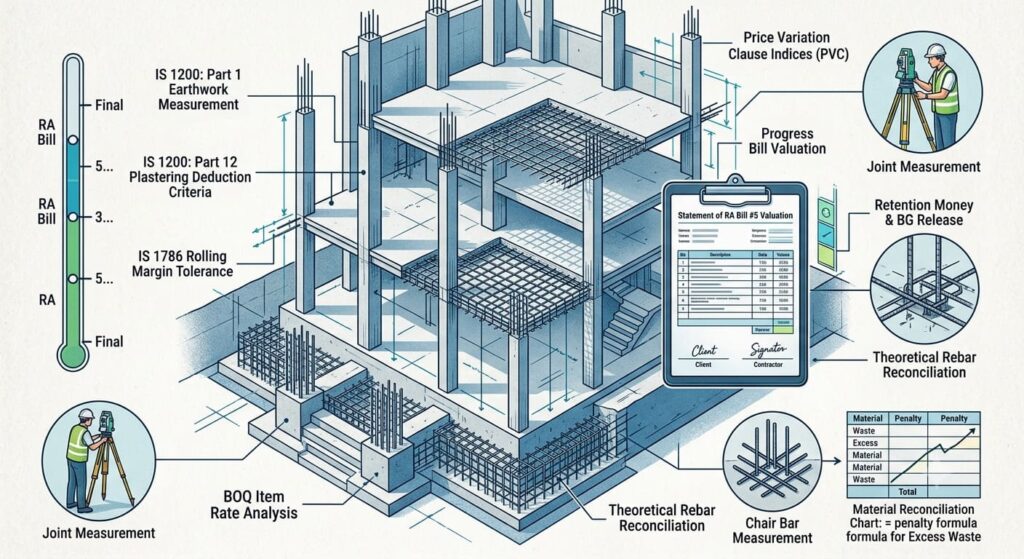
20 Essential Technical Interview Questions (Part – 3) | Master Class in Construction Project Billing & Quantity Surveying
I’ve sat on both sides of the table for these Technical interviews as the guy…
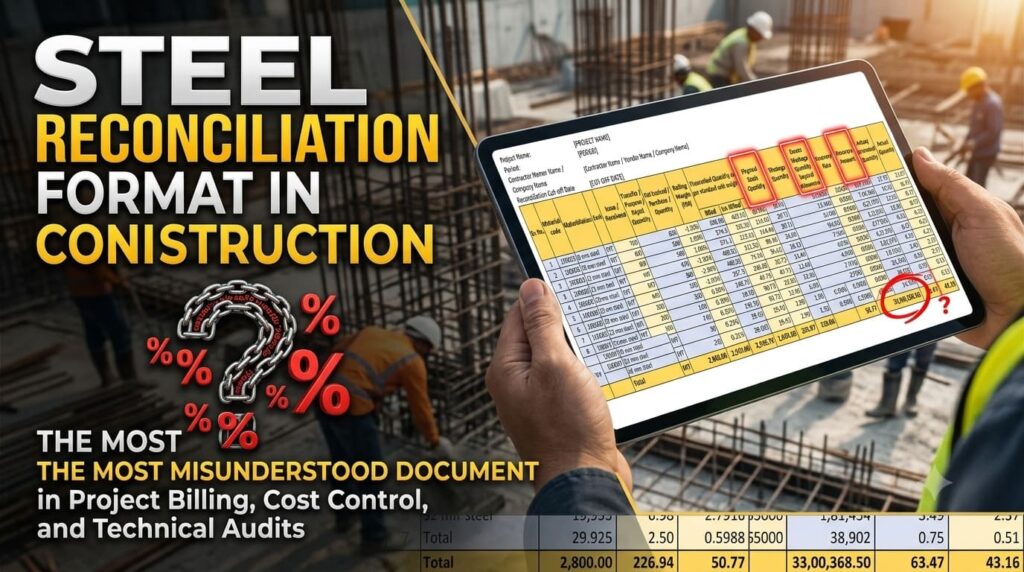
Steel Reconciliation Format in Construction | The Most Misunderstood Document in Project Billing, Cost Control and Technical Audits
Excel Reconciliation Format Download here There are a few documents like Steel Reconciliation Format in…

Complete Guide Work Order Understanding | Beyond The BOQ: How A Billing Engineer Must Read Every Line Of A Work Order (Part 2)
I still remember one particular bill audit many years ago. Work Order Understanding was the…