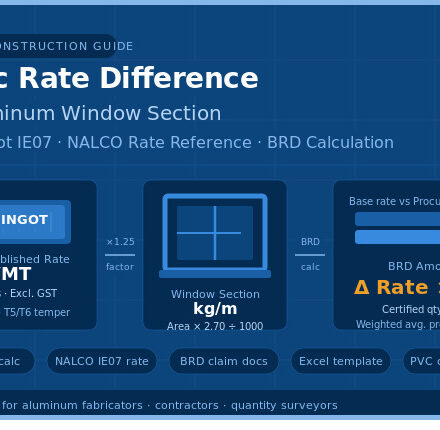
Basic Rate Difference of Aluminum Window Section from Ingot IE07: A Complete Guide to BRD Calculation, NALCO Rate Reference

If you are working in aluminum fabrication, construction procurement, or cost estimation, understanding the basic rate difference of aluminum window section from ingot IE07 is not just useful, it is an absolute professional necessity. This blog post is a complete, practical guide that walks you through the background and theory of basic rate difference (BRD), step-by-step unit weight calculation of aluminum window sections, how to correctly refer to the NALCO rate chart, the mandatory requirements for raising a BRD claim, a ready-to-use Excel-compatible calculation table, key checkpoints, limitations, and cross-verification methods — all explained with real-world examples and practical references.
What Is Basic Rate Difference (BRD) and Why Does It Matter?
Before we get into the numbers and formulas, let us first understand what Basic Rate Difference actually means in the context of aluminum construction materials.
When a contractor or fabricator enters into an agreement for supply or fabrication of aluminum sections whether for windows, doors, curtain walls, or structural glazing the contract price is typically fixed at the time of signing based on the prevailing rate of aluminum ingot or billet at that moment. However, aluminum is a commodity whose market price fluctuates continuously. The London Metal Exchange (LME) prices, domestic demand-supply dynamics, import duties, and the pricing policy of primary producers like NALCO (National Aluminium Company Limited) all cause the ingot price to move up or down over the project execution period.
This creates a financial gap between the base rate at which the contract was priced and the actual rate at which aluminum was procured during fabrication. That gap the difference between the base ingot rate assumed in the contract and the actual ingot rate at the time of procurement is what we call the Basic Rate Difference, commonly abbreviated as BRD.
In India, the benchmark for this calculation is almost universally tied to NALCO’s ingot price, specifically for the alloy designation IE07, which is the standard aluminum alloy used for extruding architectural sections such as window and door frames, curtain wall mullions, and similar profiles. NALCO publishes its ingot rates periodically, and these rates serve as the official reference for all BRD claims in government contracts, PSU projects, and many private sector projects as well.
The financial impact of BRD can be enormous on large projects. On a project involving several hundred metric tonnes of aluminum sections, even a ₹5,000 per tonne variation in ingot price translates to lakhs of rupees. Ignoring BRD or calculating it incorrectly can result in significant financial loss for the fabricator or, in the opposite case, an inflated claim that can be challenged and rejected.
The IE07 Alloy and Its Significance
Aluminum alloys are classified based on their chemical composition, and each alloy behaves differently during the extrusion process. For architectural applications windows, doors, partitions the most widely used alloy in India is 6063 (T5 or T6 temper), and when NALCO refers to this alloy in its ingot supply classification, it is designated as IE07.
IE07 ingot is essentially an aluminum-magnesium-silicon alloy that, after melting and extrusion through a die, produces sections with excellent surface finish, good mechanical strength, and superior corrosion resistance. These are the exact properties required for window sections that must withstand decades of weather exposure without degrading.
The reason NALCO’s IE07 price is the standard reference for BRD is straightforward NALCO is the largest primary aluminum producer in India, a Government of India enterprise, and its prices are publicly declared, auditable, and accepted as a neutral market reference by government agencies, courts, and arbitration panels. When a contract specifies “NALCO rate” as the basis for price variation, it removes ambiguity and creates a transparent, defensible audit trail.
The ingot price published by NALCO for IE07 includes the basic metal value and excludes GST. For BRD purposes, the ex-works price (the price at NALCO’s factory gate) is what matters, not the delivered price which includes freight and handling surcharges.
Conversion from Ingot to Extruded Section
Here is where most people get confused. The price of an aluminum window section is NOT the same as the price of the ingot from which it is made. The transformation from raw ingot to finished extruded section involves losses, additions, and processing costs. Understanding this transformation is the theoretical foundation of BRD calculation.
The key principle is this: When you compute BRD, you are only computing the variation in the raw material (ingot) cost component of the section’s price. You are not computing variation on the full fabricated section price, because the full price includes extrusion charges, die charges, surface treatment (anodizing or powder coating), freight, handling, and profit none of which vary with ingot price.
So the BRD calculation chain looks like this:
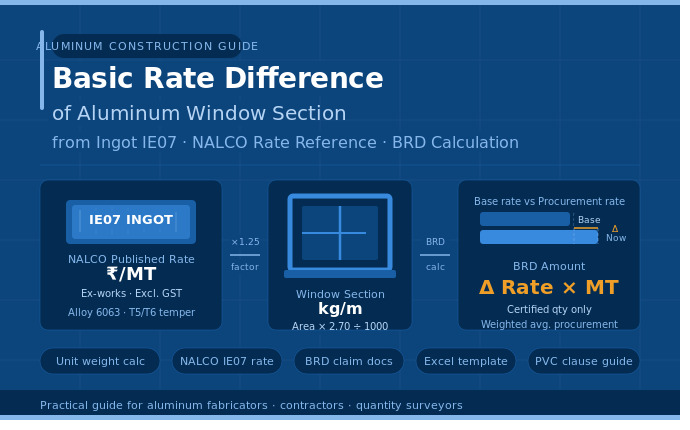
Ingot Price (per MT, NALCO IE07) → Multiply by Unit Weight of Section (kg/m) → Get ingot cost per meter of section → Compare base rate vs. current rate → Difference is BRD per meter.
Let us now go through each element of this chain in detail.
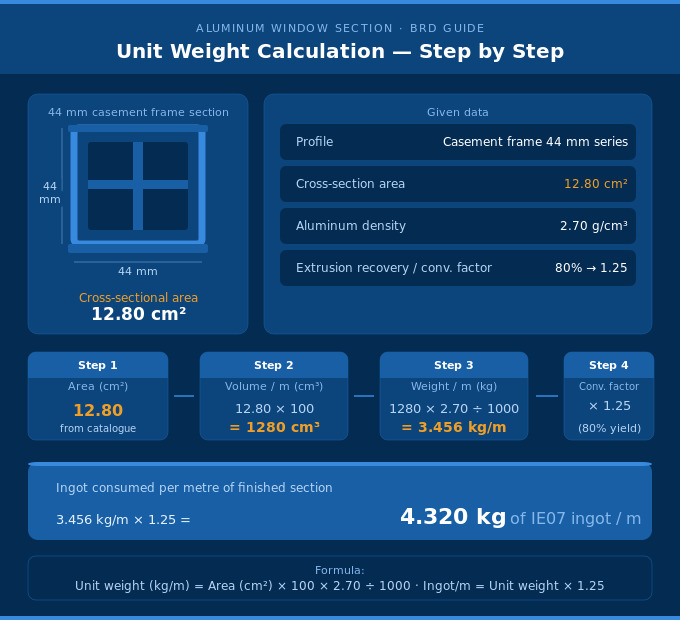
Step-by-Step Unit Weight Calculation of Aluminum Window Sections
The unit weight of an aluminum section (expressed in kg per linear meter) is the single most critical input in BRD calculation. Get this wrong, and your entire claim is wrong.
What Is Unit Weight?
Unit weight means: for every 1 meter length of a particular aluminum window section profile, how many kilograms of aluminum does it contain? This is a fixed physical property of each profile, determined by its cross-sectional area and the density of aluminum.
The density of aluminum is 2.70 g/cm³ or 2700 kg/m³. This is a physical constant. It does not change with alloy, temper, or manufacturer.
Step 1: Obtain the Cross-Sectional Area
Every aluminum section manufacturer (extruder) maintains a profile catalogue that lists the cross-sectional dimensions and area of each profile. For standard architectural sections used in sliding windows, casement windows, and fixed lights, this area is typically expressed in mm² (square millimeters).
For example, let us take a commonly used sliding window frame section. The catalogue specifies its cross-sectional area as 14.50 cm² (or equivalently 1450 mm²).
If you do not have the catalogue value, and you have a physical sample of the section, you can calculate the area by measuring the section dimensions and computing the area of each sub-element (hollow chambers, flanges, webs) using basic geometry. However, catalogue values are always more reliable and should be used wherever available.
Step 2: Convert Area to Consistent Units
For the weight calculation, we need the area in cm² because we will use the density in g/cm³.
In our example: Area = 14.50 cm²
Step 3: Calculate Volume per Meter
Volume = Cross-sectional Area × Length
For 1 meter (= 100 cm) of section:
Volume = 14.50 cm² × 100 cm = 1450 cm³
Step 4: Calculate Weight per Meter
Weight = Volume × Density of Aluminum
Weight = 1450 cm³ × 2.70 g/cm³ = 3915 grams = 3.915 kg per meter
So the unit weight of this section is 3.915 kg/m.
Step 5: Account for Process Recovery Factor (Extrusion Yield)
This step is often missed or ignored, but it is critically important for BRD calculation.
During the extrusion process, not all the ingot that goes into the press comes out as usable section. There are butt losses (the tail end of the billet that is cut off), die entry discards, cut-to-length wastage, and surface defects that require rejection. The industry standard recovery factor (also called extrusion yield) for architectural sections ranges from 75% to 85%, with a commonly accepted standard of 80% used in many contracts.
What this means is that to produce 1 kg of finished extruded section, you actually need to consume approximately 1.25 kg of ingot (because 1 ÷ 0.80 = 1.25).
This factor is called the Ingot-to-Section Conversion Factor, and for standard BRD calculations using NALCO rates, the factor 1.25 (corresponding to 80% recovery) is widely accepted. Some contracts specify a different factor — always check the contract terms.
So, the effective ingot consumption per meter of section = Unit Weight × Conversion Factor
= 3.915 kg/m × 1.25 = 4.894 kg of ingot per meter of section
This is the figure you will use in your BRD computation.
Full Unit Weight Calculation for a Common Window Profile
Let us walk through a real-world example using a 44mm × 44mm top-hung casement window section.
Given Data:
- Profile: Casement Window Frame Section (44mm series)
- Cross-sectional area from catalogue: 12.80 cm²
- Density of aluminum: 2.70 g/cm³
- Extrusion yield/recovery factor: 80% (conversion factor = 1.25)
Calculation:
| Step | Parameter | Formula | Value |
|---|---|---|---|
| 1 | Cross-sectional area | From catalogue | 12.80 cm² |
| 2 | Length considered | Standard | 100 cm (1 m) |
| 3 | Volume per meter | Area × Length | 1280 cm³ |
| 4 | Weight per meter (section) | Volume × 2.70 | 3456 g = 3.456 kg/m |
| 5 | Ingot consumption per meter | Wt × 1.25 | 4.320 kg/m |
So, for this casement section, 4.320 kg of IE07 ingot is consumed per running meter of finished section.
How to Refer to the NALCO Rate Chart?
Now that you know the ingot consumption per meter, you need to pick the correct NALCO rate. This is where many practitioners make errors that result in either under-claiming or disputed claims.
What NALCO Publishes
NALCO publishes its aluminum product prices periodically on its official website and through formal price circulars issued to its registered customers. The relevant price for BRD purposes is the IE07 ingot/billet price in ₹ per Metric Tonne (MT), ex-works, excluding GST.
NALCO typically revises prices monthly or in response to significant LME movements. Each price revision is accompanied by a formal circular that carries the effective date of the new price.
Which Rate to Use: Base Rate vs. Procurement Rate
In BRD calculation, you work with two NALCO rates:
1. Base Rate (Contract Rate): This is the NALCO IE07 ingot price that was prevailing on the date the contract was signed (or the date specified in the contract as the base date for price variation). This rate is frozen and does not change regardless of what NALCO publishes later.
2. Procurement Rate (Actual Rate): This is the NALCO IE07 ingot price that was prevailing during the period when the aluminum sections were actually procured or ordered for the project.
The difference between these two gives you the BRD per MT. Multiply that by the ingot consumption to get the BRD amount.
Practical Example of Rate Reference
Suppose:
- Contract Base Date: 1st January (NALCO IE07 rate = ₹2,10,000 per MT)
- Actual Procurement Month: October of the same year (NALCO IE07 rate = ₹2,35,000 per MT)
BRD per MT = ₹2,35,000 − ₹2,10,000 = ₹25,000 per MT
This means for every metric tonne of ingot equivalent consumed, the fabricator has paid ₹25,000 more than what was factored into the contract price.
Important: Use Weighted Average Rate for Multi-Period Procurement
If procurement happened over multiple months at different NALCO rates, you must use a weighted average procurement rate based on the quantities procured in each month.
Example:
| Month | Qty Procured (MT) | NALCO Rate (₹/MT) | Value (₹) |
|---|---|---|---|
| August | 5.0 | 2,28,000 | 11,40,000 |
| September | 8.5 | 2,31,000 | 19,63,500 |
| October | 6.5 | 2,35,000 | 15,27,500 |
| Total | 20.0 | — | 46,31,000 |
Weighted Average Rate = 46,31,000 ÷ 20.0 = ₹2,31,550 per MT
This weighted average rate (₹2,31,550) becomes your procurement rate for BRD calculation.
Mandatory Requirements for BRD Claim Referring to NALCO Rate
A BRD claim is a financial claim, and like all financial claims in a contract, it must satisfy specific documentary and procedural requirements before it will be accepted. Missing any one of these requirements can result in the claim being held up for months or rejected outright.
Here are the mandatory requirements I have compiled based on common practice in government and PSU contracts:
1. Contract Provision for Price Variation: The contract must explicitly contain a price variation clause (PVC) or escalation clause that links aluminum section pricing to NALCO ingot rates. Without this clause, no BRD claim can be entertained regardless of how legitimate the price increase is.
2. Base Rate Documentation: The base NALCO IE07 rate must be clearly established either by reference to the contract date, or as explicitly stated in the contract. Retain the NALCO price circular corresponding to that base date.
3. Procurement Rate Documentation: You must produce NALCO official price circulars for every month in which procurement happened. Downloaded website pages are not always sufficient formal NALCO price circulars issued to registered customers carry more evidentiary weight.
4. Purchase Orders and Invoices: The actual purchase orders placed with your section supplier, and the corresponding tax invoices, must be produced to prove the quantity and timing of procurement. These documents establish the link between the NALCO rate period and the actual purchase.
5. Section Weight Certificates: Weight per meter (unit weight) for each section must be supported by the manufacturer’s catalogue or a weight certificate from the extruder. Some clients also ask for third-party testing certificates for unit weight verification.
6. Measurement Book (MB) or Running Account (RA) Bills: The quantity of sections used on-site must be certified through proper measurement entries, running account bills, or completion certificates. BRD is payable only on quantities actually incorporated into the work.
7. Calculation Sheet in Prescribed Format: The BRD calculation must be presented in a structured, auditable format. An Excel-based calculation table (described in the next section) is the most practical and accepted format.
8. Conversion Factor Declaration: The contract may specify the conversion factor (ingot-to-section factor). If not specified, 1.25 is the industry standard, but you should explicitly state the factor you have used and justify it.
9. GST Compliance: NALCO rates for BRD are always taken exclusive of GST, since GST is separately reimbursable under the contract. Using GST-inclusive rates inflates the BRD claim and will be rejected.
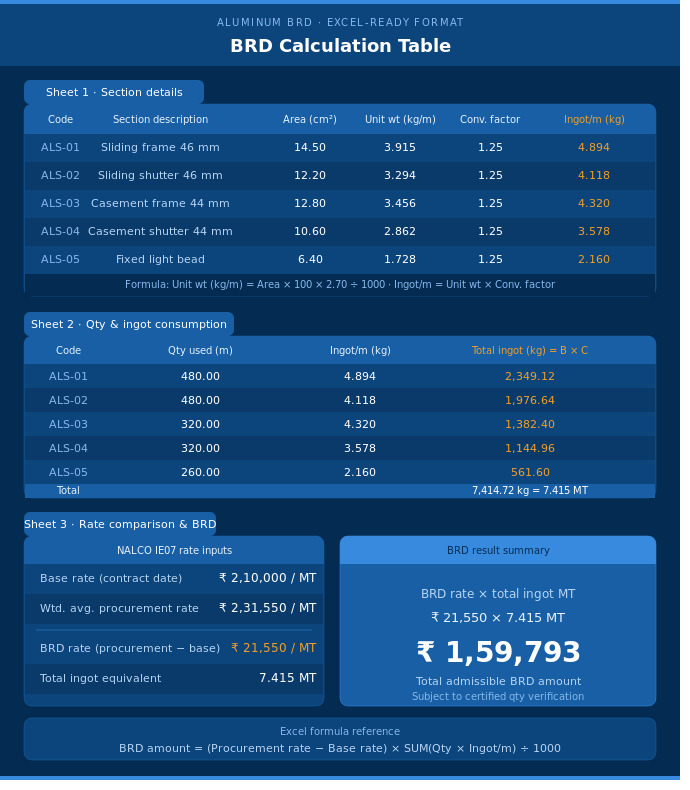
BRD Calculation Table
Below is a structured calculation table that I use in practice, formatted so that it can be directly entered into Microsoft Excel or Google Sheets. This table covers multiple section types (as a real project always has a mix of profiles) and handles both positive BRD (rate increase) and negative BRD (rate decrease).
Sheet 1: Section Details and Unit Weight
| Col A | Col B | Col C | Col D | Col E | Col F |
|---|---|---|---|---|---|
| Profile Code | Section Description | Cross-Section Area (cm²) | Unit Weight (kg/m) = C×100×2.70÷1000 | Conv. Factor | Ingot/m (kg) = D×E |
| ALS-01 | Sliding Frame 46mm | 14.50 | 3.915 | 1.25 | 4.894 |
| ALS-02 | Sliding Shutter 46mm | 12.20 | 3.294 | 1.25 | 4.118 |
| ALS-03 | Casement Frame 44mm | 12.80 | 3.456 | 1.25 | 4.320 |
| ALS-04 | Casement Shutter 44mm | 10.60 | 2.862 | 1.25 | 3.578 |
| ALS-05 | Fixed Light Bead | 6.40 | 1.728 | 1.25 | 2.160 |
Sheet 2: Quantity and Ingot Consumption
| Col A | Col B | Col C | Col D |
|---|---|---|---|
| Profile Code | Qty Used (m) | Ingot/m (kg) | Total Ingot (kg) = B×C |
| ALS-01 | 480.00 | 4.894 | 2349.12 |
| ALS-02 | 480.00 | 4.118 | 1976.64 |
| ALS-03 | 320.00 | 4.320 | 1382.40 |
| ALS-04 | 320.00 | 3.578 | 1144.96 |
| ALS-05 | 260.00 | 2.160 | 561.60 |
| TOTAL | 7414.72 kg = 7.415 MT |
Sheet 3: Rate Comparison and BRD
| Col A | Col B | Col C | Col D | Col E | Col F |
|---|---|---|---|---|---|
| Description | Value | Unit | |||
| Base NALCO IE07 Rate | 2,10,000 | ₹/MT | |||
| Weighted Avg. Procurement Rate | 2,31,550 | ₹/MT | |||
| BRD Rate (per MT) | 21,550 | ₹/MT | |||
| Total Ingot Equivalent | 7.415 | MT | |||
| Total BRD Amount | ₹1,59,793 |
Excel Formula Reference (for Sheet 3 setup):
Unit Weight (kg/m): =(C3*100*2.70)/1000
Ingot per meter: =D3*E3
Total Ingot per profile: =B_qty * F_unit_ingot
Grand Total Ingot MT: =SUM(D:D)/1000
BRD Rate: =Procurement_Rate - Base_Rate
BRD Amount: =BRD_Rate * Total_MT
Key Checkpoints in BRD Calculation
Whether you are preparing a BRD claim or verifying one submitted to you, these are the checkpoints that must be reviewed before any amount is accepted or disbursed:
Checkpoint 1 – Correct Base Date: Verify that the NALCO rate used as the base rate corresponds exactly to the base date defined in the contract. Neither the date immediately before nor after the exact date matters.
Checkpoint 2 – Correct Rate Type: Confirm that ex-works, GST-exclusive NALCO IE07 ingot/billet prices are being used. Do not mix up extruded section prices or LME prices with ingot prices.
Checkpoint 3 – Unit Weight Verification: Cross-check the unit weight of each section against the manufacturer’s catalogue. If the unit weight used in the claim is higher than the catalogue value, the ingot consumption will be inflated and the claim will be overstated.
Checkpoint 4 – Quantity Reconciliation: The quantities used in BRD calculation must match the certified quantities in the Measurement Book or RA Bills. No BRD on uncertified quantities.
Checkpoint 5 – Conversion Factor Confirmation: Check the contract for the specified conversion factor. If none is specified, 1.25 is standard, but document this assumption explicitly.
Checkpoint 6 – Procurement Timing: Confirm that the procurement rate claimed corresponds to when the material was actually ordered or received, not when the invoice was raised or payment was made. Purchase order date is generally the reference point.
Checkpoint 7 – Weighted Average Accuracy: If multiple procurement lots are involved, verify the weighted average calculation by multiplying each lot’s quantity by its rate, summing the values, and dividing by total quantity.
Checkpoint 8 – GST Neutrality: Confirm that neither the base rate nor the procurement rate includes GST. Any inadvertent inclusion of GST in either rate must be corrected before the BRD calculation proceeds.
Checkpoint 9 – Negative BRD: If the procurement rate is lower than the base rate (i.e., aluminum prices fell during the project), the BRD is negative meaning a recovery must be made from the contractor. This is often contested, but most price variation clauses work in both directions.
Limitations of BRD Calculation Using NALCO Rates
No calculation method is without limitations, and being transparent about these limitations actually strengthens the credibility of your claim. Here are the key limitations:
Limitation 1 – NALCO Rate ≠ Market Purchase Rate: Most fabricators do not buy ingot directly from NALCO. They buy extruded sections from secondary extruders who procure ingot from NALCO or secondary sources. The secondary market ingot price may differ from NALCO’s official price. Using NALCO rate as a proxy is a contractual convention, not a reflection of actual purchase cost in all cases.
Limitation 2 – Regional Freight Variation: NALCO’s ex-works price does not include freight. A fabricator in Tamil Nadu procuring material from NALCO’s plant in Odisha faces significantly higher freight than one in West Bengal. BRD based on NALCO ex-works rate does not capture this freight variation.
Limitation 3 – Extrusion Yield Variation: The 80% recovery factor (1.25 conversion) is an industry average. Actual recovery varies by profile complexity, die condition, press size, and operator skill. Thin-walled sections may have recovery as low as 72%, while simple solid sections may achieve 85%. A fixed conversion factor may not precisely reflect actual ingot consumption.
Limitation 4 – Alloy Variations: While IE07 is the standard alloy for architectural sections, some specialized sections (for structural applications, marine environments, or high-strength applications) use different alloys (such as 6061 or 6082) whose prices differ from IE07. Using IE07 rate for non-IE07 alloys would be incorrect.
Limitation 5 – Monthly Rate Granularity: NALCO rate revisions may happen multiple times in a month, but BRD calculation typically uses the rate for the month as a whole. This averages out intra-month fluctuations and may slightly under- or over-state the actual variation for procurement at the very start or end of a month.
Limitation 6 – Base Rate Disputes: Sometimes the contract is ambiguous about which NALCO circular corresponds to the base date (e.g., if there was a rate revision mid-month around the contract signing date). This ambiguity can lead to disputes and should ideally be clarified with a contract amendment.
Cross-Checking the BRD Claim
When you are on the verification side as a project engineer, quantity surveyor, or client’s representative — here is how to cross-check a BRD claim submitted to you:
Step 1 – Independent Weight Lookup: Pull out the manufacturer’s catalogue for each section claimed and verify the unit weight independently. If the catalogue is not available, ask the submitter to provide the extruder’s weight certificate.
Step 2 – NALCO Rate Verification: Download the NALCO price circulars for the base month and all procurement months directly from NALCO’s official website or request them from NALCO’s customer service. Compare these against what the claimant has used.
Step 3 – Quantity Audit: Match the quantities in the BRD calculation to the certified MB entries or RA bill quantities. Discrepancies must be resolved before any BRD payment is authorized.
Step 4 – Reconstitute the Calculation: The most reliable cross-check is to independently reconstitute the entire calculation using your verified inputs (unit weights, NALCO rates, quantities, conversion factor) and compare the result with the submitted claim. If both results match, the claim is clean. If there is a difference, identify which input is at variance.
Step 5 – Delivery Challan Cross-Check: Match the purchase order quantities with the delivery challans and weighbridge receipts (if available) to verify that the quantities claimed as procured were actually received at the site or fabrication shop.
Step 6 – Back-Calculation from Bill of Quantities: Multiply the total area of aluminum work in the BOQ (in m² or in running meters) by the typical section mix and their unit weights to get a rough independent estimate of total ingot consumption. If the BRD claim implies an ingot consumption significantly higher than this estimate, further scrutiny is warranted.
End-to-End BRD Claim for an Office Window Package
Let me walk you through a complete, realistic BRD claim scenario to tie everything together.
Project: Corporate Office Building – Aluminum Sliding Window Package
Contract Details:
- Contract Sign Date: 1st March (Base NALCO IE07 Rate: ₹2,05,000/MT ex-works, excluding GST)
- Contract Value of Aluminum Work: ₹68,50,000
- Price Variation Clause: Applicable, based on NALCO IE07 ex-works rate, with 1.25 conversion factor
Sections Involved:
- Sliding Frame Section (ALS-01): 650 running meters, unit weight 3.915 kg/m
- Sliding Shutter Section (ALS-02): 650 running meters, unit weight 3.294 kg/m
- Interlock Section (ALS-03): 320 running meters, unit weight 2.430 kg/m
- Bead Section (ALS-04): 480 running meters, unit weight 1.512 kg/m
Procurement History:
| Month | Qty Procured (MT Ingot Equiv.) | NALCO IE07 Rate (₹/MT) |
|---|---|---|
| July | 4.200 | 2,18,000 |
| August | 5.800 | 2,22,000 |
| September | 3.500 | 2,27,000 |
| Total | 13.500 MT |
Weighted Average Procurement Rate:
= (4.200 × 2,18,000 + 5.800 × 2,22,000 + 3.500 × 2,27,000) ÷ 13.500 = (9,15,600 + 12,87,600 + 7,94,500) ÷ 13.500 = 29,97,700 ÷ 13.500 = ₹2,22,052 per MT
BRD Rate: ₹2,22,052 − ₹2,05,000 = ₹17,052 per MT
Total Ingot Equivalent Calculation:
| Section | Qty (m) | Wt (kg/m) | Section Wt (kg) | Ingot (kg) at 1.25 |
|---|---|---|---|---|
| ALS-01 | 650 | 3.915 | 2544.75 | 3180.94 |
| ALS-02 | 650 | 3.294 | 2141.10 | 2676.38 |
| ALS-03 | 320 | 2.430 | 777.60 | 972.00 |
| ALS-04 | 480 | 1.512 | 725.76 | 907.20 |
| Total | 7736.52 kg = 7.737 MT |
Note: Slight difference from the procurement record of 13.5 MT is because the procurement figure includes wastage and inventory build; the certified quantity used on-site is 7.737 MT. BRD is claimable only on certified quantities.
BRD Amount:
= 7.737 MT × ₹17,052 per MT = ₹1,31,952
This ₹1,31,952 is the admissible BRD for this package, subject to verification of all supporting documents.
Common Mistakes to Avoid in BRD Claims
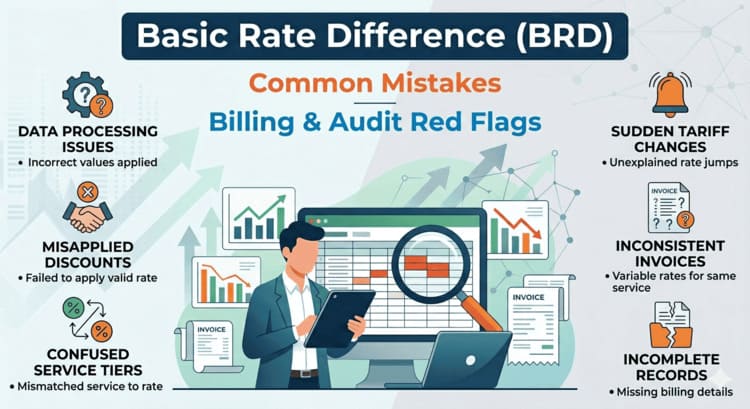
From practical experience, here are the most common mistakes that result in BRD claims being delayed, reduced, or rejected:
Presenting a BRD claim without attaching the original NALCO price circulars. Copies downloaded from unofficial sources are often not accepted. Always retain and submit the official NALCO circulars.
Using the section supply invoice price as the procurement rate rather than the NALCO ingot price. The section price includes extrusion charges, which should not influence BRD.
Claiming BRD on total ordered quantities rather than on quantities certified in the measurement book. BRD is payable on incorporated quantities, not purchase quantities.
Ignoring negative BRD periods. If rates dropped in some months, a strictly correct calculation must reflect that reduction, even if the net BRD remains positive.
Mixing up temper designations. T5 and T6 sections have the same base alloy (6063/IE07), but some suppliers quote T6 at a premium. For BRD purposes, the base ingot is the same do not let the temper distinction affect your ingot rate reference.
Conclusion
The basic rate difference of aluminum window section from ingot IE07 is a concept that sits at the intersection of material science, contract law, and financial calculation. When handled correctly, it protects both the contractor from absorbing unbudgeted aluminum price increases and the client from being overcharged when prices fall. The entire system anchored to NALCO’s publicly declared IE07 ingot prices, is designed to be transparent, auditable, and fair to all parties.
The key takeaways from this guide are: always establish your base rate clearly at the time of contract, document every NALCO rate revision during the project period, calculate unit weights from manufacturer catalogues rather than estimation, use the correct conversion factor as specified in your contract, and prepare your claim in a structured Excel-compatible table that can be independently verified.
A well-prepared BRD claim, backed by complete documentation and clear calculations, is rarely disputed. A poorly prepared one, even when the underlying claim is legitimate, invites questions, delays, and deductions. I hope this guide helps you prepare and verify BRD claims with confidence and precision.
Editor’s Pick
 Read more: Standardized Excavation Measurement Benchmark – IS Code Explained
Standardized Excavation Measurement Benchmark – IS Code Explained
on
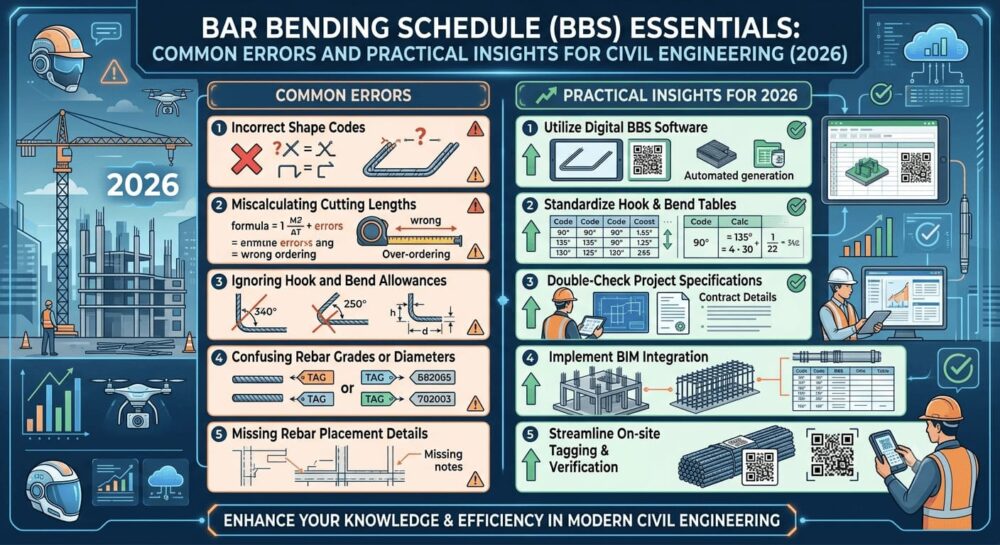
- Read more: Bar Bending Schedule Essentials: Common Errors and Practical Insights for Civil Engineering should help your Knowledge in 2026
Bar Bending Schedule Essentials: Common Errors and Practical Insights for Civil Engineering should help your Knowledge in 2026
on
 Read more: Pile Foundation: The Hidden Strength Beneath Every Structure Now even in 2026
Pile Foundation: The Hidden Strength Beneath Every Structure Now even in 2026
on
 Read more: Basic Rate Difference ( BRD ) – Common Mistakes and Billing & Audit Red Flags
Basic Rate Difference ( BRD ) – Common Mistakes and Billing & Audit Red Flags
on

For more blogs ……………………………..>>>
Frequently Asked Questions (FAQs): Basic Rate Difference of Aluminum Window Section from Ingot IE07
FAQ 1: What exactly is Basic Rate Difference (BRD) in the context of aluminum window sections, and who is eligible to claim it?
Basic Rate Difference is the financial adjustment made to a contract when the price of aluminum ingot IE07 the raw material from which window sections are extruded changes between the date the contract was signed and the date the material was actually procured and used. It is not a bonus or a penalty by itself; it is simply a correction mechanism to ensure that neither the contractor nor the client bears an unfair burden due to raw material price volatility beyond anyone’s control.
Eligibility to claim BRD rests on two fundamental conditions. First, the contract must contain an explicit price variation clause (PVC) or escalation clause that references NALCO’s IE07 ingot price as the benchmark. Without this clause in the agreement, no BRD claim has contractual standing regardless of how much the ingot price has moved. Second, the BRD can only be claimed on quantities of aluminum sections that have been actually incorporated into the work and certified through measurement book entries or running account bills. Quantities ordered but not yet used, or sections rejected and returned, do not qualify.
FAQ 2: Why is NALCO’s IE07 ingot price used as the reference rate and not the actual purchase price of the sections from the market?
This is one of the most frequently raised questions by contractors who feel their actual purchase cost should be the reference. The answer lies in the need for a neutral, auditable, and publicly verifiable benchmark.
NALCO — the National Aluminium Company Limited is a Government of India enterprise and the largest primary aluminum producer in the country. Its IE07 ingot prices are officially declared through formal price circulars, are available on record, and are accepted by government agencies, PSUs, courts, and arbitration tribunals as a credible reference. No private supplier’s invoice can claim that level of official recognition.
Additionally, using the actual section purchase price would create complications because different fabricators buy from different suppliers at different prices, some of which may include processing charges, surface treatment costs, freight, and profit margins that have nothing to do with the raw ingot price movement. By isolating the ingot cost component using NALCO’s rate, BRD captures only the genuine raw material price variation and excludes everything else. This makes the claim structurally clean and far less susceptible to dispute.
FAQ 3: How do I find and access the NALCO IE07 ingot price for a specific month? Is it available to everyone?
Yes, NALCO’s aluminum product prices are publicly accessible. The most reliable source is NALCO’s official website where they publish current and recent pricing. However, for formal BRD claims — especially in government and PSU contracts the preferred documentation is the official NALCO price circular, which is a formal letter or notification that NALCO issues to its registered customers whenever it revises prices.
If you are a fabricator who does not directly purchase from NALCO (most secondary fabricators buy extruded sections rather than ingot), you can still obtain the official price circulars by contacting NALCO’s sales office and requesting copies for specific periods. Alternatively, industry associations such as the Aluminium Association of India or the Architectural Aluminium Manufacturers Association often maintain records of historical NALCO price movements that can be used as supporting reference.
For BRD documentation, always use the ex-works price of IE07 ingot, excluding GST. Do not use prices that include freight surcharges, packaging, or taxes, as these inflate the rate artificially.
FAQ 4: What is the significance of the 1.25 conversion factor and where does it come from? Can a different factor be used?
The 1.25 conversion factor represents the relationship between the weight of aluminum ingot consumed and the weight of finished extruded section produced. It is derived from the concept of extrusion yield or recovery rate.
During the extrusion process, a billet of aluminum is pushed through a die under high pressure to produce the desired section profile. However, not all the aluminum in the billet becomes usable section. The tail end of the billet (called the butt) must be cut off and discarded because it contains contamination from the press liner. Die entry wastage, cut-to-length offcuts, and rejected pieces due to surface defects further reduce the yield. In the aluminum extrusion industry, the standard acceptable yield for architectural sections is approximately 80%, meaning only 80 kg of usable section comes out for every 100 kg of billet/ingot fed into the press.
To recover 1 kg of finished section, you therefore need 1 ÷ 0.80 = 1.25 kg of ingot. That is the origin of the 1.25 factor.
Whether you can use a different factor depends entirely on your contract. If the contract explicitly states a conversion factor, that figure governs whether it is 1.20, 1.25, or 1.30. If the contract is silent, the industry-standard 1.25 is used and must be declared explicitly in your claim documentation along with the justification. For complex or thin-walled profiles where extrusion yield is genuinely lower, a higher conversion factor may be justified, but this requires technical supporting evidence from the extruder.
FAQ 5: If aluminum prices fell during the project instead of rising, does the client have the right to recover money from the contractor under BRD provisions?
Yes, and this aspect is often conveniently overlooked by contractors when submitting claims. A price variation clause in a contract works symmetrically in both directions. If the NALCO IE07 ingot price on the procurement date is lower than the base rate established at the time of contract signing, the BRD is negative meaning the contractor has procured material at a cheaper rate than what was factored into the contract price, and the client is entitled to recover that benefit.
In practice, many contractors quietly avoid raising negative BRD adjustments, and many client-side engineers do not pursue them either, particularly on smaller projects. But on government and PSU contracts where audit scrutiny is high, negative BRD recovery is a legitimate and enforceable provision. Audit observations have been raised in multiple instances where contractors were found to have claimed only upward price variations while ignoring periods when prices were lower.
The correct and ethical approach is to compute BRD for each procurement period independently whether the variation is positive or negative and net the result. If the overall net BRD is positive (more months of higher prices than lower), the contractor claims the difference. If it is negative overall, the contractor returns the excess.
FAQ 6: My project procurement happened over eight months with different NALCO rates each month. How do I present this in my BRD claim without it being rejected for being too complex?
This is actually a very common situation on projects of any meaningful size, and the weighted average method is specifically designed to handle it cleanly. The key is structure and documentation.
Prepare a month-wise procurement table that lists, for each month: the quantity of ingot-equivalent procured (derived from the section quantities received during that month), the NALCO IE07 rate applicable for that month, and the product of quantity multiplied by rate. Sum the total quantity column and the total value column, then divide total value by total quantity to arrive at the weighted average procurement rate. This single weighted average rate is then compared to the base rate to compute the BRD per metric tonne.
For the claim document, attach the NALCO price circular for every single month in the procurement period even months where the rate did not change from the previous month. This demonstrates diligence and completeness. Also attach the delivery challans or purchase invoices for each month to corroborate the procurement quantities. A well-organized, month-by-month schedule presented in a clear table format is far more likely to be accepted quickly than a narrative description. Excel format with clearly labeled columns and locked formula cells is ideal for this purpose
FAQ 7: How do I calculate the unit weight of an aluminum section if the manufacturer’s catalogue is not available?
The manufacturer’s catalogue is always the first preference for unit weight, and you should make every effort to obtain it before resorting to alternatives. That said, there are situations particularly for older or discontinued profiles, or for sections procured from smaller extruders where the catalogue is genuinely not available.
In such cases, the unit weight can be established through direct physical measurement and weighing. Take a sample length of the section ideally 1 meter or at minimum 500 mm — and weigh it on a calibrated scale. Divide the weight by the length to get weight per meter. If you use a 500 mm sample, multiply the weight by 2 to get the per-meter figure. Repeat this measurement on three to five samples and take the average to minimize measurement error.
The measurement must be done on sections that are clean and dry, without any anodizing or powder coating applied (since these surface treatments add weight). Have the weighing witnessed by the client’s representative or a third-party inspector and have a certificate signed. This witnessed weight measurement, while less preferred than a catalogue value, is a defensible fallback and is generally accepted by most clients when properly documented. You can also cross-check your measured value using the formula: Unit Weight (kg/m) = Cross-sectional Area (cm²) × 100 × 2.70 ÷ 1000, where the cross-sectional area can be measured from a section cut using a planimeter or CAD tracing.
FAQ 8: What happens if there is a discrepancy between the ingot quantity computed through the BRD calculation and the actual ingot quantity shown in the fabricator’s purchase records?
This discrepancy is more common than people realize, and it arises from the difference between what was procured for the project and what was actually certified as incorporated into the work.
The BRD calculation uses certified quantities from the measurement book, multiplied by the unit weight and conversion factor, to arrive at the ingot-equivalent used in the work. The fabricator’s purchase records, on the other hand, reflect what was physically bought which may include safety stock, buffer for wastage beyond the standard factor, material for rework, or sections fabricated but held as future spares.
The reconciliation approach is this: BRD is payable strictly on the ingot equivalent of certified, incorporated quantities. If the fabricator procured more ingot than what is reflected in the certified quantities (which is normal), that excess procurement is the fabricator’s own business decision and does not entitle them to additional BRD. Conversely, if the actual ingot purchase price on the excess material was higher than the NALCO rate, that loss is the fabricator’s to absorb.
During verification, if the ingot quantity in the BRD claim exceeds what would reasonably be expected from the certified section quantities (say, by more than 8–10% above the standard conversion factor), the verifying officer is fully justified in asking for a detailed reconciliation before approving the claim.
FAQ 9: Is BRD applicable on the anodizing or powder coating cost of aluminum sections, or only on the bare section cost?
BRD as defined in standard price variation clauses applies exclusively to the aluminum ingot raw material component of the section’s cost. Anodizing and powder coating are post-extrusion surface treatment processes whose costs are driven by their own input factors electricity, chemicals, labor, water treatment and have no direct connection to aluminum ingot prices.
Therefore, BRD is not applicable on the surface treatment portion of the section cost. In practical terms, this means that if your contract has a separately itemized rate for anodized sections, the BRD is computed only on the bare extruded section cost component (typically derived by subtracting the known anodizing cost from the total section rate), and the ingot consumption per meter remains the same regardless of whether the section is anodized or powder coated.
Some contracts explicitly state that BRD shall be computed only on the “metal content” of the section rate, which is precisely this bare extrusion component. If your contract does not define this split, use industry-standard rates or get a written clarification from the client before submitting your claim, because this ambiguity, if left unresolved will inevitably create a dispute during verification.
FAQ 10: What is the shelf life of a BRD claim — is there a time limit within which it must be submitted after the work is completed?
Yes, and this is a critically important point that many contractors miss, resulting in legitimate claims becoming time-barred.
Most government and PSU contracts incorporate the conditions of contract from standard documents (such as CPWD, MES, or PWD conditions) which specify a defined period within which claims for price variation, including BRD, must be submitted after the relevant work is completed or the relevant billing period closes. This period typically ranges from 30 days to 90 days from the date of the running account bill in which the work is first certified, or from the date of virtual completion, depending on the contract language.
Beyond this prescribed period, the contract authority has the right to refuse the claim on grounds of being time-barred, even if the underlying calculation is perfectly correct and the amount is genuinely due. In arbitration, time-barred claims are routinely rejected unless the claimant can demonstrate that the delay was caused by circumstances beyond their control or by the client’s own actions.
The practical advice is simple: raise BRD claims on a running basis with every RA bill, rather than accumulating the entire claim for the end of the project. This approach not only avoids time-bar risk but also distributes the cash flow benefit across the project duration, which is far more valuable from a working capital perspective than receiving a lump sum after project closure.