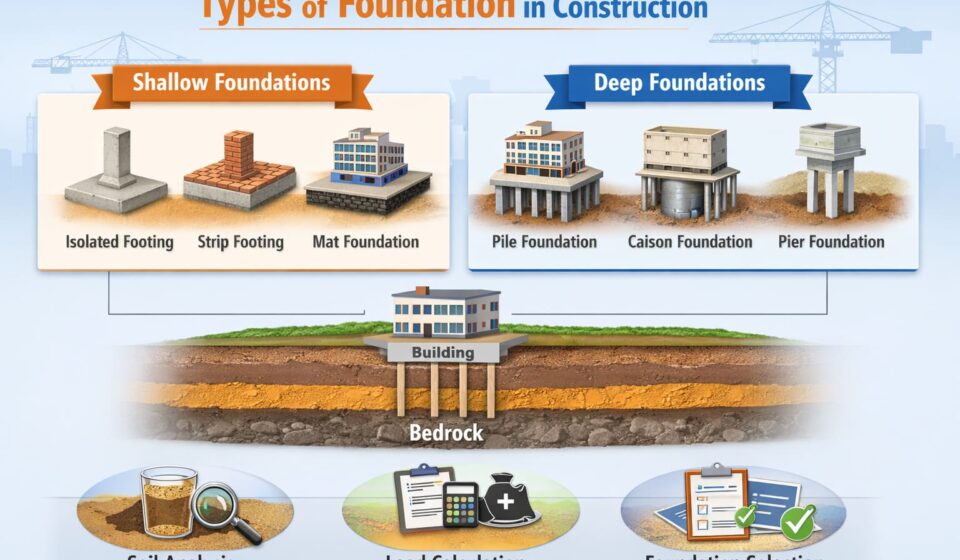
Types of Foundation in Construction: A Complete Technical Guide for Your Positive Self Development

When I first started reviewing construction projects in Mumbai, I quickly realised that the one thing every engineer talks about but very few people truly understand is the foundation. The types of foundation you choose for a building decide almost everything that follows — the construction time, the cost, the risk, and the long-term behaviour of the structure. Get the foundation right, and the building will stand for a hundred years. Get it wrong, and no amount of quality work above ground level will save you from cracks, settlement, or catastrophic failure.
In this guide, I am going to walk you through every major type of foundation used in construction from the simple strip footing under a boundary wall to the 30-metre bored piles beneath a Mumbai high-rise. I will cover construction methods, suitable soil conditions, cost implications, and the billing audit angles that most engineers never talk about. Whether you are a civil engineer, a site supervisor, a quantity surveyor, or someone preparing for GATE or SSC JE, this is the only foundation guide you will need.
What Is a Foundation and Why Does It Matter in Construction?
A foundation is the lowermost structural element of any building. Its job is straightforward in concept: take all the loads generated by the structure above columns, beams, slabs, walls, people, furniture, wind, and earthquake forces and transfer them safely into the ground. The ground then accepts those loads through either direct bearing pressure at the base of the foundation or through friction and adhesion along the sides of a deep element.
The reason I say the types of foundation matter is because soil is not concrete. It is a natural material with enormous variability — in strength, compressibility, moisture content, and geological history. What works in Thane does not necessarily work in Dharavi. A foundation type that is perfectly economical in Pune can be dangerously inadequate in Bandra where you may hit marine clay before you hit anything worth calling firm ground.
How Load Transfer Works in Different Foundation Types
Every foundation transfers load through two basic mechanisms. The first is base bearing, where the bottom of the foundation element presses against the soil and the soil pushes back. The second is skin friction or side shear, where the surface area of a deep foundation element develops adhesive and frictional resistance against the surrounding soil. Shallow foundations rely mostly on base bearing. Pile foundations use both, and in soft marine clay like you find all along Mumbai’s coast skin friction can account for 80 to 90 percent of the pile’s total capacity.
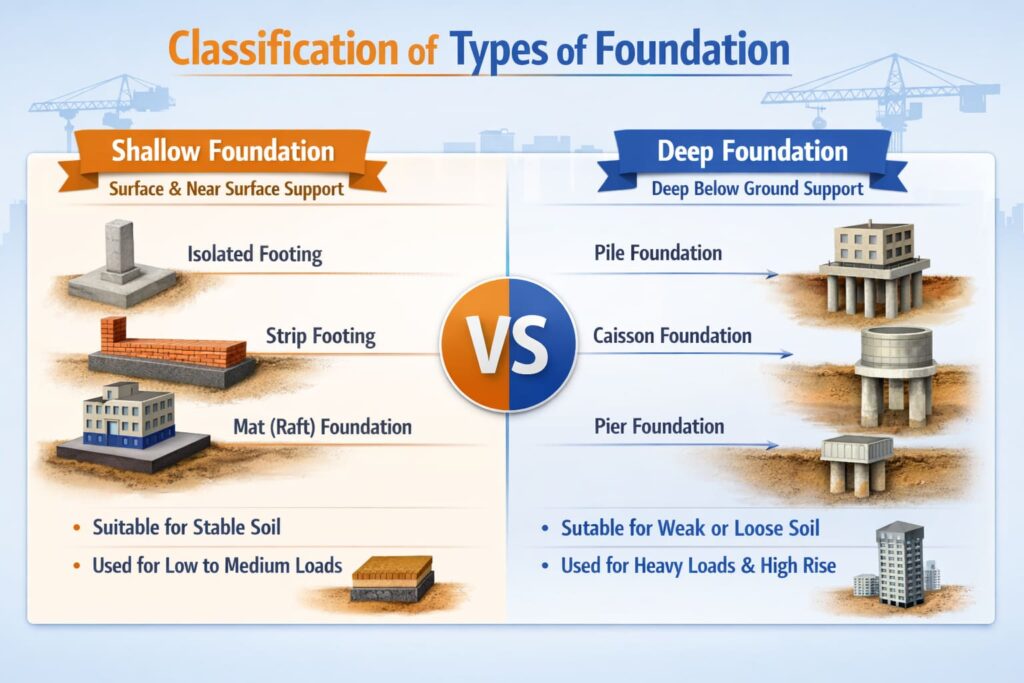
Classification of Types of Foundation: Shallow vs Deep
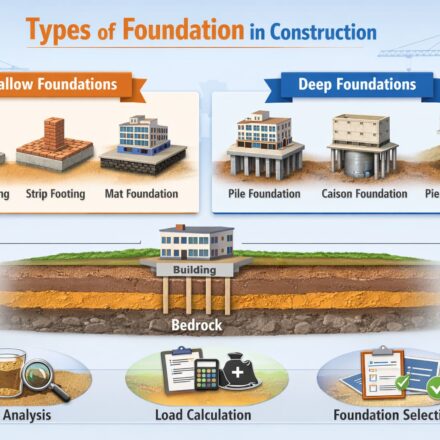
All types of foundation fall into two broad categories based on the depth at which load is transferred to the soil: shallow foundations and deep foundations. This is not just a textbook classification, it has direct consequences for cost, construction method, machinery requirement, and the level of geotechnical investigation needed.
Shallow Foundations: When Competent Soil Is Close to the Surface
A foundation is called shallow when the depth of the foundation is roughly equal to or less than its width or more practically, when the bearing stratum is accessible by open excavation. Shallow foundations spread the column or wall load over a larger contact area so that the pressure per unit area comes within the soil’s capacity. They are constructed in open pits or trenches and require no specialist machinery beyond a standard excavator.
- Isolated Spread Footing — one column, one footing
- Combined Footing — two or more columns share one footing
- Strip Footing — continuous below load-bearing walls
- Raft or Mat Foundation — single slab covering the full building footprint
- Grillage Foundation — used under heavy steel column bases
Deep Foundations: When You Have to Go Down to Find Strength
When the soil near the surface is too weak, too compressible, or simply cannot provide the required bearing without settling excessively, the only option is to go deeper until you find a stratum that can do the job. Deep foundations are defined not by a fixed depth but by their mechanism: they bypass the weak upper layers and transfer load to competent material far below. They require specialised equipment, detailed design, and rigorous quality control during construction.
- Pile Foundation — most common deep foundation type in India
- Caisson Foundation — used for bridge piers and marine structures
- Pier Foundation (Drilled Shaft) — large diameter, single deep element
- Well Foundation — a traditional Indian bridge foundation type
Factors That Determine the Right Type of Foundation for Your Project
Choosing the right type of foundation is never a guessing game. It is an engineering decision driven by data soil data, structural load data, site data, and budget data. In my years of reviewing project documentation and audit reports across Mumbai and Maharashtra, I have seen expensive mistakes made precisely because one or more of these factors was ignored or incorrectly evaluated.
Soil Type and Bearing Capacity
This is always the starting point. Coarse-grained soils like gravel and sand have high bearing capacity and drain quickly, they are generally suitable for shallow foundations. Fine-grained cohesive soils like clay are compressible and consolidate slowly under load. Black cotton soil, found widely across Vidarbha and Marathwada, expands and shrinks with moisture changes and can destroy shallow foundations over time if not handled correctly. Weak marine clay prevalent across Mumbai’s coastal zones often makes pile foundations the only practical option.
Groundwater Table Level
A high water table creates multiple problems simultaneously. It reduces the effective stress in the soil and therefore reduces bearing capacity. It makes deep excavation expensive because dewatering becomes mandatory. It increases the risk of heaving or piping failure at the base of excavation in sandy soils. And saline groundwater which is common in Mumbai within 500 metres of the sea or tidal creeks attacks concrete and reinforcement, requiring upgrades to concrete mix design and cover specifications.
Structural Load Magnitude and Type
A light residential building with 200 kN column loads needs a very different foundation from a commercial tower with 5000 kN per column. But magnitude is only part of the story. The type of load matters too, buildings with tall shear walls generate significant uplift forces that shallow footings may not be able to resist without anchoring. Structures with dynamic loads from machinery or seismic forces need foundations designed for lateral loads and cyclic action, not just vertical compression.
Seismic Zone and Liquefaction Risk
Mumbai is in Seismic Zone III as per IS 1893:2016. This places a real but moderate seismic demand on structures. More importantly, soft marine clay deposits amplify earthquake ground motion before it reaches the structure, a phenomenon called site amplification. In loose saturated sands, earthquake shaking can cause liquefaction, where the soil temporarily loses its shear strength entirely. Pile foundations are strongly preferred in seismic zones because they provide lateral load resistance and can bridge across liquefiable soil layers.
Detailed Explanation of Each Type of Foundation in Construction
1. Isolated Spread Footing — The Most Common Foundation Type
The isolated spread footing also called individual column footing is probably the most commonly used foundation type in India for low to mid-rise framed structures on reasonably competent soil. The concept is simple: widen the base of the column so that the load is spread over a larger area, bringing the contact pressure within the soil’s safe bearing capacity. The footing is typically square or rectangular in plan, reinforced with a two-way mesh at the bottom to handle the cantilever bending action, and sits on a lean concrete (PCC) bed.
Construction begins with excavating a pit to the required depth (typically 1.0 to 2.5 metres for residential buildings), cleaning and compacting the base, laying a 75 to 100 mm PCC bed, placing the reinforcement cage, and pouring concrete in grade M20 or higher as per IS 456.
- Best suited for: SBC above 100 kN/m², uniform soil, moderate loads, column spacing above 3 metres
- Advantages: simple design, easy construction, low cost, no specialist machinery
- Disadvantages: impractical when columns are closely spaced or loads are heavy
- Cost: Rs. 25,000 to Rs. 70,000 per footing depending on load and soil conditions
2. Combined Footing — When Columns Are Too Close Together
A combined footing supports two or more columns on a single footing element. It is used when adjacent isolated footings would overlap in plan, or when an exterior column sits so close to a property boundary that it cannot extend beyond it without encroaching on the neighbour’s land. The footing may be rectangular (equal loads) or trapezoidal (unequal loads) in plan, and a connecting strap beam or thick slab distributes the load more uniformly to the soil.
- Best suited for: closely spaced columns, boundary constraints, unequal column loads
- Advantages: avoids overlapping of adjacent footings, handles eccentricity from boundary columns
- Disadvantages: more complex structural design and reinforcement detailing than isolated footings
3. Strip Footing — The Foundation Under Load-Bearing Walls
A strip footing runs continuously under the length of a load-bearing wall, providing a widened concrete base that distributes the wall load per unit length over a greater soil contact area. This is the default foundation type for low-rise load-bearing masonry construction — still widely used in rural and semi-urban India. The footing is essentially the wall base, widened and deepened in concrete, with transverse reinforcement to handle the outward cantilever bending.
- Best suited for: load-bearing walls, low-rise masonry buildings, uniform soil with SBC above 80 kN/m²
- Advantages: economical for wall loads, simple construction, no specialist equipment
- Disadvantages: not suitable for soft soils the required width becomes impractically large
4. Raft Foundation — The Right Choice for Weak or Variable Soil
A raft foundation also called a mat foundation covers the entire footprint of a building (or a large portion of it) with a single continuous reinforced concrete slab, often thickened under column and wall locations. The principle behind a raft is simple: by spreading the total building load over the maximum possible plan area, the contact pressure on the soil is reduced to a level that even weak soils can tolerate. As a bonus, the rigid raft slab ties all column points together and resists differential settlement effectively.
In Mumbai, raft foundations are extensively used for high-rise buildings on Navi Mumbai’s reclaimed coastal land and in suburban Mumbai where soft alluvial deposits overlay relatively competent soil at moderate depth. The raft also doubles as the basement waterproofing base slab when properly detailed with a waterproof membrane system.
- Best suited for: weak or variable soils, structures requiring strict differential settlement control, basement buildings
- Advantages: large load distribution area, resists differential settlement, works as waterproof slab in basements
- Disadvantages: high concrete and steel quantity, large pour management challenges, does not solve total settlement
- Cost indicative: for a 20 m x 30 m footprint at 600 mm thickness approximately 360 m³ of concrete and proportionate reinforcement a significant investment but often cheaper than piling the same area
5. Pile Foundation — The Workhorse of Mumbai’s High-Rise Construction
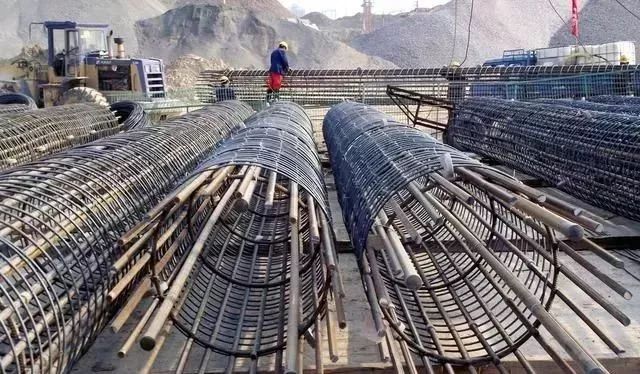
Pile foundations are the most important type of deep foundation in Indian construction and, from my experience, the one where billing complexity and audit risk are highest. A pile is a slender, deep structural element typically reinforced concrete that is installed into the ground to bypass weak upper soil layers and transfer the structure’s loads to deep, competent strata through a combination of skin friction along its length and end bearing at its tip.
In Mumbai, bored cast-in-situ piles dominate because the city’s dense urban fabric cannot tolerate the noise, vibration, and ground displacement of driven piles. The boring process uses a rotary drilling rig to create a cylindrical hole (300 mm to 1200 mm diameter) to the required depth, after which a reinforcement cage is lowered and concrete is poured using a tremie pipe — especially critical when groundwater is encountered. At the top, a reinforced concrete pile cap connects all piles under a column and distributes the column load among them.
- Best suited for: weak surface soils, heavy loads, high water table, seismic zones, coastal and marine environments
- Advantages: can carry very large loads, resists both compression and uplift, excellent seismic performance
- Disadvantages: requires heavy machinery, specialist labour, detailed soil investigation, expensive testing
- Cost drivers: boring per running metre (soil vs. rock rates differ 5x to 10x), concrete with 15–30% wastage factor, reinforcement per kg, pile cap construction, mandatory load testing
| ⚠ Audit Flag: Pile foundation BOQs are the most fraud-prone area in construction billing. Rock boring at inflated quantities, excess concrete wastage claims, and load test bills without actual test records are the three most common audit findings I encounter. |
6. Caisson Foundation — For Bridges and Marine Structures
A caisson is a large, hollow, watertight structure that is sunk into the ground or into water by excavating material from within it while it descends under its own weight. Caissons come in three forms: open caissons (open top and bottom, sunk by dredging from inside), box caissons (closed at the bottom, floated to position and sunk by filling), and pneumatic caissons (pressurized chamber allows work below water largely phased out due to health hazards from compressed air work).
- Best suited for: bridge pier foundations in rivers and estuaries, marine and offshore structures, very large diameter foundation elements
- Advantages: suitable for deep water and river bed conditions, large base area, no pile group effects
- Disadvantages: complex construction, slow progress, expensive, unsuitable for urban sites near existing structures
7. Pier Foundation (Drilled Shaft) — Large Diameter Single Elements
A pier, also called a drilled shaft or bored pier, is essentially a very large diameter bored pile typically 600 mm to 3000 mm installed singly under a column rather than in a group. Piers derive their capacity mainly from end bearing on rock or very dense soil, though skin friction also contributes. The base is sometimes enlarged (belled or underreamed) to increase the end-bearing area without increasing the shaft diameter. Piers are preferred when individual column loads are very high and a single large element is structurally more elegant and easier to quality-control than a pile group with a cap.
- Best suited for: bedrock or dense gravel at moderate depth, very large column loads (5,000–20,000 kN), situations where pile groups are impractical
- Advantages: single element simplicity, no group effects, large capacity
- Disadvantages: requires large rotary drilling equipment, difficult in water-bearing strata without casing
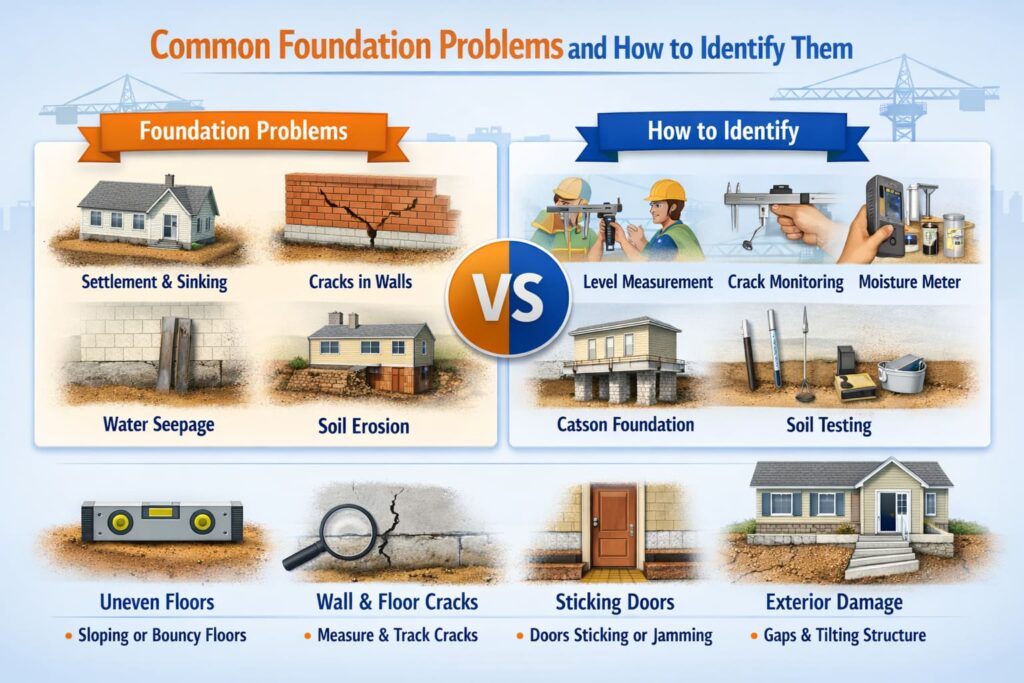
Common Foundation Problems and How to Identify Them
Settlement and Differential Settlement
Settlement is the downward movement of a foundation under load. Some settlement is always expected and acceptable, the danger lies in excessive total settlement and differential settlement. Differential settlement is the difference in downward movement between two points of the same structure, and it is this unevenness that causes diagonal wall cracks, jammed doors and windows, out-of-plumb columns, and in severe cases, structural failure. In Mumbai’s coastal marine clay areas, consolidation settlement can continue for 20 to 30 years and accumulate to 200 to 400 mm in buildings without adequate pile support.
Poor Compaction at Foundation Level
I have flagged this in more audit reviews than I care to count. Before the PCC bed is placed, the formation level of every shallow foundation must be cleaned, levelled, and compacted. When this step is rushed or skipped which happens constantly under schedule pressure, the footing ends up sitting on disturbed, loosened soil rather than the original undisturbed ground that the design assumed. The result is additional settlement that the design never accounted for.
| ⚠ Audit Flag: If site records do not include compaction test results (field density or Proctor test) at the foundation formation level, it is a strong indicator the compaction step was either skipped or not properly supervised. Flag this immediately. |
Soil Testing and Geotechnical Investigation for Foundation Design
No type of foundation can be correctly selected or designed without a proper geotechnical investigation. This seems obvious, yet I see projects small and mid-sized ones particularly go ahead with foundations based on a neighbour’s soil report or the engineer’s general experience with the area. This is engineering negligence dressed up as cost-saving.
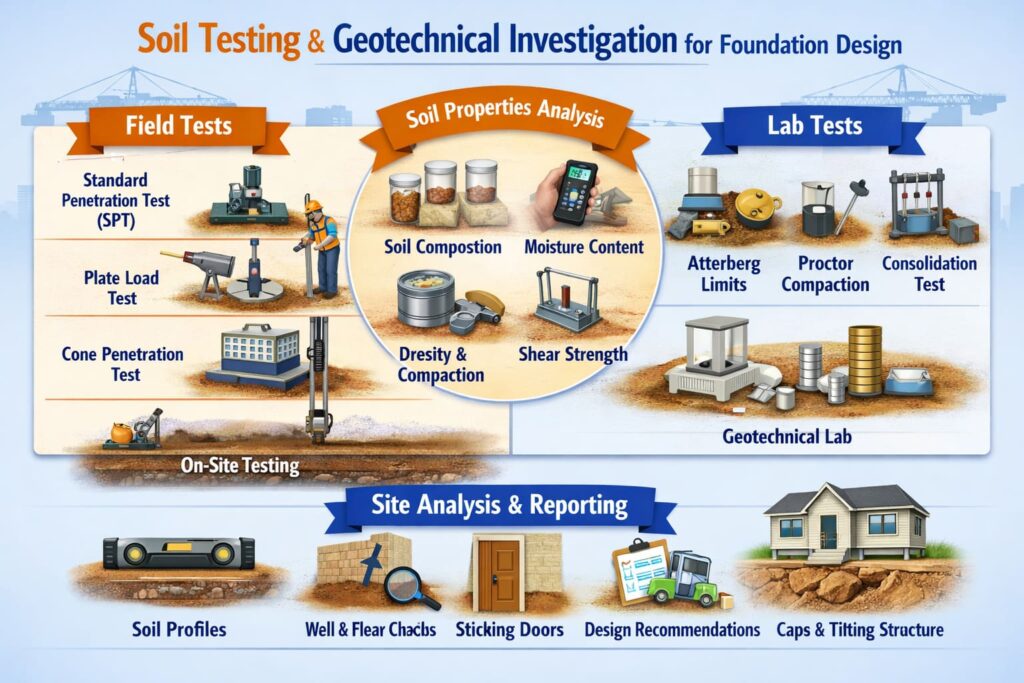
Standard Penetration Test (SPT) — The Most Used Test in India
The SPT measures the resistance of soil to a standard sampler driven by a 63.5 kg hammer dropped 750 mm. The N-value (blow count per 300 mm) correlates with soil density, consistency, and bearing capacity. IS 2131 governs this test in India. Raw N-values must be corrected for overburden, hammer efficiency, borehole diameter, and rod length before use in design. Using uncorrected values overestimates bearing capacity of loose sands — a dangerous shortcut.
Plate Load Test — Direct Measurement at Foundation Level
The plate load test places a rigid steel plate at the proposed foundation depth and loads it incrementally while measuring settlement. It gives bearing capacity and settlement characteristics directly at the test level. Its limitation: it only samples a shallow zone of soil (1.5 to 2 times the plate width). A weak layer below this depth common in layered Mumbai soil profiles will not be detected and can lead to a dangerously optimistic assessment.
| ✅ Pro Tip: A complete geotechnical report should include: borehole logs with SPT N-values at every metre, groundwater levels (strike and stabilised), laboratory test results, interpreted soil profile, SBC recommendations at multiple depths, and specific groundwater management guidance for construction. Reject any report that gives SBC values without backing data. |
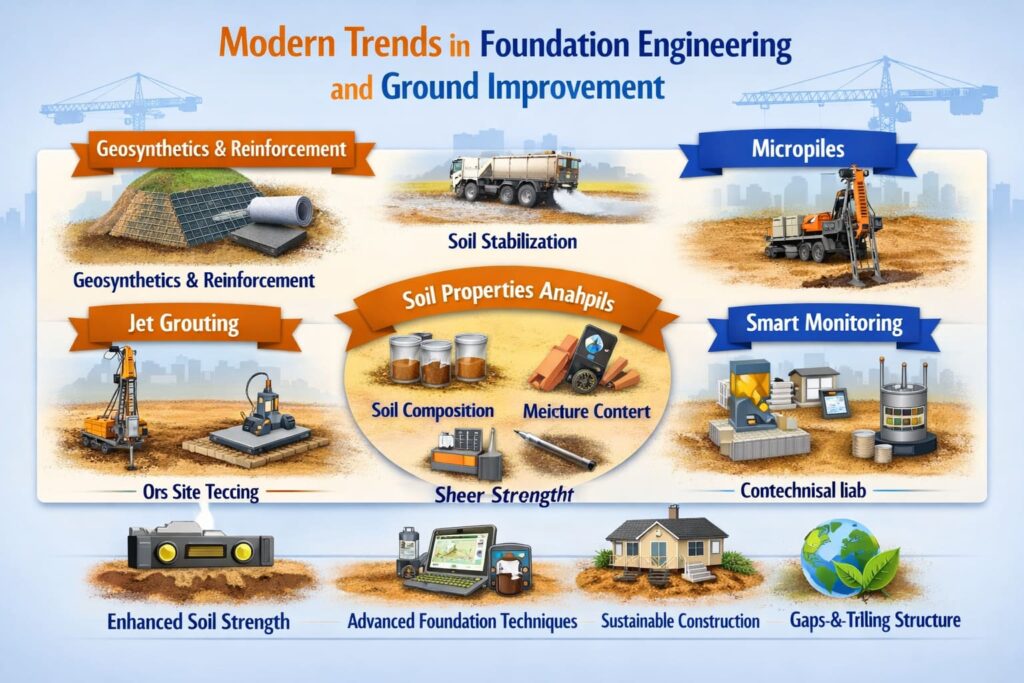
Modern Trends in Foundation Engineering and Ground Improvement
Geosynthetics as Foundation Reinforcement
Geotextiles and geogrids placed at the base of shallow foundations on weak soils reinforce the system by mobilizing tensile forces that increase the apparent bearing capacity and prevent lateral spreading. In Mumbai’s development of reclaimed coastal plots where the natural surface is too weak for shallow foundations and piling seems over-engineered geosynthetic-reinforced shallow foundations are increasingly being explored as an economical middle ground.
Ground Improvement Techniques
When surface soil is weak and deep foundations feel excessive, ground improvement bridges the gap. Dynamic compaction densifies loose granular soils by dropping heavy weights from height. Vibro-replacement installs stone columns in soft clay, increasing drainage and composite strength. Chemical grouting and deep soil mixing create soil-cement columns that significantly increase bearing capacity. Preloading with surcharge accelerates consolidation settlement before construction begins, eliminating future settlement under the actual building loads.
Smart Monitoring of Foundation Behaviour
Modern foundation engineering increasingly embeds sensors during construction. Vibrating wire strain gauges in pile bodies measure load distribution between skin friction and end bearing in real time. Piezometers monitor pore pressure changes in the soil around foundations during and after construction. For Mumbai’s high-rise buildings on compressible soils, MCGM now requires periodic settlement monitoring using precise levelling benchmarks as a condition of building approval allowing early detection of problems before they become structural emergencies.
Foundation Billing, BOQ Analysis, and Audit Red Flags
Foundation work is where construction billing is most complex and where financial irregularities deliberate or accidental are most common. The hidden nature of the work is part of the problem: once concrete is poured and backfill covers the evidence, verification becomes extremely difficult. As someone who has reviewed hundreds of foundation-related payment claims, I want to share the specific red flags that every auditor, client representative, and PMC engineer must know.
BOQ Items for Pile Foundations — Where Disputes Are Born
- Boring per running metre: separate rates mandatory for soil vs. rock, verify transition depth against borehole logs
- Concrete in piles: actual quantity always exceeds theoretical, 15 to 30% wastage is normal, but must be contractually pre-agreed
- Reinforcement per kg: verify cage drawings against actual bar diameters and lengths installed
- Pile cap excavation: must not include volume of pile shafts already in place, a common overstatement
- Rock boring overclaiming: cross-check contractor’s claimed rock level against independent geotechnical borehole log
- Load test bills without records: demand actual load-settlement curves, test dates, and pile numbers without these, reject the claim
IS Codes and International Standards for Foundation Design
- IS 456: Reinforced concrete design — governs footings, pile caps, and raft slabs
- IS 2911: Design and construction of pile foundations — Parts 1 to 4 cover different pile types
- IS 1893: Seismic design — foundation requirements in different seismic zones
- IS 1904: Design and construction of foundations in soils — general guidance
- ACI 318: American concrete code — sometimes referenced in internationally financed projects
- FIDIC: Governs large infrastructure contracts — more conservative payment verification clauses than domestic contracts
| ⚠ Audit Flag: Always verify that the geotechnical report used for foundation design is site-specific, recent (within 2 years), and signed by a qualified geotechnical engineer. Reports borrowed from adjacent projects or older investigations are not acceptable for billing audit purposes. |
Types of Foundation in Mumbai: Local Challenges and Code Requirements
Mumbai presents a unique set of foundation challenges that engineers from other cities sometimes underestimate when they come here for the first time. The city’s geological history, a chain of islands gradually joined by centuries of land reclamation means much of its ground is made-up material of variable quality, underlain by soft marine clay, frequently saturated with saline groundwater, and subject to tidal influence.
- Marine clay with N-values of 2 to 6 is common across South Mumbai, Bandra, Kurla, and Navi Mumbai reclamations — virtually unusable for shallow foundations
- Groundwater salinity near the coast often exceeds 2,000 ppm chloride — foundation concrete must use minimum M30 grade, w/c ratio below 0.40, and 75 mm cover to reinforcement
- Seismic Zone III with site amplification in soft soil areas — pile foundations with proper lateral load design are mandatory for high-rise buildings
- Black cotton soil in Vidarbha and Marathwada — strip and isolated footings require depth below the zone of seasonal moisture variation, or under-reamed piles per IS 2911 Part 3
- Pre-construction condition surveys of adjacent buildings are practically mandatory before any piling or deep excavation in Mumbai’s dense neighbourhoods — vibration from piling equipment has caused plaster cracking in century-old adjacent buildings
Foundation Types: Career Interview Questions and GATE/SSC JE Exam Preparation
Top Interview Questions on Types of Foundation
Q: What is the difference between a raft and a pile raft? A raft transfers all load through direct soil contact. A pile raft uses piles plus raft contact pressure together, ideal when piles alone are over-conservative but a raft alone would settle excessively.
Q: When would you recommend a pile over a raft? When the surface soil is too weak at any practically achievable raft thickness, when loads are very concentrated, when uplift resistance is needed, or when seismic lateral capacity requirements cannot be met by a raft alone.
Q: What is skin friction in pile design? The resistance developed by adhesion and friction between the pile surface and the surrounding soil. In soft clay, it can account for 80 to 90 percent of total pile capacity.
GATE and SSC JE Key Topics on Foundation Engineering
- Terzaghi’s bearing capacity equation — shape, depth, and inclination factors for different foundation types
- Settlement calculations — immediate (elastic) and consolidation settlement using Cc and e0
- Pile capacity by static formula — skin friction plus end bearing, with IS 2911 correlations from SPT N-values
- Pile group efficiency — when does group capacity govern over sum of individual pile capacities?
- IS code allocation — IS 456 for RC design, IS 2911 for piles, IS 1893 for seismic, IS 1904 for general foundation guidance
- Types of piles by material (concrete, steel, timber), installation (driven, bored, screwed), and load mechanism (friction, end-bearing, combination)
| ✅ Pro Tip: In GATE, always check whether the question specifies strip, square, or circular footing before applying Terzaghi’s equation. Shape factors change the answer significantly. This is the most common mark-losing error in bearing capacity numericals. |
Conclusion: Choosing the Right Type of Foundation Is an Engineering Responsibility
After everything I have covered in this guide, the most important takeaway is this: there is no universally best type of foundation. There is only the right type for your specific site, your specific loads, and your specific constraints. The decision demands proper soil investigation, honest engineering judgement, and rigorous construction supervision.
From the simple strip footing under a village school to the 25-metre bored piles under a Mumbai tower, every type of foundation in construction carries the same fundamental responsibility keeping people safe in the buildings they occupy. Treat that responsibility with the seriousness it deserves, and the foundation will do its job silently and invisibly for generations. if you want to know more about excavation measurement click here.
Editor’s Pick
 Read more: Standardized Excavation Measurement Benchmark – IS Code Explained
Standardized Excavation Measurement Benchmark – IS Code Explained
on
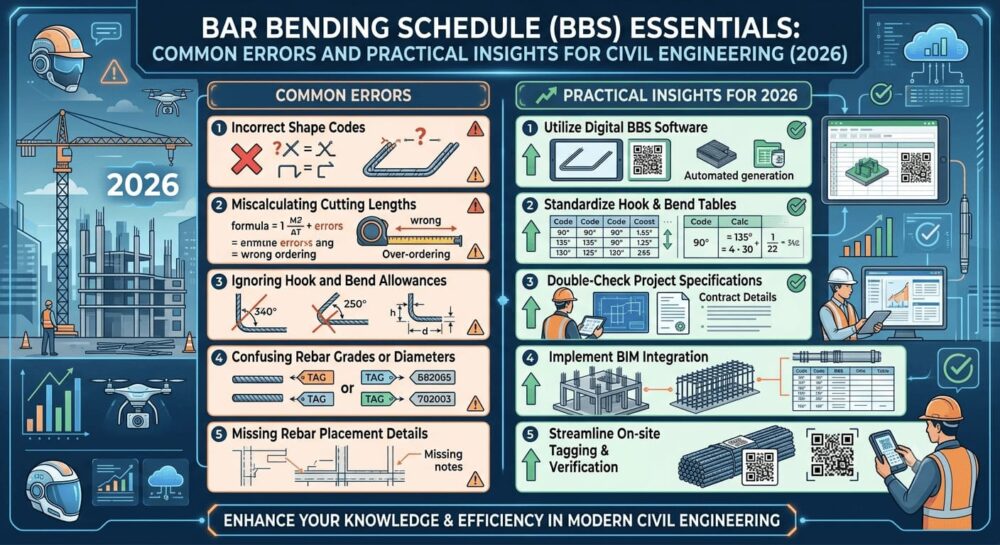
- Read more: Bar Bending Schedule Essentials: Common Errors and Practical Insights for Civil Engineering should help your Knowledge in 2026
Bar Bending Schedule Essentials: Common Errors and Practical Insights for Civil Engineering should help your Knowledge in 2026
on
 Read more: Pile Foundation: The Hidden Strength Beneath Every Structure Now even in 2026
Pile Foundation: The Hidden Strength Beneath Every Structure Now even in 2026
on
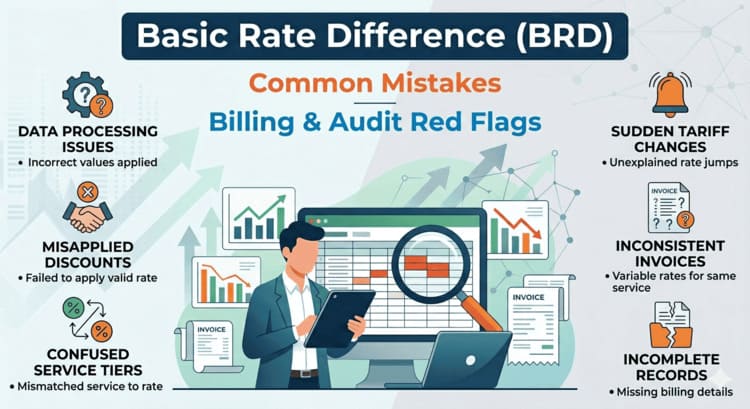
 Read more: Basic Rate Difference ( BRD ) – Common Mistakes and Billing & Audit Red Flags
Basic Rate Difference ( BRD ) – Common Mistakes and Billing & Audit Red Flags
on

Frequently Asked Questions (FAQ): Types of Foundation in Construction
| Question | Answer |
| Q1. What are the main types of foundation in construction? | There are two main categories: shallow foundations (isolated footing, combined footing, strip footing, raft) and deep foundations (pile, caisson, pier). The choice depends on soil strength, load magnitude, and depth to competent strata. |
| Q2. What is the most common type of foundation used in India? | Isolated spread footings are the most common for low to mid-rise framed buildings on stable soil. Bored cast-in-situ piles are the most common deep foundation type, especially in urban areas like Mumbai. |
| Q3. What is the difference between a shallow and a deep foundation? | A shallow foundation transfers load near the ground surface through direct soil bearing. A deep foundation bypasses weak upper layers and transfers load to stronger, deeper strata through skin friction and end bearing. |
| Q4. When should I use a pile foundation instead of a raft? | Use piles when surface soil is too weak for a raft, when loads are very heavy and concentrated, when uplift resistance is needed, or when seismic lateral capacity requirements cannot be met by a raft alone. |
| Q5. What is a raft foundation and when is it used? | A raft (mat) foundation is a continuous RC slab covering the full building footprint. It is used when soil is weak or variable, when differential settlement must be controlled, and in basement buildings where the slab also serves as the waterproofing base. |
| Q6. What is safe bearing capacity (SBC) and why does it matter? | SBC is the maximum pressure a soil can sustain without shear failure, divided by a safety factor. It is the primary parameter for sizing shallow foundations and for determining whether a site needs deep foundations. |
| Q7. Which IS codes govern foundation design in India? | IS 456 for reinforced concrete design of footings and pile caps. IS 2911 for pile foundations. IS 1904 for general foundation design. IS 1893 for seismic design requirements. IS 6403 for allowable bearing pressure. |
| Q8. What is the Standard Penetration Test (SPT) and how is it used for foundation design? | SPT measures soil resistance using a hammer-driven split-spoon sampler. The N-value correlates with bearing capacity, pile skin friction, and pile end-bearing parameters. It is governed by IS 2131 and is the most widely used site investigation test in India. |
| Q9. What is differential settlement and why is it dangerous? | Differential settlement is unequal downward movement between two points of the same structure. It causes diagonal wall cracks, out-of-plumb columns, jammed doors, and in severe cases, structural failure. It is more dangerous than total settlement. |
| Q10. What are the typical foundation challenges in Mumbai’s coastal areas? | Soft marine clay with very low bearing capacity, high groundwater table, saline water causing reinforcement corrosion, seismic Zone III with site amplification, and reclaimed land with variable fill quality. These factors generally make pile foundations mandatory for mid-rise and high-rise buildings. |
| Q11. How does foundation type affect construction cost? | Shallow foundations are cheapest — simple excavation, concrete, and reinforcement. Raft foundations are moderately expensive due to high concrete volume. Pile foundations are most expensive — boring machinery, testing, pile caps, and higher reinforcement and concrete quantities with wastage. |
| Q12. What is a combined footing and when is it used? | A combined footing supports two or more columns on a single footing element. It is used when adjacent isolated footings would overlap in plan or when a boundary column cannot extend beyond the property line without causing eccentricity. |
| Q13. What is skin friction in pile capacity? | Skin friction is the resistance developed by adhesion and friction between the pile surface and surrounding soil. In soft marine clay like Mumbai’s coastal zones, skin friction can provide 80 to 90 percent of total pile capacity, with minimal end bearing. |
| Q14. What are common red flags in foundation billing and auditing? | Rock boring quantities that exceed the geotechnical borehole log depth, pile cap excavation volume not deducting pile shaft volumes, concrete wastage claimed beyond the contractually agreed factor, and load test bills submitted without actual test records or load-settlement curves. |
| Q15. What foundation type is used for bridge piers in rivers? | Open caissons or well foundations are traditionally used for bridge piers in rivers in India. Box caissons are used in calmer water. For modern highway and railway bridges, large-diameter bored piles or drilled shafts (piers) are increasingly preferred due to faster construction and better quality control. |